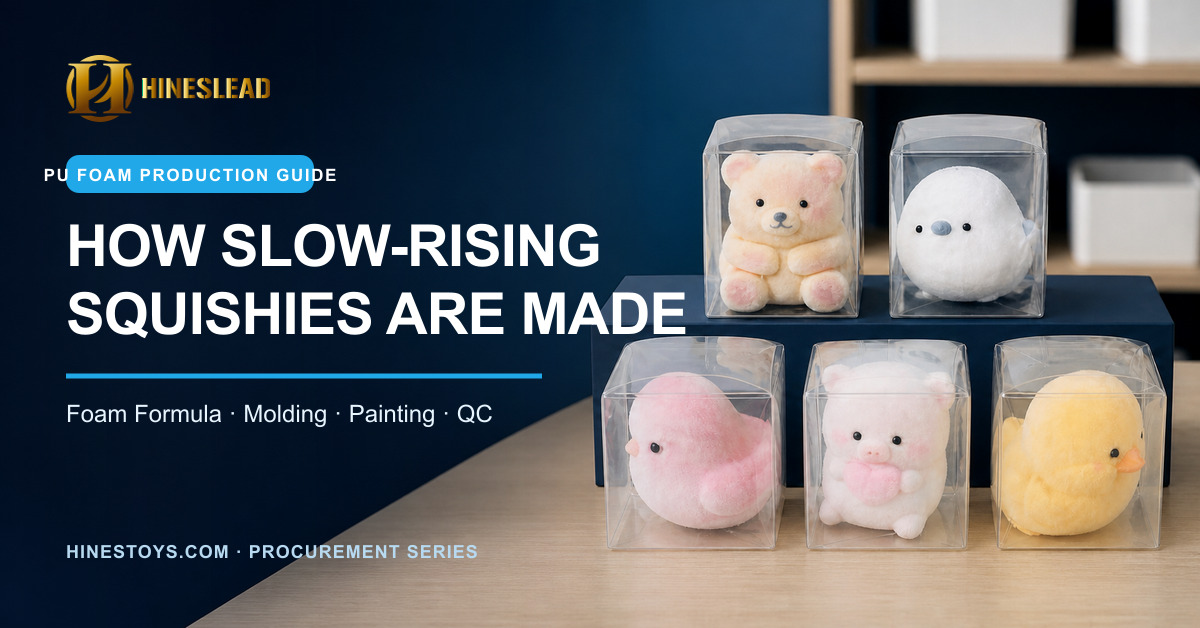
Set a slow-rising sample on a meeting-room table and somebody will squeeze it before the discussion starts. For a few seconds the bread, fruit, or animal stays flattened. Then it comes back. That small performance is what the customer buys, yet purchasing teams sometimes approve it too quickly. They remember the stopwatch and overlook the paint at the crease, the piece that feels heavier, the carton that keeps a corner dented, or the later sample that does not behave quite like the first.
The factory does not make that recovery at a single workstation. The result begins with the foam system and follows the part through the mold, the curing area, the trimming bench, the paint room, the conditioning period, and the packing line. A quiet change at any of those points can be visible in the buyer's hand. It might show up as a faster rise, a rough cell near the seam, a weak stem, or a coating that turns pale when squeezed.
This guide gives importers, distributors, retailers, promotional buyers, and brand owners a practical way to buy that system. It does not reveal or pretend to know a supplier’s proprietary formulation. Instead, it explains what a buyer can specify, observe, sample, test, and place on an inspection sheet. That is the information that turns a pleasing prototype into repeatable production.
Quick answer: how are slow-rising squishies made?
In broad terms, a polyurethane foam system is metered and mixed, introduced into a prepared mold, allowed to expand and form, then removed after the process reaches the appropriate stage.The piece is cured or conditioned, trimmed, base-coated or sealed as required by the finish system, painted and detailed, dried, inspected, and packed. The exact chemistry and process parameters belong to the manufacturer and must be controlled under appropriate industrial safety procedures.
For buyers, the critical point is that “rebound time” is an output of the full product and process. It cannot be separated from size, shape, density, temperature, compression method, coating, and conditioning. A quote asking only for “10-second slow rise” is incomplete.
Need a slow-rising sample you can evaluate properly?
Send the shape, dimensions, target rebound range, market, quantity, decoration and pack. Ask for a coded sample set so your team can choose with evidence.
Choose Rebound Time & Request Samples →Table of contents
- What “slow rising” really describes
- Foam formulation as a controlled performance system
- From CAD and mold to expanded part
- Curing, trimming, sealing, and painting
- How to specify rebound and hand feel
- Defects buyers should understand
- Packaging and transport recovery
- Cost, MOQ, sampling, and quality control
- Compliance and responsible documentation
- RFQ template and buyer FAQs
1. Start with the user moment
Before discussing foam, define the moment the product must create.Is it a palm-sized promotional fruit that shows a logo? A large bread shape built for social-video compression? A flocked animal presented in a clear gift box? A licensed character whose color and facial proportions must remain recognizable after repeated squeezing? These are different engineering and commercial briefs.
The same slow rebound can feel appropriate in one and disappointing in another. A large bread form has room for dramatic deformation. A tiny character with narrow ears may need a different balance between softness, recovery, and robustness. A heavily coated surface may hold color well but change the hand feel. Flocking creates a distinctive appearance while introducing its own adhesion and pack-contact questions.
Write a one-line product job before the RFQ. An example might be: “A 120 mm fruit-shaped slow-rising promotional toy for adult event distribution, one-color logo on a protected panel, individually packed, delivered to a U.S. fulfillment center.” The supplier can then ask useful questions about intended classification, test scope, print area, pack, and schedule.
If the product is intended for children, specify the intended age and destination at the beginning. Do not use packaging art to decide age grading after production. Design, foreseeable use, small features, coatings, labels, and testing must be considered together.
2. What “slow rising” means—and what it does not
Slow rising describes time-dependent shape recovery after compression. It does not, by itself, describe quality, safety, density, cell structure, tensile behavior, paint adhesion, or durability.Nor is there one universal stopwatch method used by every buyer.
One person may crush the toy to half its height for two seconds. Another may hold it for ten seconds, release it at a cold warehouse temperature, and stop timing when it appears “mostly” recovered. Those results cannot be compared. If rebound is a selling feature, define a reproducible test.
A buyer-friendly method should state sample conditioning, room temperature range, compression direction, target compressed height or fixture, hold time, release method, timing start, timing endpoint, number of cycles, and number of pieces. Photograph or video the setup. Use the approved sample as a physical benchmark, especially when the commercial requirement is a range rather than a laboratory performance claim.
Avoid advertising a precise number that production is not controlled to meet. “Approximately 8–12 seconds under the agreed internal method” is more honest than “10 seconds” if the product naturally varies. The commercial team should use language supported by the quality plan.
3. Polyurethane foam in buyer-level language
Polyurethane foam is produced through reactive chemistry. Component choice, ratios, catalysts, surfactants, pigments, temperature, mixing, mold conditions, and curing all influence the cellular structure and final behavior. A responsible factory treats those inputs as controlled manufacturing variables, not as a kitchen recipe.
Buyers do not need proprietary percentages to manage an order.They need evidence that the manufacturer controls the formula version, incoming components, batch identity, process window, and finished output. Ask how a formulation is coded, how a change is approved, and how samples are linked to later production. The answer should be more specific than “same material.”
Reactive polyurethane production also requires workplace controls. The U.S. National Institute for Occupational Safety and Health notes that isocyanates are reactive chemicals used in flexible and rigid foams and can present respiratory and skin hazards to workers. Its isocyanates guidance underscores why handling, ventilation, training, and protective measures are factory responsibilities. Finished-toy buyers should not infer consumer risk from a raw manufacturing ingredient, nor should they ignore the need for competent industrial controls.
The finished product must be assessed as a finished product for its intended market. Raw-material paperwork, factory controls, and finished-item compliance evidence answer different questions. Keep them distinct in the sourcing file.
4. Formula choices show up as observable performance
A foam formulation and process can influence apparent density, softness, compression resistance, rebound, cell uniformity, surface skin, dimensional stability, odor, and compatibility with coating. Geometry and processing interact with the chemistry, so two shapes made from the “same formula” may not feel identical.
Rather than specifying an undocumented secret formula, build a performance envelope.Include approved dimensions and weight range, rebound method and range, visual cell expectations at permitted trim areas, odor acceptance procedure, recovery after pack-out trial, coating adhesion, and agreed handling durability. Where a test requires specialist judgment, use a qualified laboratory or technical provider.
Piece weight is particularly useful. A surprising weight shift can signal a change in fill, density, or process, although it does not diagnose the cause on its own. Record weight alongside dimensions and rebound; no single data point should carry the entire decision.
Density language must be handled carefully. Apparent density of a molded piece is not always inferred accurately from catalog terminology. If density is a contractual requirement, agree how it is measured and sampled. If the buyer mainly cares about tactile impression and recovery, a coded reference sample plus reproducible tests may be more practical.
5. Shape design comes before mold steel
Foam expansion does not rescue weak geometry. Thin ears, spikes, stems, straps, and narrow necks may fill, demold, trim, paint, and survive compression differently from the main body. Deep grooves can trap paint or show coating bridges. Large flat areas reveal waviness. Sharp relief details may soften in the foam surface.
Review the design at actual size. A 3D rendering enlarged on a monitor can make a 0.5 mm line look important even though it cannot remain clear in the final piece. Ask the manufacturer to identify minimum robust features, parting location, vent-related marks, likely trim areas, and surfaces intended for printing or hand decoration.
Round transitions are often kinder to both foam and coating. That does not mean every design becomes a blob. It means character identity should come from a controlled silhouette and deliberate features rather than fragile microgeometry. If the brand requires a thin projection, discuss reinforcement, geometry adjustment, pack protection, and inspection criteria before tooling.
For licensed work, issue a hierarchy: non-negotiable brand features, function-critical dimensions, and flexible manufacturing details. This allows technical adaptation without accidental character drift.

This scene uses actual Hines Toys products to illustrate an assortment review. Buyers should approve production-representative samples and final packaging.
6. Mold design and preparation
The mold defines the cavity, but the manufacturing team must also plan introduction of the reacting material, expansion, air displacement, parting, release, and extraction. The exact mold material and construction depend on size, detail, production quantity, economics, and factory process.
A buyer should ask for the information that affects approval: number of cavities if relevant, expected parting and trim zones, tooling lead-time assumptions, ownership, maintenance, change charges, and storage. If a mold modification is possible, confirm the limits. Some geometry changes require a new cavity rather than a quick adjustment.
Surface texture deserves an explicit decision.Texture can hide minor variation and reinforce a food or character concept, but it also affects paint appearance and cleaning. A glossy coating on a textured surface looks different from a matte coating on a smooth one. Approve texture in the molded and finished sample, not only in CAD.
Mold-release practice can affect downstream coating. A piece that demolds easily but holds contamination may create paint adhesion problems. The production route should include compatible release, cleaning or conditioning, and surface preparation where required. Buyers do not need to dictate the chemical; they should require a stable approved finish and change control.
7. Metering, mixing, pouring, and expansion
During foaming, material preparation and mixing consistency matter. Inadequate control can appear as density variation, voids, streaking, incomplete fill, uneven cells, or inconsistent rebound. Mold temperature and ambient conditions can also affect the reaction and finished piece.
For procurement, ask how the factory records batches and responds to drift. Does it check component identity before use? Does it have a defined start-up approval? Are first-off pieces reviewed for weight, appearance, and recovery? Are out-of-window pieces isolated? How are parameter or raw-material changes authorized?
The goal is not to demand a confidential process sheet. It is to establish that a process sheet exists and that the shipment can be traced to it. A vague claim of “experienced workers” is not equivalent to controlled production.
Expansion must be considered with mold fill and cell behavior.Overfilling, underfilling, trapped air, or uneven reaction can create defects that painting later hides rather than corrects. Inspect uncoated development pieces when possible. They reveal cell and surface behavior more clearly than a polished sales sample.
8. Demolding and cure: the piece is not finished when it leaves the mold
Demolding too early can distort the product or damage fragile features. Demolding too late may reduce efficiency or create other process challenges. The correct timing depends on the system and part. After demolding, the foam may need further cure or conditioning before trimming, coating, testing, or packing.
This stage helps explain why a rush sample can mislead. A sample shipped immediately after decoration may smell different or behave differently from a properly conditioned piece. Packaging a product before the material and coating are ready can trap odor, mark surfaces, or encourage deformation.
Ask the supplier to state when the sample is ready for meaningful evaluation. For production, confirm the conditioning time assumed in the schedule. Do not compress that time casually to recover days lost during artwork approval.
Conditioning also belongs in inspection planning. A rebound check performed immediately after opening a tightly packed carton may differ from one performed after the product has rested. Define whether the inspection includes an unpacking recovery period and how long it is.
9. Trimming, repair, and surface preparation
Parting and vent areas may need trimming.The acceptance standard should distinguish a normal, neatly finished trim line from a gouge, tear, hard repair, or obvious mismatch. Photographs are more effective than a sentence such as “no defects.”
Some foam pieces receive a base layer, sealer, or other surface preparation before color. This can reduce porosity, create a more uniform ground, and support the paint system. It can also change hand feel and rebound if applied inconsistently. Approve the complete coating stack.
Ask whether minor voids or surface flaws are repaired, how repair is identified, and what limit is acceptable. A hidden repair in a low-stress area may be commercially different from a stiff patch across a squeeze line. The specification should reflect function and appearance rather than banning a word without defining the risk.
Before paint approval, squeeze the sample at several points and observe the surface as it recovers. A finish that looks perfect at rest may wrinkle, whiten, crack, or delaminate when the foam deforms.
10. Painting is a system, not a color chip
Slow-rising squishies may use molded color, base coating, sprayed color, printing, hand-applied details, flocking, or combinations. Every additional layer adds visual possibility and a new compatibility or control question.
A buyer should define the appearance hierarchy.Which color covers the main body? Which boundaries must be crisp? Which shading is decorative and allowed to vary? Which facial marks are character-critical? Which backside area may show the production code? Without this hierarchy, inspectors may reject harmless airbrush variation and overlook a misregistered eye that changes the expression.
Create a decoration map containing artwork version, color references, process notes, print positions, and tolerances. Mark areas exposed to maximum compression. Ask for adhesion and flexibility evaluation on a finished production-representative sample.
Paint coverage must be judged under agreed lighting. Highly saturated foam beneath a pale coating may show through at thin spots. Deep recesses may receive less coverage; raised edges may rub in packaging. A second coat improves opacity but can change cost, drying time, surface feel, and flexibility. The finish decision should be made as a system.
11. Flocking and special finishes
Flocking gives a soft fiber surface that can transform a foam animal from a painted object into something visually closer to plush. The look is distinctive, but the buyer must evaluate fiber shedding, coverage at recesses, adhesive behavior under deformation, color transfer, pack scuffing, and consumer handling expectations.
Use a repeatable rub and squeeze sequence on a conditioned sample. Check the clear box or inner bag for loose fibers. Inspect high points and deep grooves. Compare appearance before and after the agreed cycle. If the product includes printed eyes or applied parts over flock, inspect those interfaces separately.
Special effects—metallic coatings, gradients, scent, glitter, or surface powders—can create a strong concept while complicating testing and production. Introduce one new variable at a time during development. A sample that changes formula, pigment, coating, fragrance, and package simultaneously does not reveal which change caused a problem.
Claims around scent or materials require careful review. Do not assume a pleasant smell is harmless or marketable for every age and destination. Give the full construction and intended claims to a qualified compliance professional or laboratory.
12. How to specify rebound time properly
Start with the selling experience. Does the buyer want a visibly slow recovery on camera, or simply a softer response than ordinary foam? Then build a method both sides can reproduce.
One internal purchasing method might condition pieces at an agreed room environment, compress the product vertically to a marked fraction of original height using a fixture, hold for a stated time, release without twisting, and time recovery to a defined percentage of original height. The exact numbers must be agreed for the product; this example is a structure, not a universal standard.
Test multiple pieces and cycles. Record the range, average if useful, sample condition, and any permanent set. Video helps resolve interpretation. Keep the approved reference sample coded and sealed.
Do not over-tighten the range without evidence. Soft cellular materials naturally show variation, and visual endpoints introduce observer variation.A practical tolerance that protects the consumer experience is more valuable than an artificially precise promise that creates disputes.
Temperature, time after manufacture, storage, and packaging pressure can change the observation. If shipments cross hot or cold routes, consider conditioning and recovery checks that reflect those conditions. Define the procedure with technical specialists rather than relying on social-media demonstrations.
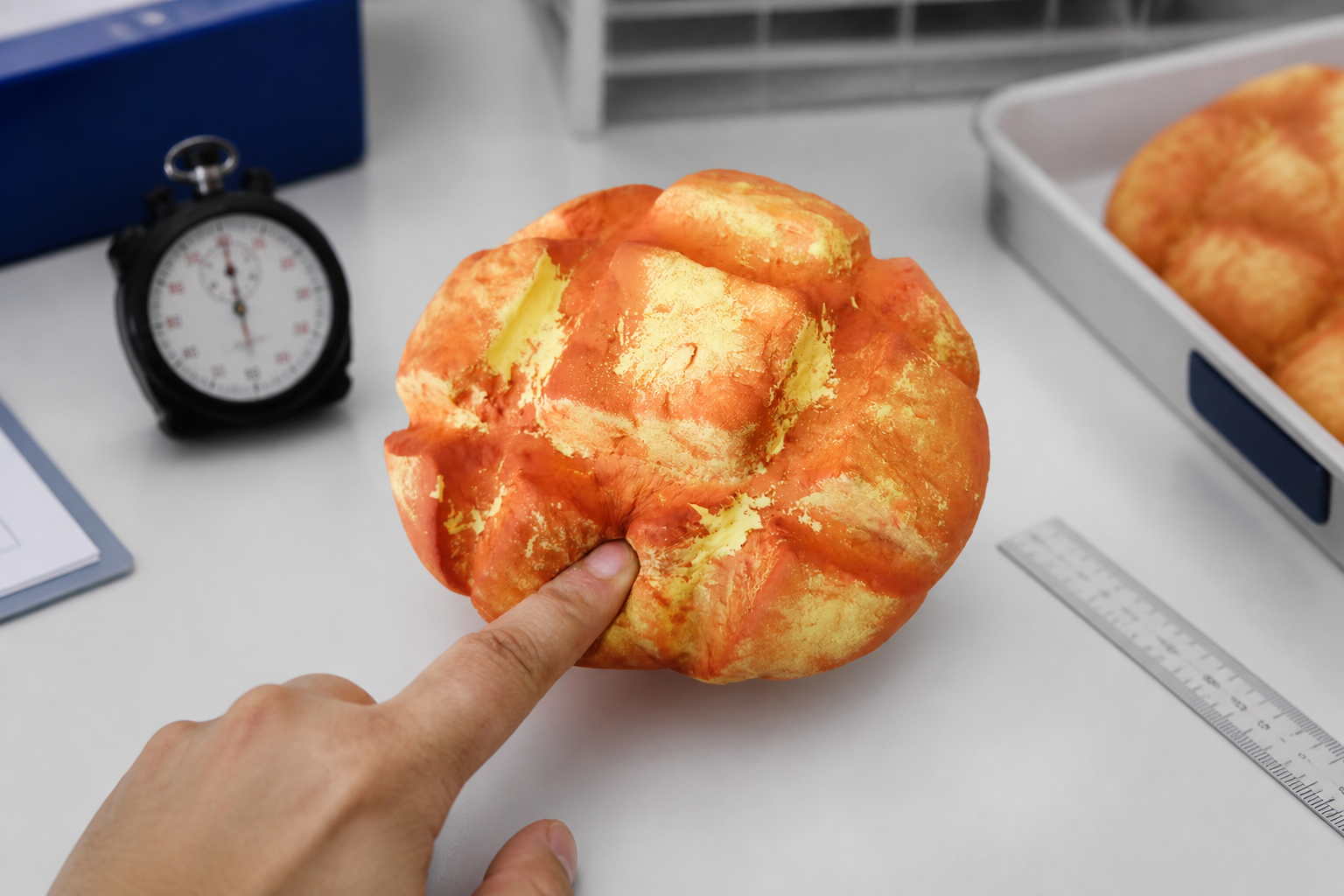
A useful rebound specification identifies conditioning, compression, hold time, release, endpoint, cycles, and sample count.
13. Hand feel is more than rebound
Two toys can recover in the same number of seconds and feel different. One may compress with little initial resistance and then bottom out. Another may feel springier throughout. Surface coating can feel dry, rubbery, velvety, or slightly tacky. Shape determines where pressure concentrates.
Build a sensory scorecard with plain observations:
- initial compression resistance;
- smoothness through the squeeze;
- bottoming or internal hard spots;
- speed and evenness of recovery;
- surface drag or tack;
- noise during compression;
- odor under the agreed method;
- comfort at seams and projections;
- appearance after repeated handling.
Use a small trained internal panel for comparison, not a rotating group of whoever is near the sample desk.Record coded results before discussing preferences so that one loud opinion does not anchor the group.
Sensory scoring does not replace compliance testing or mechanical evaluation. It gives purchasing and product teams a consistent language for the commercial experience.
14. Common defects and what they suggest
Buyers benefit from knowing defect language without diagnosing beyond the evidence.
Voids or pits. These may relate to trapped air, fill, surface preparation, or other process factors. Agree acceptable limits by location and size.
Incomplete fill. Missing detail or thin areas can appear when the cavity does not form properly. Character-critical features should be identified as critical.
Large or irregular cells. Visible at trim or damage areas, cell variation may accompany tactile or structural differences. Compare against approved samples.
Tears at projections. Thin geometry, demolding, trimming, handling, or packing may contribute. Review design and process together.
Permanent denting. Packing pressure, insufficient recovery time, conditioning, formulation, or heat exposure may be involved. Conduct a packed-storage trial.
Paint cracking or whitening. Coating flexibility, thickness, cure, surface preparation, or compression location may matter.
Sticky or blocking surfaces. Coating cure, compatibility, temperature, or pack contact can play a role. Inspect after storage in the actual pack.
Color inconsistency. Substrate shade, coating thickness, pigment control, lighting, and manual shading may contribute. Use physical standards and define decorative variation.
Defect review should lead to containment, evidence, root-cause work by the responsible technical team, corrective action, and verification. It should not produce an instant guess passed through a chat message as fact.
15. Packaging can change the product before the customer sees it
Slow-rising foam is vulnerable to prolonged compression. An efficient carton that squeezes every piece may save freight and create deformed inventory. The correct pack balances cube with recovery protection.
Run a pack-out trial using production-representative product and materials. Record how pieces are oriented, how much pressure the inner pack applies, and how the master carton stacks. After the agreed storage or simulation, open the carton, allow the defined recovery period, and inspect dimensions, surface marks, paint transfer, odor, and rebound.
Clear boxes protect display surfaces but increase cube. Bags reduce volume but may contact painted high points. Trays keep orientation but can leave pressure lines if too tight. Tissue or film can prevent scuffing yet introduce transfer or fiber concerns. Evaluate the whole assembly.
Retail and e-commerce routes differ. A retail display may need a clear face and hanger strength. E-commerce packaging must tolerate individual parcel shocks and unattractive orientations. A subscription box may combine the squishy with printed paper, food, cosmetics, or textiles; compatibility and odor transfer deserve attention.
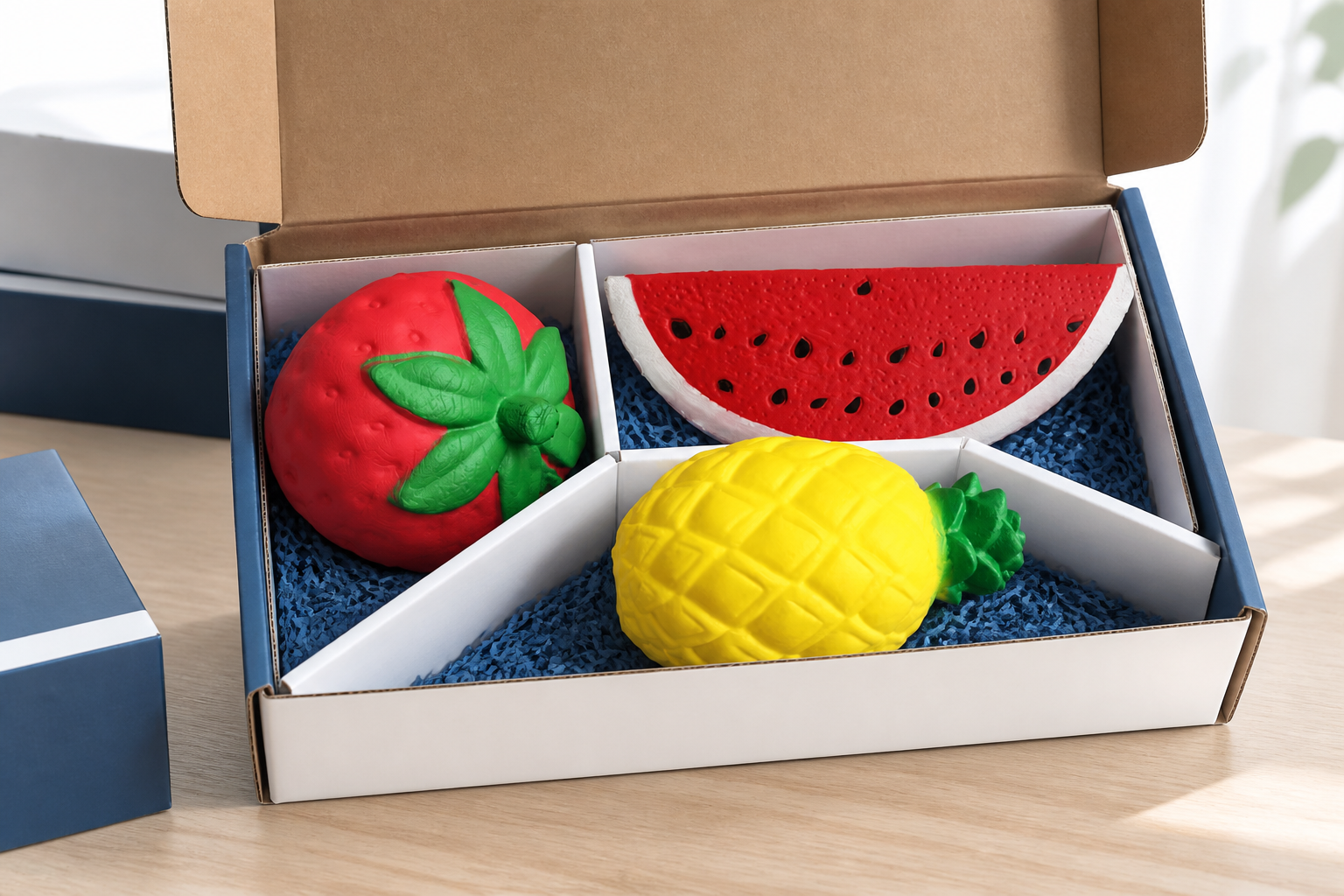
The lowest-cube package is not automatically the lowest landed-risk solution. Test recovery after realistic packing and storage.
16. Packaging and logistics checklist
| Topic | Buyer question | Approval evidence |
|---|---|---|
| Unit pack | Does it prevent scuffing without compressing the toy? | Packed sample after storage |
| Inner pack | Are shapes oriented and separated consistently? | Pack-out photo and inner count |
| Master carton | What are gross weight, dimensions, board grade, and stack plan? | Sealed carton sample or specification |
| Recovery | How long after unpacking before inspection or sale? | Agreed conditioning instruction |
| Marking | Are PO, SKU, lot, color, quantity, and destination visible? | Approved carton mark |
| Assortment | Is the ratio controlled per inner and master? | Assortment map and count check |
| Freight basis | Which Incoterm, mode, and destination were quoted? | Comparable logistics quote |
Ask whether carton dimensions are estimates or based on an actual pack-out. Early estimates are normal; treating them as final is not. Recalculate freight when the final package is approved.
17.How cost is built for a slow-rising squishy
Cost starts with size, weight, formulation, geometry, mold requirements, finish complexity, packaging, quantity, and quality or compliance scope. A larger object is not merely a scaled-up small object: material use rises, curing and handling may change, carton cube grows, and painting surface expands.
Tooling should be quoted separately for custom shapes. Clarify whether prototypes, mold corrections, fixtures, printing plates, and packaging dies are included. Record ownership and change rules.
Decoration can dominate labor. A two-tone fruit with a small face differs from a character with gradient shading, six masked colors, and several hand-applied details. Request a costed decoration map. If the target price is missed, value-engineer the map while protecting character recognition.
Packaging can become a major landed-cost driver for large lightweight pieces because freight may be governed by volume. Compare a clear gift box, printed carton, bag, and shelf-ready tray using the same protection requirement. The cheapest unit pack may not produce the cheapest delivered carton.
Testing, inspection, and documentation should be visible cost lines where applicable. So should sample charges and freight. A complete quote is easier to negotiate because each trade-off has a place.
18. MOQ and assortment economics
MOQ may be driven by foam batch efficiency, pigment preparation, mold productivity, coating setup, printed packaging minimums, and the labor of sorting variants. Ask for minimum total order, minimum per shape, minimum per color, and minimum for custom packaging.
A family mold or shared base shape can sometimes support an assortment efficiently, but only the manufacturer can confirm technical feasibility. Different shapes may have different weights and cycle characteristics, complicating equal production ratios.
For a first launch, reduce unnecessary variation. One hero size, three designs, a common base coat, and a universal package with design-specific labels may be a stronger test than nine complex SKUs. Put variety into paint or graphics only where production control remains sound.
When comparing factories, normalize assortment. A quotation for 10,000 units of one fruit cannot be compared directly with 10,000 units spread across ten characters. Ask both suppliers to price the same SKU matrix and packaging print plan.
19. Sampling gates for foam and paint
Use stages and label what each stage can prove.
Reference sample: aligns tactile direction and finish family, but may not match size or formula.
Prototype: checks proportion and visual identity; it may not represent production foam or paint.
First mold sample: reveals actual geometry, parting, trim, fill, weight, and early rebound behavior.
Finish sample: adds base coat, color, printing, flocking, or other decoration for compression and adhesion review.
Packed pre-production sample: brings the approved toy, final packaging, labels, assortment, and conditioning together.
Production reference: a coded sealed sample used by factory and inspector.
Record every sample’s formula or material code, mold revision, decoration version, date, and status. “Approved” should say what was approved. Shape approval is not automatic approval of color, rebound, or packaging.
Consolidate feedback in one annotated document. Identify the owner and deadline for each change. Update drawings and artwork after approval so that the purchase order points to a clean source of truth.
20. Quality-control plan from incoming material to shipment
A mature plan observes the process at several points rather than hoping final inspection can sort everything.
Incoming control can confirm component identity, pigment or coating references, packaging material, artwork, and supplier documentation. Start-up approval can check first pieces for weight, shape, surface, and rebound direction. In-process checks can monitor drift, paint coverage, print position, trim quality, and cure or conditioning status. Final inspection can verify quantity, assortment, specifications, packaging, markings, and agreed performance.
Create a defect catalogue. Critical issues may include conditions presenting a safety concern or legal nonconformity. Major issues may include material, construction, function, appearance, or packing that makes the item unsaleable or substantially different from approval. Minor issues may be limited cosmetic variation that does not affect use but exceeds the agreed appearance standard. Exact classification should match the product and inspection agreement.
For rebound testing, use the approved method and sample plan. For paint, inspect at rest and after agreed compression cycles.For packed recovery, open selected cartons and follow the defined waiting period. Preserve photos and sample codes.
If third-party inspection is used, give the agency the same approved files as the factory. An inspector cannot enforce a standard hidden in an old message thread.
21. Compliance planning for the destination market
There is no single “international toy certificate.” Requirements depend on destination, intended age, construction, materials, coatings, labeling, and claims.
For U.S. children’s toys, the CPSC states that ASTM F963, as incorporated into 16 CFR part 1250, is mandatory, and toys intended primarily for children 12 and under generally require testing by a CPSC-accepted third-party laboratory and certification to applicable requirements. Its current Toy Safety FAQ and ASTM F963 requirements chart help businesses identify topics to discuss with a laboratory.
For the European Union, consult the European Commission’s current toy safety legislation information. The Commission notes that toys must satisfy the applicable safety criteria before being marketed and comply with other relevant EU legislation. Chemical requirements can be amended as technical knowledge and law develop.
ISO 8124-1 covers mechanical and physical aspects for toys and considers age and reasonably foreseeable use.It may inform programs in relevant markets but does not erase national legal obligations.
Give the laboratory a SKU matrix that identifies foam, pigments, every coating, print, flock, adhesive, applied part, packaging, age grade, and market. Let the laboratory define representative sampling and applicable tests. Do not assume one color report covers all colors or that a raw-material declaration replaces finished-product evaluation.
22. Comparing slow-rising PU with other toy routes
Slow-rising foam is compelling when controlled deformation and visible recovery are central. Other constructions may fit different briefs.
| Buyer objective | Route to compare | Relevant category or guide |
|---|---|---|
| Visible slow rebound and sculpted volume | PU slow-rising foam | slow rising squishy toys wholesale and squishy toy manufacturer |
| Custom molded PU shapes and coatings | Broader PU projects | PU foam toys manufacturer and custom PU foam toys |
| Small elastic, stretchable characters | TPR/mochi route | TPR squeeze toy manufacturer and mochi squishy toys wholesale |
| Classic branded giveaway with broad mark area | Stress-ball route | custom stress balls with logo and promotional stress balls wholesale |
| Lightweight closed-cell shapes | EVA route | EVA foam toys wholesale and custom EVA foam toys |
| Molded silicone tactile concepts | Silicone route | silicone squishy toy manufacturer and custom silicone sensory toys |
| Sewn, filled character expression | Plush route | custom plush toy manufacturer and plush toys OEM |
| Sports campaigns and ball forms | Foam sports concepts | custom foam sports toys and foam balls wholesale |
Teams building a multi-SKU tactile range can start with sensory toys wholesale categories and ask a sensory toy manufacturer to compare physical samples. A buyer seeking an OEM toy manufacturer China should still issue construction-specific requirements, while a broad custom toy manufacturing program needs separate specifications and compliance review for each material family.
23. A quotation-comparison worksheet
Compare proposals only after making their scope equivalent.
| Line item | Information that should match |
|---|---|
| Product | Drawing revision, dimensions, weight, foam/rebound reference |
| Finish | Base coat, colors, printing, flocking, special effects |
| Quantity | Units per SKU/color and repeat assumptions |
| Tooling | Mold, prototype, fixtures, plates, changes, ownership |
| Packaging | Unit, inner, display, master, labels, assortment |
| Quality | Inspection plan, performance checks, sample retention |
| Compliance | Market, age, lab scope, sample and report responsibility |
| Logistics | Incoterm, destination, mode, carton data, validity |
Then score clarity.Does the supplier list exclusions? Does it identify open questions? Does the sample resemble the proposed production route? Can it explain how formula and artwork revisions are controlled? How will packed recovery be checked?
A higher transparent quote can carry less total risk than a low incomplete quote. The buyer’s task is not to reward the shortest answer; it is to select a controlled path to sellable inventory.
24. The RFQ information that reduces back-and-forth
Include your company, country, sales channel, destination market, intended age, product use, shape references, IP authorization, dimensions, quantity by SKU, target rebound experience, color standards, decoration files, packaging, labeling languages, barcode needs, compliance plan, destination, Incoterm, and target arrival date.
Attach a simple table for the assortment. If one character has four colorways, list each line. State whether the order quantity is firm, forecast, or range. Ask the supplier to quote tooling, samples, print setup, packaging development, testing, inspection, and freight separately.
If a physical benchmark exists, send two coded samples and retain two identical samples. Photograph seals and record courier tracking. State what the benchmark proves—perhaps hand feel and rebound, but not paint or size.
Ask for alternatives when price matters: existing mold versus new mold, one decoration scheme versus another, clear box versus bag, one shared package versus SKU-specific boxes, or smaller size at the same visual proportion. A good alternative preserves the reason consumers want the item.
25.Questions to ask during supplier evaluation
Ask how formula revisions are identified, how molds are maintained, how first-off pieces are approved, how rebound is checked, how coating compatibility is validated, and how packed recovery is evaluated. Ask what records connect incoming material, production batch, inspection, and shipment.
Request current representative samples. Review communication quality: does the team separate confirmed facts from estimates? Does it note that compliance scope depends on market and design? Does it explain what a prototype cannot prove?
If conducting an audit or factory review, focus on the processes relevant to the order: chemical handling and worker protection, material identification, mixing and mold controls, cure or conditioning, trimming, coating areas, drying, inspection, sample control, and traceability. Do not reduce evaluation to a showroom and a certificate wall.
Commercially, clarify payment milestones, mold ownership, artwork confidentiality, change procedure, nonconforming-product handling, and delivery terms. Technical strength cannot compensate for an undefined agreement.
26. Mistakes that make slow-rising projects expensive
The first is approving only a hero sample. A hand-finished sample may look excellent but fail to define production variation. Approve measurable specifications and multiple production-representative pieces.
The second is selecting a precise rebound number before the shape and pack are final. Develop the complete product, then set a realistic range with a repeatable method.
The third is adding paint detail until the target price fails.Rank decoration by consumer importance and cost each layer.
The fourth is testing a loose product and shipping a compressed one. Conduct a pack-out and recovery trial with final materials.
The fifth is asking for reports after production. Define markets, age, claims, and laboratory scope early enough to change the design if needed.
The sixth is placing six variants under one vague purchase-order line. Build a SKU matrix, assortment map, artwork list, and carton-identification plan.
The seventh is promising “non-toxic,” “safe,” or “eco-friendly” without claim-specific evidence. Use precise, supportable language reviewed for the destination market.
27. Frequently asked questions
Can a factory make any rebound time I request?
The manufacturer may be able to develop different recovery behaviors, but feasibility depends on size, geometry, foam system, coating, process, and tolerance. Start with coded samples and a reproducible method. Approve a practical range, not a marketing number alone.
Why does a sample rise differently after shipping?
Temperature, prolonged compression, time since manufacture, packaging pressure, and conditioning can influence the observation. Define an unpacking and conditioning procedure. If the piece does not recover as agreed, preserve the pack and batch information for investigation.
Does slower always mean better?
No. The right speed supports the intended experience. Extremely slow recovery can frustrate some users or signal permanent set if the piece does not regain shape.Evaluate complete recovery, feel, appearance, and repeatability.
Can paint make the toy rise more slowly?
The full coating system can influence surface behavior and perceived recovery, especially if thickness or flexibility changes. Approve the finished decorated piece, not only uncoated foam.
What is the best package for a large bread squishy?
The best package protects the coating and prevents damaging compression while meeting display and freight needs. Compare a bag, tray, and carton through actual pack-out, storage, and shipment simulation. There is no universal answer.
Can one test report cover a series of shapes and colors?
Only a qualified laboratory can determine representative coverage after reviewing all materials, pigments, coatings, construction differences, ages, and markets. Provide a complete matrix rather than assuming.
How do I check paint adhesion on a squeezable surface?
Agree a method appropriate to the coating and use. It may include conditioning, repeated compression at defined zones, rub or tape-related evaluation, and visual criteria. A laboratory or coating specialist should help set formal requirements.
What causes a hard spot?
Several design or process factors may contribute. Do not diagnose from one photo. Quarantine affected samples, compare weight and construction, document location, and ask the manufacturer’s technical team for root-cause analysis and corrective verification.
How long should a new mold take?
Timing depends on design readiness, size, complexity, mold route, corrections, and approval speed.Ask for a gate-based schedule covering design confirmation, tool build, trial, revision, finish sample, package sample, testing, production, inspection, and shipment.
What should I send for an OEM quote?
Send the product job, destination market, intended age, reference images, dimensions, quantity by SKU, target tactile/rebound sample, decoration, packaging, compliance needs, delivery country, and arrival date. Label unknown points clearly so the supplier can state assumptions.
28. Final pre-production checklist
Do not release mass production until the controlled file identifies the drawing or approved physical reference, mold revision, dimensions, piece-weight range, foam or formula code, rebound method and range, surface texture, base coat, colors, artwork versions, print positions, flock or special finish, packaging, assortment, labels, warnings, test responsibility, inspection standard, carton requirements, sample codes, and commercial terms.
Confirm that both factory and inspector have the same file. Confirm that the laboratory has the final product matrix. Confirm that packaging trials use the final decorated pieces. Confirm that requested arrival date includes testing, inspection, transit, customs, and contingency.
Slow-rising squishies succeed when the rebound is treated as one part of a controlled product, not as a magic adjective. Shape must support molding and handling. Foam and process must deliver repeatable feel. Coating must flex with the object. Packaging must protect the recovery. Documentation must match the shipment.
Build a slow-rising squishy brief your supplier can manufacture
Share the destination market, intended age, shape, size, quantity by SKU, target rebound reference, coating, artwork and packaging. Request tooling, samples, testing, inspection and freight as separate lines.
Contact Hines Toys for Slow-Rising Samples & an OEM Quote →