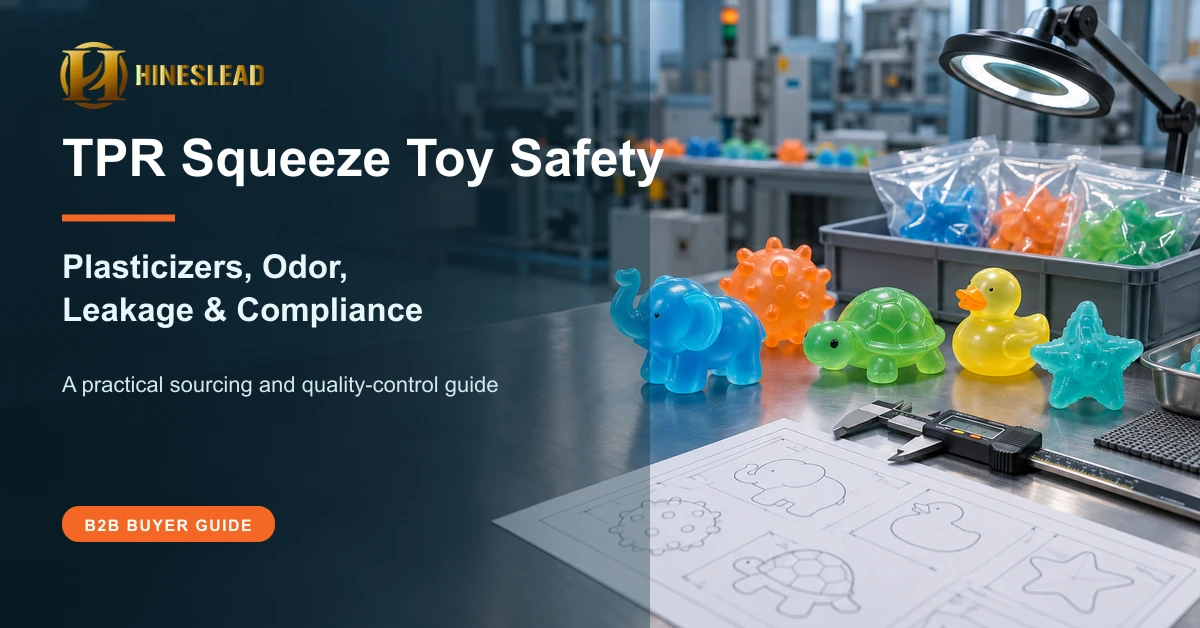
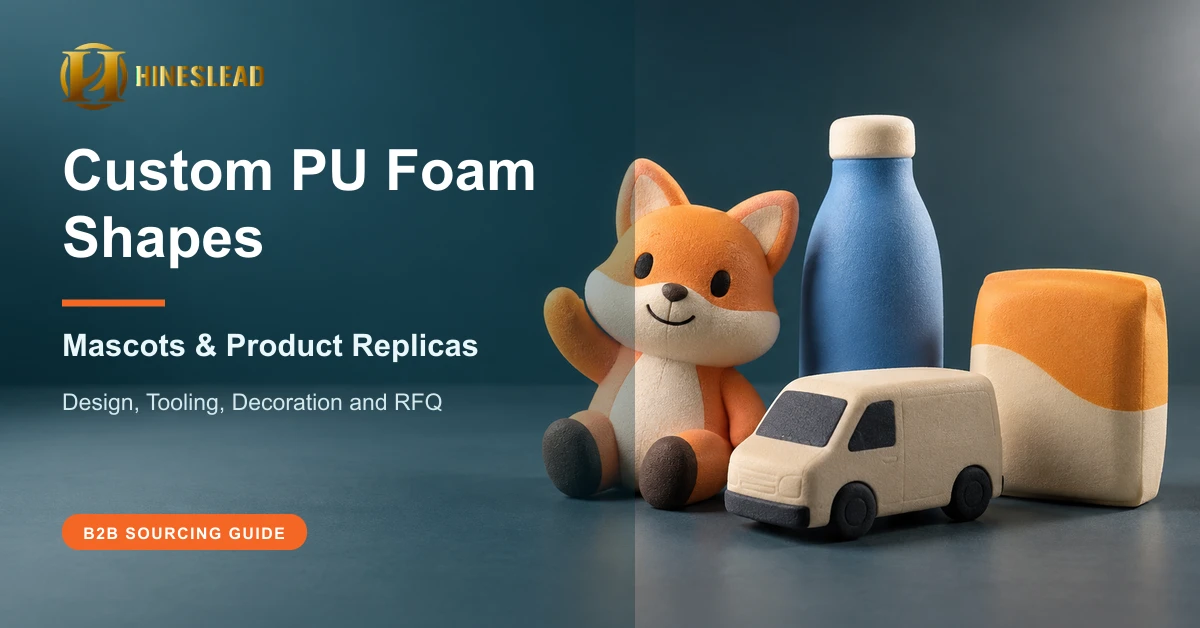
A quick reality check: a flat mascot drawing is a useful starting file, not a finished PU foam toy. The first sample forces real choices. Which features make the character recognizable? Which thin details need more material? Where can paint sit without losing the look? Who approves the sculpt, controls the mold, and signs off the finished evidence? A useful RFQ answers those questions with controlled views, dimensions, color references, intended age and use, destination markets, packaging, quantity tiers, and an approval plan.
This guide is for brand owners, promotional distributors, museum and attraction buyers, licensing teams, retailers, agencies, and sourcing managers comparing a PU foam toys manufacturer. It focuses on the decisions between a flat illustration and a repeatable bulk product. It does not claim that every drawing is moldable, that every shape can meet every toy rule, or that one material specification suits all projects. Final construction, compliance scope, cost, MOQ, sampling time, and production timing must be confirmed for the actual design.
Have a mascot or product replica ready for review?
Send front, side, and back views; target dimensions; Pantone or approved color references; intended age and market; quantity tiers; packaging; and the date when samples must be reviewed. If only a 2D image exists, identify the features that cannot change.
Send Your Artwork for a Mold ReviewBegin with the job the foam shape must do
For a buyer comparing a PU foam toys manufacturer, the first question is how the item will be used. A mascot can become a retail collectible, event giveaway, employee gift, educational prop, souvenir, desk item, or part of a boxed promotion. A product replica might represent a beverage can, tool, vehicle, appliance, food item, building, or package. These objects may look similar in a rendering, yet the commercial brief is different. A five-centimeter giveaway carried in a pocket faces different design, labeling, and damage questions from a twelve-centimeter licensed retail toy displayed in a printed box.
Write the intended use before the sculpt begins. State whether the item is presented as a children’s toy, a general promotional article, or another product category.State the intended age and sales channels. Identify foreseeable handling: squeezing, pulling a thin feature, dropping, mouthing, attaching a key chain, storing in heat, or compressing for shipment. Classification and requirements depend on the finished item, its design, its marketing, its instructions, and the destination. A buyer should not expect a disclaimer to erase the use suggested by the product itself.
Decide what a successful result means to the brand team. Is instant recognition more important than exact scale? Must a wordmark remain readable? Is the product silhouette protected? Can a hand, antenna, handle, or bottle neck become thicker? Can a complex underside be simplified? Which view appears most often in advertising? Ranking these points prevents the development team from spending time on details that do not survive the material or matter to the customer.
| Kickoff field | Buyer input | Why it changes development |
|---|---|---|
| Commercial use | Retail toy, giveaway, souvenir, gift set, or display item | Affects features, package, labeling, evidence, and target cost |
| Audience and market | Intended age, sales channel, United States, EU, UK, or another destination | Guides classification, risk review, warnings, and test planning |
| Identity anchors | Silhouette, face, package panel, logo, colors, signature feature | Shows what can be simplified and what needs approval |
| Dimensions | Overall height, width, depth, print area,and critical feature sizes | Controls proportions, tooling envelope, packaging, and small-feature review |
| Tactile target | Reference sample, squeeze force, recovery observation, surface feel | Turns “soft” or “slow” into an approvable behavior |
| Commercial quantities | Pilot, launch, and repeat-order tiers by design and package | Allows tooling, setup, packaging, and inspection costs to be compared |
Confirm rights before converting artwork into a product
Mascots, logos, packaging graphics, character artwork, and branded product forms may involve several kinds of intellectual property. The rights folder may need more than one document. In the United States, the USPTO describes a trademark broadly: a word, phrase, symbol, design, or combination can identify the source of goods or services. Copyright reaches different ground. The U.S. Copyright Office includes fixed original illustrations and sculptural works among protected subject matter, while copying and derivative works are among the copyright owner's exclusive rights.
The mold shop can check a filename; it cannot verify the chain of title behind that file.Put that responsibility with the buyer or licensing principal. Get written answers to practical questions: Who owns the source art? Who may approve the three-dimensional adaptation? Which territories and product categories are covered? May subcontractors receive the files? Which markings must appear? If an agency commissioned the character, check the contract rather than assuming that payment transferred every right.
Build an IP checkpoint into the RFQ. Identify the artwork owner, license reference, authorized product, territory, term, approval contacts, file-handling rules, tooling ownership, allowed overruns, sample disposal, photography permission, and whether the supplier may display the item. Legal counsel should review the relevant agreements. The practical sourcing point is record control: development should not begin from an image found online or from a salesperson’s informal statement that permission will arrive later.
Use version numbers for every art and model file. A filename such as “mascot-final-final2” provides little protection against an accidental old revision. A controlled record can identify the project, view, revision, date, author, approver, and change note. Put the same revision on the color sheet, packaging art, approval report, and quotation. If a license owner changes the eye shape or logo position, the team can see which cost, sample, and evidence decisions must be revisited.
Translate a flat mascot into a readable three-dimensional form
Two-dimensional artwork often cheats perspective. One ear may be larger because the head is turned.A package illustration may show only the front. A product photograph can hide the back and underside. The first modeling task is therefore interpretation, not copying. Request a proper turnaround: front, side, rear, top, and bottom. If the brand owner has no such set, draw it first and label the uncertain parts before anyone invests time in a detailed sculpt.
Start with the silhouette. View the proposed form at thumbnail size and from the angle in which a buyer will first see it. The outline usually carries more recognition than shallow surface detail. For a mascot, the head-to-body ratio, ears, hair, hat, tail, or pose may do the work. For a product replica, the container profile, cap, handle, grille, wheel, or opening may matter most. Lock those identity anchors before refining wrinkles, labels, panel lines, or textures.
Then look for parts that stand alone or become very thin: fingers, horns, stalks, antennae, blades, cables, handles, straps, bottle necks, and sharp corners. On a squeezable object, these details may tear or distort, and paint may not sit on them cleanly. They also need a safety review as projections. The usual design choices are practical ones—add thickness, shorten the part, bridge it to the body, show it as shallow relief, or print it instead of molding it. Ask the brand team which compromise still reads as the character. A lifelike appendage that fails in ordinary handling is not a successful replica.
Deep recesses also deserve attention. A narrow gap between an arm and body, a hollow wheel arch, a tiny letter cavity, or an undercut beneath a cap may complicate molding and demolding.Do not hide this question until tooling. During design review, color-code areas that are too thin, too deep, too isolated, or difficult to coat. The supplier should explain which forms can remain three-dimensional and which are better treated as shallow relief or artwork.
| Artwork feature | Manufacturing question | Possible design response | Approval evidence |
|---|---|---|---|
| Thin ear, tail, or handle | Will it bend, tear, or deform during demolding and use? | Thicken, shorten, attach to body, or change to relief | Section dimensions and physical squeeze sample |
| Tiny text or logo | Can it be molded or printed with readable edges? | Enlarge, simplify, move,or use package graphics | Actual-size artwork proof and decorated sample |
| Hidden back or underside | What geometry is intended where no source view exists? | Create controlled turn-around drawings before sculpting | Signed multi-view sheet |
| Deep gap or undercut | Can the part release without damage or excessive distortion? | Open the gap, fill the recess, move the split, or simplify | Tooling review image and first molded sample |
| Sharp visual corner | Will the finished corner be durable and appropriate for the intended use? | Add radius while protecting the recognizable outline | Dimensioned model and risk review |
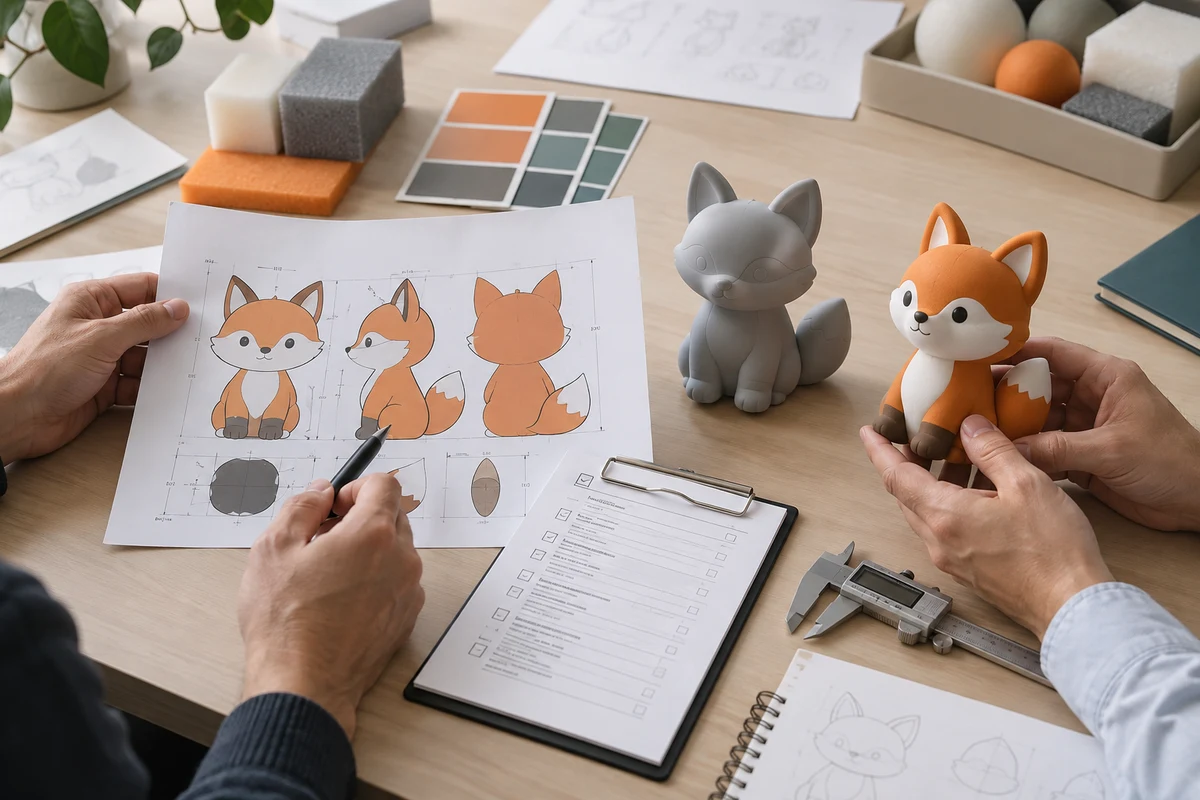
A turn-around review catches missing geometry and fragile features before tooling. Record every approved simplification against the artwork revision.
Specify size by proportions and critical dimensions
Overall height alone is rarely enough. A mascot with an oversized head may meet the height target while the face becomes too narrow for decoration. A bottle replica may fit the stated height but miss the shoulder angle that makes the brand recognizable. Provide overall width and depth, plus critical dimensions for the head, face, logo panel, appendages, base, holes, and attachment areas. Mark dimensions that may vary with soft foam and those that must remain visually controlled.
Let the intended package set an early boundary. Otherwise, a delightful sculpt can demand an oversized carton or reach the customer with a permanent shipping dent. Decide how the object travels: standing, on its side, in a tray, on a hanging header, or loose in a bag. Give the packaging designer measured samples and real recovery observations. Give the sculptor the package envelope before the form is frozen.
Review scale effects rather than assuming that a small and large version are identical. Thin features do not always scale safely. The print method and minimum readable text may change. A heavier or larger object may behave differently when dropped or squeezed.If two sizes will be sold, treat them as two finished SKUs with their own samples and applicable review instead of approving one and mathematically enlarging it.
Define foam behavior with a reference and a method
“Soft,” “squishy,” and “slow rising” are purchasing language, not complete specifications. Two samples can feel equally soft during the first squeeze yet differ in force, compression depth, recovery, surface skin, temperature response, or fatigue. Provide a physical reference when hand feel is central. Record its code and condition. If a measurable method is used, define conditioning, compression, hold time, release, observation interval, and acceptance range.
Shape changes the sensation. A thick round torso resists the hand differently from a thin product replica made from a similar foam system. A large head and narrow body can recover unevenly. Deep molded details may create local stiffness. For this reason, approve the behavior on the final geometry rather than on a generic material block. The formulation, part volume, skin, coating, and curing route work together.
Do not claim an exact density, hardness, rebound time, odor level, or durability unless the supplier has confirmed how it will be measured and controlled. The attached Hines knowledge base contains no verified public values for these properties. A responsible quotation should name the proposed reference sample and the tests or comparisons used for approval. Bulk inspection then uses the same agreed reference or method.
Plan coating and decoration as part of the construction
The molded piece is only the beginning of the visible mascot. It may still receive surface preparation, a base coat, sprayed zones, pad or screen print, small hand-applied details, and a protective finish. Each step can alter the touch, odor, color, recovery, or cracking response. On the artwork sheet, separate color that belongs in the foam from coating, printed graphics, and package graphics. Edges, recesses, compound curves, and high-flex areas do not accept every decoration method equally well.
Use Pantone or another controlled color reference, but approve color on the intended substrate and finish. A number on a monitor is not a physical standard. Gloss, texture, film thickness, lighting, and the base color beneath a coating affect appearance. Keep a signed color sample or limit board. Define normal viewing distance and lighting for visual inspection, particularly when adjacent colors or skin tones are important.
Place logos where they remain legible during ordinary deformation. A mark printed over the deepest squeeze zone may crack or distort. Small type on a curved surface can close up. If a licensed statement or legal line must be readable, packaging may be the better location. Ask for actual-size print proofs and a decorated physical sample. A magnified PDF can make an impossible detail look acceptable.
Decoration durability should be evaluated on the approved construction. A simple review may include repeated compression, flexing, rubbing under a defined method, package contact, and cleaning exposure if the product will be cleaned.Record the method and resulting defects. “No paint loss” means little unless the number of cycles, force, contact material, cure age, and acceptance threshold are known.
Use sample rounds as decisions, not souvenirs
Every sample should answer a named question. The first sculpt can settle proportions and missing views. A tooling or first-molded sample can reveal release, seams, thin features, surface skin, and actual squeeze behavior. A decorated sample confirms color placement and print readability. A packaging sample tests fit and presentation. Compliance samples must represent the controlled finished configuration selected for evaluation.
Do not write “approved” without stating what was approved. A gray unpainted model may be approved for geometry but not color, surface, hand feel, package, or compliance. A photo can confirm logo position, yet it cannot reliably confirm softness, odor, tactile finish, coating flexibility, or recovery. Keep physical samples when the decision depends on touch or deformation.
| Sample gate | Questions it should answer | What remains unapproved |
|---|---|---|
| Turn-around or concept model | Proportions, silhouette, missing views, simplifications, critical dimensions | Bulk material, molded surface, decoration, package, and compliance |
| First molded sample | Tool release, seam, local thickness, hand feel, recovery, visible defects | Final colors, printing, pack-out, and evidence |
| Decorated sample | Color, masks, print position, readability, coating behavior, brand approval | Production consistency and shipment packaging unless represented |
| Package trial | Fit, deformation,presentation, labels, barcode, carton efficiency | Regulatory suitability and bulk transit performance unless evaluated |
| Compliance and pre-production set | Frozen materials, colors, construction, artwork, labels, and evidence route | Unapproved substitutions or later revisions |
Turn the artwork into a comparable RFQ
Share the controlled artwork, identity anchors, dimensions, tactile reference, decoration map, destination, quantity tiers, packaging, and approval milestones. Hines can organize the open product and quotation questions around the actual design.
Request a PU Foam Shape Sample PlanReview toy safety on the finished SKU
When the finished article is a children’s toy for the United States, the applicable federal requirements must be identified for that product. The U.S.Consumer Product Safety Commission’s ASTM F963 chart says that 16 CFR part 1250 incorporates ASTM F963 by reference and shows provisions that apply broadly or to particular toy types. Its list includes material quality, accessible coatings and substrates, small objects, accessible edges, projections, points, producer markings, and a specific section for squeeze toys. The chart also identifies provisions that require testing by a CPSC-accepted third-party laboratory.
This is why a generic material report is not a complete answer. The finished foam, coating, ink, attachments, size, shape, age grade, labeling, and marketing presentation matter. A thick mascot with no attachments and a replica fitted with a key ring, cord, hard plastic eye, or electronic sound component do not have the same construction or questions. Ask a qualified laboratory to review the finished design and intended market before selecting samples.
For the European Union, the European Commission explains that toys must meet essential safety requirements before being marketed. The requirements address general risks and particular physical, mechanical, flammability, chemical, electrical, hygiene, and radioactivity risks as applicable. The Commission also states that toys sold in the EU must carry CE marking and describes conformity assessment routes. Regulation (EU) 2025/2509 entered into force on January 1, 2026 and will apply from August 1, 2030 after the transition period, so long-lived programs should track the change.
Do not print a CE mark, age warning, tracking information, or compliance statement merely because it appeared on an earlier product.Map each marking to the responsible party and evidence for this SKU. When a color, coating, component, factory, or construction changes, ask whether existing evidence still applies. The decision should be documented rather than inferred from visual similarity.
| Evidence question | What the buyer should request | Common gap |
|---|---|---|
| Which product was reviewed? | Sample code, photos, dimensions, construction, colors, artwork revision | Report describes a different shape or color |
| Which rules or methods were applied? | Destination, age grade, applicable citations, laboratory scope | “Full test” is listed without product classification |
| Who is responsible for records and certification? | Named manufacturer,importer or responsible party and required documents | Supplier report is treated as the buyer’s complete duty |
| How are bulk units linked to evidence? | Material references, approved samples, batch records, markings, change log | No connection between tested sample and production lot |
| What happens after a change? | Written review of affected tests, samples, labels, and approvals | Substitution enters production without documented release |
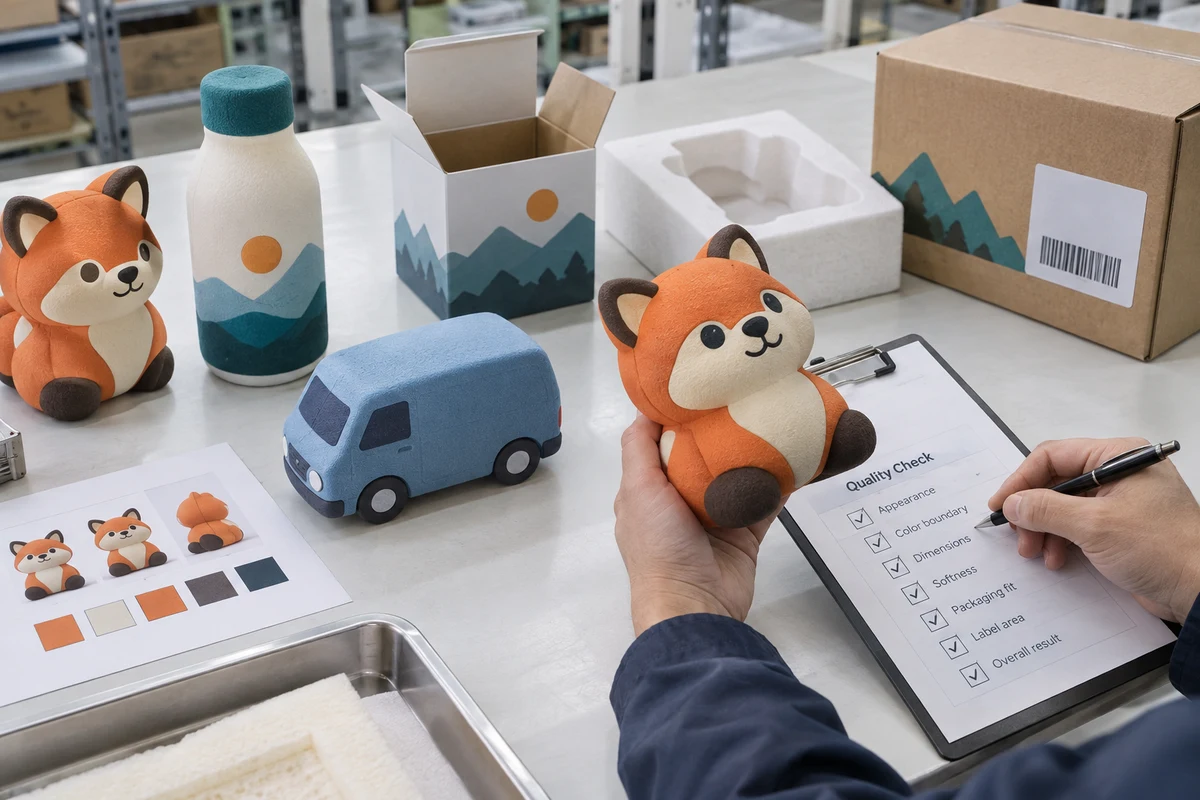
Inspect the decorated sample and package together. Brand recognition, coating durability, deformation, labels, and traceability belong to the same release decision.
Build production controls around what buyers will notice
A quality plan for a custom shape should begin with the approved product, not a generic inspection template.Control overall dimensions and critical proportions, but also identify the visual points that define the brand. Those may include eye spacing, cap angle, logo position, color boundary, molded panel line, or the way a character stands. Inspectors need clear photos, dimensions, limit samples, or defect examples rather than an instruction to check “appearance.”
Functional checks can include mass, compression behavior, recovery, permanent deformation, tear-prone areas, coating cracks, adhesion, print legibility, odor assessment under an agreed method, surface contamination, and package count. The method and acceptance rule must be stated. If a hand comparison is used, identify the reference sample and conditioning. If a cycle test is used, define compression, frequency, number of cycles, rest time, and defects to record.
Separate critical, major, and minor defects according to the project rather than copying a classification from another toy. A detached part, exposed unsuitable edge, leakage, or missing required marking may be treated differently from a small color variation in a hidden area. The buyer and supplier should agree on inspection level, sampling approach, defect classification, acceptance criteria, and disposition process before the order is ready for inspection.
Retain controlled samples from development and production. A useful retention set identifies the project, SKU, mold or cavity when relevant, material and color references, artwork revision, production date or lot, and approval status. It helps when a later order looks or feels different.Without traceable references, teams rely on memory or photographs that cannot show tactile properties.
Design packaging around recovery and presentation
Soft foam can be economical to ship, but aggressive compression may change shape, crease a coating, transfer color, or delay recovery. Test the proposed bag, tray, box, divider, and carton using finished decorated samples. Record packing orientation, units per inner and master carton, protective layers, carton dimensions, and storage time before evaluation. A package trial should reflect the actual distribution route rather than a short office demonstration.
Retail products may need clear display, barcode placement, age information, warnings, responsible-party details, care instructions, and licensed-brand statements. Promotional programs may emphasize unit bags, event distribution, mixed cartons, or individual names. A product replica can be confused with the real product, especially food or drink forms, so the buyer and safety reviewer should examine foreseeable use and presentation. Do not use package graphics to make unsupported claims.
Ask how replacement units will be identified. A licensed campaign may contain several mascots or colorways that look similar in a warehouse. Put the SKU and revision on the unit package and carton records. Mixed packs need a count pattern and inspection method. If the program depends on a launch date, approve the dieline and mandatory text early; late legal changes can affect print plates, labels, pack-out, and schedule.
Understand what drives tooling, MOQ, and unit cost
Custom shape cost is built from more than foam volume. Development may include artwork interpretation, sculpting or model work, tooling, color and coating setup, print fixtures or masks, sample rounds, packaging development, testing, inspection, and freight. The unit price may change with part size, number of decoration steps, rejected yield, cure and handling time, package labor, order quantity, and carton efficiency. Ask suppliers to state assumptions so quotes can be compared on the same scope.
MOQ may be driven by material preparation, color batching, coating or printing setup, custom bags, labels, inserts, cartons, or an efficient production run. One project can therefore have several minimums. A pilot may use a standard bag and label while the launch order uses a printed box. A group of colorways may share one tool but require separate color and decoration setups. Ask which component establishes each minimum and what changes at the next quantity tier.
Tooling quotations should state what is included, how revisions are charged, who owns the tool, where it is stored, how long it is retained, who can authorize its use, whether maintenance is included, and what happens at the end of the agreement. Those commercial terms require a written contract suited to the buyer’s legal needs. Do not rely on the assumption that paying an invoice automatically resolves every ownership and access question.
| Cost or MOQ driver | Buyer question | Comparison method |
|---|---|---|
| Model and tooling | How many revisions, samples, cavities, and maintenance items are included? | Compare the same revision allowance and ownership terms |
| Color and decoration | How many sprayed colors, masks, print positions, and setup charges? | Use one approved decoration map across quotations |
| Packaging | Stock bag, custom bag, tray, box, insert, label, and carton minimums? | Compare packed unit cost and carton volume |
| Evidence and inspection | Which tests, certificates, reports, samples,and inspections are included? | Price the required destination and retailer scope |
| Logistics | Packed dimensions, gross weight, Incoterm, destination, and shipment mode? | Compare landed cost, not only ex-factory unit price |
Build a schedule from decision gates
A development schedule should show inputs and approvals, not only a promised ship date. Typical gates include complete artwork, IP authorization, turn-around approval, model approval, tooling start, first molded sample, material and tactile approval, decoration proof, package proof, laboratory sample selection, pre-production release, production, inspection, and shipment. The exact route varies with the design. Ask who owns each decision and what information must be present before the clock starts.
Buyer response time belongs in the schedule. A license owner may need several reviewers. A minor geometry change can affect tooling, package dimensions, artwork, and evidence. Combine feedback into one controlled response rather than sending conflicting comments from marketing, legal, safety, and procurement. Set a deadline for each round and state whether silence counts as approval—it generally should not unless the agreement says so.
Keep contingency for material, color, decoration, compliance, and package changes discovered through physical samples.A calendar with no room for a failed decision gate encourages teams to accept a weak sample. Hines should confirm the project-specific sample and production timeline only after reviewing the design, quantity, package, evidence route, and required approvals.
Use related Hines product routes when the design changes material
A mascot brief sometimes starts as foam and moves to another construction after the use case is reviewed. Buyers sourcing sensory toys wholesale or comparing a sensory toy manufacturer may need a mixed program rather than one foam shape. The material choice should follow intended use, geometry, tactile target, decoration, cleaning, package, and compliance—not a keyword.
For foam routes, custom PU foam toys can be reviewed alongside slow rising squishy toys wholesale and a squishy toy manufacturer route when recovery behavior is central. Promotional programs may compare custom stress balls with logo with promotional stress balls wholesale before paying for a fully custom shape.
Some concepts suit EVA foam toys wholesale or custom EVA foam toys, particularly when the design is a cut, layered, puzzle, construction, or lightweight sports form. Movement projects may also compare custom foam sports toys and foam balls wholesale. These categories need their own specifications and risk review; they are not automatic substitutes for molded PU foam.
Stretchy or filled forms call for a different discussion with a TPR squeeze toy manufacturer. Buyers exploring small soft characters may also review mochi squishy toys wholesale. When a one-piece elastic structure is preferred, a silicone squishy toy manufacturer can be compared for custom silicone sensory toys. Finished geometry, formulation, attachments, intended use, and evidence still control the decision.
If the character needs fabric texture, stitched clothing, or a soft filled body, a custom plush toy manufacturer or plush toys OEM route may preserve the identity better. A buyer selecting an OEM toy manufacturer China should ask for one controlled project file across all SKUs. The same discipline supports broader custom toy manufacturing: approved drawings, materials, samples, artwork, packaging, evidence, inspection criteria, and changes belong together.
A practical RFQ for a custom PU foam mascot
Use the following checklist as the first message. Attach files separately and name every attachment in the RFQ so missing information is visible.
- Buyer company, project owner, decision contacts, and target launch.
- Artwork owner or license reference, authorized product and territory, approval contact, and confidentiality requirements.
- Controlled front, side, back, top, and bottom artwork or a request for a turn-around proposal.
- Identity anchors that cannot change and features open to manufacturing simplification.
- Overall and critical dimensions, including logo panel, thin features, base, and package envelope.
- Intended age, use, sales channel, destination markets, and retailer-specific protocols.
- Reference sample or defined squeeze, recovery, surface, and odor expectations.
- Color references, decoration map, actual-size logo art, legal markings, and package artwork.
- Pilot, launch, and repeat-order quantity tiers for each shape, colorway, and package.
- Required sample gates, inspection method, laboratory review, documentation, Incoterm, destination, and requested timing.
Ask the supplier to return an assumption list with the quotation.It should identify unclear geometry, proposed simplifications, material and surface route, sample scope, tooling scope, decoration steps, package, MOQ drivers, exclusions, evidence responsibilities, and decision dates. A single unit price without those points is not a comparable proposal.
Hypothetical example: a beverage mascot launch
Consider a beverage brand planning a ten-centimeter foam mascot for a seasonal retail promotion. The source file shows a smiling bottle character from the front. The arms are thin, the cap has deep ribs, and the label includes small legal text. The initial request asks for an exact three-dimensional copy, three colors, a printed retail box, and a low pilot quantity. No side or back art is supplied.
The development team first creates a controlled turn-around. The brand identifies the bottle shoulder, cap, face, and main label colors as identity anchors. The arms may be joined to the body, the cap ribs can become shallower, and the legal text will move to the package. The buyer confirms rights for the character and names the licensing approver. The intended age, U.S. and EU markets, retail presentation, and foreseeable squeezing are included in the brief.
The first model reveals that an exact bottle proportion creates a narrow neck and unstable base. Two versions are reviewed. The chosen version slightly thickens the neck and widens the base while keeping the front silhouette recognizable. The first molded sample is approved for geometry but rejected for hand feel. A second sample is compared with a coded tactile reference.Decoration trials move the smallest print away from the highest-deformation area.
Package testing shows that the face rubs against the carton window during transport simulation, so a small internal clearance change is made. The laboratory receives the finished construction, intended age, markets, and artwork rather than a generic foam swatch. The final project file links the licensed art revision, model, sample code, colors, package, evidence, inspection criteria, and production lot. This example is illustrative; it does not describe a verified Hines customer case or promise a result.
Frequently asked questions
Can a supplier quote from one front-view image?
A preliminary range may be possible, but a dependable quotation needs assumptions about the side, back, underside, dimensions, thin features, decoration, package, and intended use. Ask for a paid or defined concept stage if those views do not exist. Do not treat an early estimate as the final cost of an unapproved three-dimensional design.
How exact can a foam product replica be?
Accuracy depends on scale, geometry, material behavior, molding route, coating, printing, and safety constraints. Buyers should rank identity anchors and approve documented simplifications. Exactness is best judged with controlled dimensions, multi-view comparisons, actual-size artwork, and a decorated physical sample—not a statement that the replica will be “100% identical.”
What files should a buyer provide?
Provide vector logos, high-resolution artwork, controlled multi-view drawings or approved photographs, dimensions, Pantone or physical color references, package dielines, mandatory text, and a revision list. CAD data can help when it is owned and appropriate, but the soft product may still require design changes. Identify confidential files and authorized recipients.
Who owns the mold and three-dimensional model?
Ownership and permitted use should be stated in a written agreement. Cover model files, drawings, tooling, revisions, maintenance, storage, access, sample disposal, overruns, photographs, and end-of-life handling. Payment alone should not be assumed to answer every question. Obtain legal advice appropriate to the contract and jurisdictions involved.
What determines the MOQ?
Material and color preparation, coating and print setup, tooling efficiency, custom bags or boxes, labels, testing, inspection, and the number of shapes or colorways can each set a minimum. Ask which component controls the quoted MOQ. Request pilot, launch, and repeat-order tiers using the same specification and package scope.
How long does development take?
There is no responsible universal lead time. The schedule depends on artwork completeness, IP approval, model complexity, sample rounds, tooling, tactile and color decisions, package development, laboratory scope, buyer response time, and production quantity. Request milestones with start conditions and approval deadlines.Confirm timing in the project quotation.
Can a previous foam test report cover the new mascot?
Do not assume that it can. The finished shape, size, foam system, coating, ink, attachments, age grade, market, and manufacturing details may differ. Give the new design to a qualified laboratory or compliance owner, identify the existing evidence precisely, and document what can be used and what needs new evaluation.
How should buyers approve color and print?
Use a controlled color reference and approve it on the intended foam and finish under stated lighting. Review actual-size print on the curved, flexible surface. Check readability, boundary position, deformation, rubbing, and package contact. Retain the signed sample or limit board and connect it to the artwork revision.
What should happen if production requires a design change?
Pause release, record the proposed change, and identify every affected record: model, tooling, material, decoration, package, evidence, cost, schedule, and license approval. Obtain written approval before production continues. Update the revision and retain a new reference sample when the change affects appearance, feel, function, or compliance evidence.
Official sources used for this guide
- U.S. Consumer Product Safety Commission — ASTM F963 requirements chart
- European Commission — Toy Safety in the EU
- United States Patent and Trademark Office — What is a trademark?
- U.S. Copyright Office — What is Copyright?
These pages support the general safety and intellectual-property points above. They do not replace product classification, laboratory advice, or legal review for a particular mascot, license, market, or contract.
Prepare a mold-review inquiry that can be answered
When comparing a PU foam toys manufacturer, send the controlled artwork, rights contact, identity anchors, multi-view references, target dimensions, tactile reference, colors, decoration, intended age and market, package, quantities, evidence needs, and decision dates. Hines can review the brief and identify the questions needed for a sample plan and project-specific quotation. Final design feasibility, MOQ, tooling, price, compliance scope, and timing will depend on the approved product.
Request a custom PU foam shape review
Share your mascot or product artwork, dimensions, target feel, colors, quantity tiers, packaging, destination markets, and launch window.We will organize the model, sample, tooling, evidence, and quotation questions around the actual design.
Send Your Artwork for a Mold Review