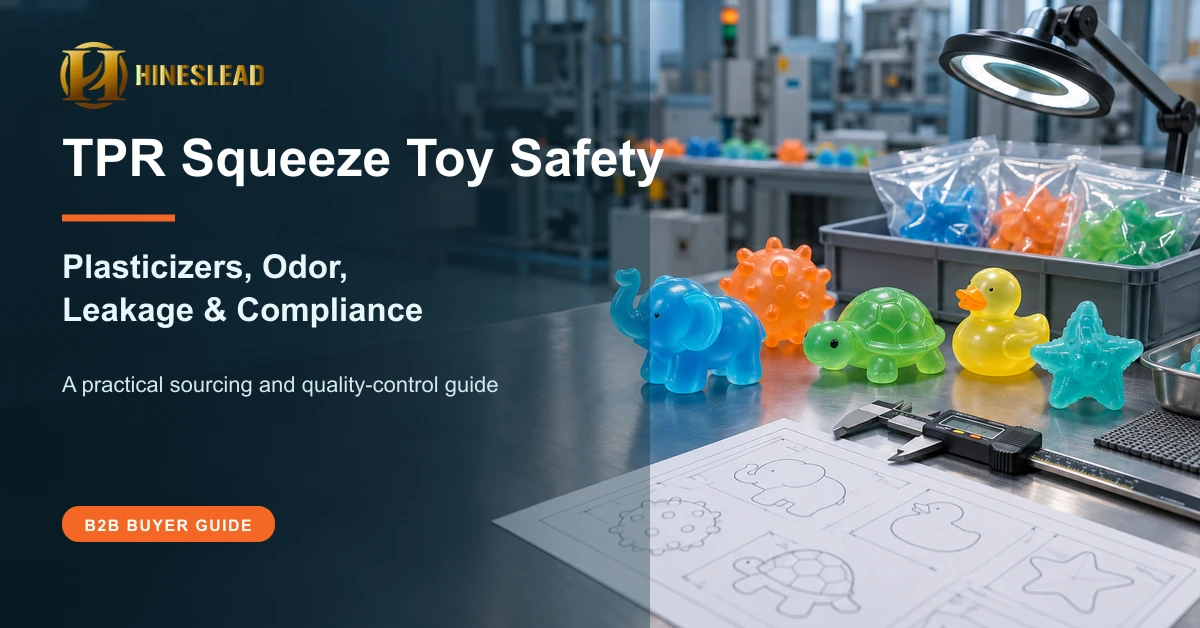
Put the test report to one side for a moment. The first job is to describe what the buyer is actually purchasing, because a repeatable TPR squeeze-toy program rests on a controlled construction. A solid mochi figure fails differently from an air-filled squeaker; add a liquid-filled skin or bead-filled shell and the risk picture changes again. At minimum, the buyer’s working file should name the accessible materials, filling, closure, age grading, destination market, expected misuse, pack-out pressure and the lot code that will follow the goods. Only then can a laboratory and compliance owner select the relevant requirements for the finished product.
This guide is written for importers, retail buyers, promotional distributors, private-label teams, educational suppliers, and sourcing managers evaluating a TPR squeeze toy manufacturer. It concentrates on four questions that routinely decide whether a project is ready for a quotation or still needs technical work: What does “phthalate compliant” actually cover? When does odor justify a shipment hold? Why do flexible toys leak? Which documents connect a passing sample to the goods that will arrive? It is not a substitute for legal advice, laboratory assessment, or product-specific risk evaluation.
Have a TPR squeeze-toy specification to review?
Send the product drawing, dimensions, intended age, destination markets, filling composition, closure design, colorways, packaging, quantity tiers, target dates, and any retailer protocol. A useful first review separates missing safety inputs from normal commercial questions.
Request a TPR Sample and Compliance ReviewStart with the construction, not the product nickname
Words such as mochi, jelly, squishy, stress toy, and sensory toy describe a look or play pattern more often than they describe a controlled bill of materials. Two products sold under the same nickname can differ in polymer formulation, wall thickness, filling, closure, surface treatment, decoration, and intended age. A laboratory cannot test a nickname, and an importer cannot certify one. Both need a defined product and an identifiable sample.
Split the concept into layers. The outer body may be a solid flexible piece, a hollow skin, or a skin bonded to another component. A hollow item may contain air, liquid, gel, foam, powder, sand, water beads, glitter, or mixed particles.There may be a valve, plug, heat seal, bonded neck, squeaker, fabric cover, printed face, flocking, key chain, or retail accessory. Each layer creates its own questions about accessibility, chemical composition, mechanical integrity, small parts, contamination, and change control.
| Construction family | Typical buyer concern | Information needed before testing |
|---|---|---|
| Solid or unfilled flexible piece | Surface chemistry, tearing, dirt pickup, color transfer | Compound identification, additives, dimensions, colors, surface treatment |
| Air-filled or squeaker construction | Valve or squeaker release, seam failure, projection hazards | Closure drawing, retained-part design, age grade, abuse-test plan |
| Liquid- or gel-filled membrane | Leakage, splash exposure, microbial stability, staining | Full filling composition, closure method, wall map, use and storage conditions |
| Bead-, sand-, powder-,or particle-filled shell | Ingestion, inhalation, particle release, abrasion from inside | Particle identity and size, containment, applicable special rules, rupture response |
Do not let a sample room substitute one construction for another because the shapes look alike. If the approved sample uses one filling and bulk production uses a different filling, the product has materially changed. The same is true when a clear skin becomes opaque, a soft wall becomes thinner, a printed face becomes a glued label, or a plug supplier changes. Record these differences before deciding whether existing evidence still applies.
Build a one-page safety brief before asking for price
A quotation request often begins with a photo and an order quantity. That is enough for a rough conversation, but not enough for responsible safety planning. Create a one-page brief that sits above the drawing and bill of materials. It should state the product category claimed by the brand, the age and users shown in marketing, the destination countries, the way the toy is handled, the filling, the closure, and the conditions in which it will be stored and transported.
Foreseeable behavior matters. A squeeze toy may be twisted, stretched, bitten, picked at around a plug, carried in a pocket, left in sunlight, compressed inside a display tray, or handled by a younger sibling. Marketing can also influence classification.An “office stress item” pictured in a child’s hand or sold in a toy aisle may not be assessed only by the words printed in a disclaimer. The compliance owner should review the finished design, presentation, instructions, and sales channels together.
The brief should distinguish requirements from preferences. “No strong odor on opening” is a buyer acceptance criterion that needs a defined method. “Comply with applicable U.S. requirements for a children’s toy” is a legal and technical scope that must be mapped to the product. “Soft feel” is a sensory preference. “No leakage after the agreed test sequence” is a performance requirement. Mixing these statements produces quotes that appear comparable but include different work.
Plasticizers: ask what was tested, not whether the material is safe
TPR is a family description, not a single chemical recipe. A compound may contain a base polymer system, process oil or another softening system, colorants, stabilizers, fillers, and processing aids. The word plasticizer can be used loosely in commercial discussion, so the buyer should avoid reducing the conversation to “phthalate-free.” Ask for the controlled formulation identifier, the materials covered by the test sample, the regulated substances in scope, the test method, the result, the date, and the connection between the report and the production lot.
On the U.S.side, CPSC’s business guidance gives a numerical line buyers should not blur: in covered children’s toys and child-care articles, each of eight regulated phthalates is limited to 0.1% (1,000 ppm) in accessible plasticized components. That page is equally clear about substitutes. Calling a chemical an “alternative plasticizer” does not ban it by itself, yet the finished product still must not create a hazardous-substance risk in normal play or in misuse that can reasonably be expected. The practical lesson is that “not one of the eight” is not the same as “suitable for this finished toy.” See the current CPSC phthalates business guidance.
For an EU launch, do not begin with a stock supplier checklist. Map the finished item first against the Toy Safety Directive still relevant during the transition, the REACH restrictions that apply, and any other rule tied to the product and market date. Entries 51 and 52 of REACH Annex XVII deserve an early read because they deal with named phthalates in plasticised material, including conditions for toys and childcare articles. This is not a universal test list. Ask the responsible laboratory or compliance specialist to identify the exact entries, materials, accessibility assumptions, and market date for the actual item. The official ECHA Annex XVII restriction text is the traceable starting point.
Sampling must follow the product structure.A single test on the clear outer skin may not cover a colored plug, printed eye, flocking adhesive, glitter carrier, fabric pouch, package ink, or internal filling. Conversely, testing every component for every substance without a product-specific plan can waste time and money. Build a component matrix, then have the laboratory and compliance owner determine which materials are accessible, which are exempt or supported by valid component evidence, and which require finished-product or component testing.
| Document or claim | What it can show | What it does not prove by itself |
|---|---|---|
| Supplier declaration | Stated formulation policy, named material, covered substances, issuer responsibility | That the finished toy passed every applicable requirement |
| SDS | Hazard communication information for the supplied substance or mixture | A complete consumer-product compliance assessment or exact recipe |
| Component test report | Results for identified specimens under named methods | Coverage of untested colors, fillings, coatings, suppliers,or later lots |
| Finished-product report | Results for the documented final configuration submitted | Automatic coverage after a material, color, closure, size, or factory change |
| “Phthalate-free” sales statement | The supplier’s commercial assertion, if its scope is defined | Which analytes, limit, method, sample, market, or production period was assessed |
What an odor check can—and cannot—tell you
Open two supposedly identical lots and the nose may notice a difference before any paperwork does. The reason could be residual volatiles, a changed formulation, contamination, short conditioning time, an interaction with the bag, or an allowed ingredient that simply has a noticeable smell. A human panel cannot identify the chemical behind that difference, and it cannot issue a compliance verdict. Nor should a supplier close the matter with “it always disappears.” Use the observation as a controlled QC signal: quarantine the lot, compare references, and investigate.
Define the method before approving a sample. Record when the package was opened, the room conditions, the number of evaluators, the distance from the specimen, the rating scale, and the observation times.Compare the candidate against an agreed reference from the same product family. Avoid repeatedly smelling an unknown, intense emission at close range. An evaluator who notices eye, skin, throat, or breathing irritation should end the check immediately. Isolate those samples, write down what happened, and seek qualified safety advice.
One workable record has three entries: the sealed-pack impression at opening, a reading after a short controlled airing period, and a final reading at the longer interval agreed for the project. Choose those intervals for the product and retailer program; they are not universal safety thresholds. The acceptance rule should identify both intensity and character. “2 or lower on a five-point scale and no sharp solvent-like or rancid character” is more useful than “normal smell,” but it still remains a sensory QC criterion rather than laboratory proof.
Investigate the package as well as the toy. Printed bags, adhesives, foam inserts, desiccants, cartons, and tight master-carton loading may contribute odor or slow ventilation. Compare an unpacked retained reference, an empty package, and the packed product. If the odor appears only after a certain bag or print run, the product compound may not be the root cause. Record lot codes for the body, filling, decoration, and packaging so the team can trace the change.
| Odor observation | Immediate buyer action | Useful follow-up evidence |
|---|---|---|
| Stronger than approved reference at package opening | Hold the affected lot and repeat the controlled comparison | Body, filling, print, bag, and carton lot records |
| Odor remains after the agreed conditioning period | Open a deviation; do not relabel the issue as normal | Retained sample comparison, formulation and process-change review |
| Only the printed bag or insert smells | Separate packaging and product specimens | Packaging ink, adhesive, curing, storage,and migration assessment |
| Irritation or acute symptoms reported | Stop exposure, isolate goods, follow incident and medical procedures | Incident record, product identification, qualified toxicology or laboratory review |

A useful material review connects the sample, compound, color, packaging, test scope, and production lot instead of relying on a general “safe material” statement.
Leakage begins with a failure path, not a final inspection
For filled toys, leakage is often treated as a pass-or-fail check at the end of production. That is too late. The engineering team should draw the complete containment path: skin or membrane, molded transitions, seam, fill port, plug or closure, attached parts, and the interface with packaging. Mark locations that become thin during molding or stretching. Mark sharp internal particles that can abrade the wall. Mark points where a user naturally pinches, twists, or pulls.
Wall thickness should be assessed across the shape, not only at an easy measuring point.A nominal value on a drawing can hide thin corners, facial features, narrow limbs, deep recesses, or material flow changes. The approved sample should include a dimensional or sectioning plan appropriate to the process. Transparency helps at the inspection bench: bubbles, inclusions, flow marks and an uneven closure are easier to spot. Still, a clear-looking skin is not evidence that the toy will survive repeated squeezing.
The filling changes the load. Low-viscosity liquid can escape through a path that holds a thicker gel. Heavy particles can strike and abrade the membrane from inside. Glitter or sharp-edged decorative particles may collect at the closure. Air space affects internal pressure during squeezing and temperature change. A formula that was stable in a round ball may behave differently in a narrow character shape because the same squeeze concentrates force at different points.
Packaging can create a continuous load that is absent in a quick hand test. A tight tray may press one feature for weeks. A master carton may place weight on the closure. Heat during storage or transport can change viscosity, pressure, softening, adhesion, and migration. Cold can change flexibility. Buyers should define realistic conditioning and distribution checks with their laboratory, packaging engineer, and product specialist rather than copying an arbitrary online test.
Build the validation sequence around use and foreseeable abuse.Depending on the design and applicable requirements, it may include conditioning, repeated compression, tension or torque on closures and attachments, drop or impact exposure, seam inspection, package compression, temperature exposure, and a post-test leakage check. Do not claim that a home-grown cycle count is “ASTM tested.” Contract laboratories must apply the applicable standardized methods and document deviations correctly.
| Leak location or symptom | Likely questions | Evidence to retain |
|---|---|---|
| Fill port or plug | Was the closure geometry, preparation, bonding, cure, or inspection changed? | Closure drawing, process settings, first-piece records, destructive checks |
| Thin corner or stretched feature | Is local wall thickness below the approved range? Does the shape concentrate strain? | Wall map, section samples, mold-cavity and lot traceability |
| Random pinhole | Was there contamination, an inclusion, bubble, or process instability? | Defect photos, microscopy if needed,raw-material and machine records |
| Damage after packed storage | Does tray pressure, bag interaction, carton load, or temperature create the failure? | Packing pattern, conditioning log, transport simulation and retained carton |
| Filling stains or separates | Are the filling, pigment, membrane, print, and package compatible over time? | Aged samples, formulation IDs, migration observations, approved color limit |
Water beads require a separate decision branch in 2026
Do not assume that every jelly-like or bead-filled squeeze toy is governed only by the general toy standard. In the United States, CPSC’s mandatory requirements for water-bead toys and toys containing water beads took effect on March 12, 2026. The agency’s business guidance identifies size-limit, extractable-acrylamide, and labeling requirements and points businesses to the relevant certification obligations under 16 CFR § 1250.4. Review the current CPSC Water Bead Toys Business Guidance for the precise scope and requirements.
The rule does not mean that every TPR squeeze toy contains water beads.A solid mochi figure, air-filled toy, or liquid-filled item without water beads needs its own classification and requirement map. The critical sourcing question is factual: What is inside the shell? Obtain the name, composition, particle dimensions in the relevant state, and supplier documentation. If the answer is vague—“magic beads,” “jelly balls,” or “sensory filling”—do not approve the product based on appearance.
Two notices from 2026 put this into a real buying context. In its August 5 alert about counterfeit squishies, CPSC noted that the category can include fillings as different as water beads, gels, liquids, powders and sand, any of which may escape from a torn cover. A separate notice dated September 3 announced a recall of water-bead-filled squeeze toys over ingestion, choking and obstruction concerns. Read those actions narrowly: they concern identified products and do not mean that every squeeze toy has the same hazard. What they do show is the need for positive identification of the filling, containment verification, markings, and lot records rather than a generic product name. See the 2026 CPSC squishy-toy safety alert and the September 2026 recall notice.
Temperature claims need equal care.Viral demonstrations that heat squishy toys are not a buyer validation method. The CPSC safety alert warns consumers not to microwave or otherwise heat such toys. A retailer or importer should define storage and transport conditions with qualified specialists, but should not market heating as a play feature unless the entire product was intentionally designed, assessed, and labeled for that use under the applicable rules.
Map U.S. requirements to the finished product
For a product that is a children’s toy in the United States, 16 CFR part 1250 incorporates applicable ASTM F963 requirements. The CPSC’s public chart includes material quality, accessible substrate and coating requirements, small objects, edges, points, projections, use-and-abuse tests, and a specific squeeze-toy section, among many other provisions. Applicability depends on the product. The chart also indicates which sections require testing by a CPSC-accepted third-party laboratory. Use the CPSC ASTM F963 requirements chart as an official index, then have the responsible specialist select the complete current scope.
Chemical requirements do not stop with the outer body. Lead in substrates or coatings, regulated phthalates in accessible plasticized components, and other hazardous-substance considerations may apply. Decoration colors can matter. The CPSC’s toy CPC example notes that different pigments may affect lead levels and may require separate consideration.This is one reason buyers should freeze the colorway set before final compliance samples are selected.
For covered children’s products, testing and certification are related but not identical tasks. The CPSC explains that a Children’s Product Certificate is issued by the responsible domestic manufacturer or importer and is based on passing results from a CPSC-accepted third-party laboratory for applicable rules. The laboratory produces test results; it does not take over the importer’s legal responsibility for the certificate. As of July 8, 2026, CPSC guidance also notes electronic filing requirements for importers of most regulated consumer products. Buyers selling into the United States should review the current CPSC CPC guidance and the agency’s eFiling information for their shipments.
Tracking information belongs in the artwork and production plan, not as an afterthought. CPSC guidance says children’s products need distinguishing marks that make the manufacturer or private labeler, production location and date, and batch or run information ascertainable, to the extent practicable, on the product and packaging. A tiny, soft, highly decorated toy may need early space planning for legible permanent information. Review the current CPSC tracking-label business guidance for the exact requirements and exceptions.
Plan EU compliance through the transition period
The EU file has to answer more than a chemical-test question. The European Commission organizes toy safety around essential requirements: general risk first, followed by whichever physical, mechanical, flammability, chemical, electrical, hygiene, or radioactivity hazards fit the item. In practice, the manufacturer’s work includes a safety assessment, the appropriate conformity-assessment route, technical documentation, an EU declaration of conformity, and CE marking once its conditions are satisfied. Importers and distributors have obligations of their own. The test report supports this system; it is not the system by itself.
Buyers now have two dates to keep straight. Regulation (EU) 2025/2509 entered into force on January 1, 2026; the Commission says it will apply from August 1, 2030, following a four-and-a-half-year transition. Among the changes are a digital product passport and stronger chemical provisions. If a program may still be selling at that point, decide now who owns its data, identifiers, formulation history, supplier declarations and change log. Reconstructing that trail just before the deadline is an expensive way to discover gaps. The Commission’s Toy Safety in the EU page links the current legislation and transition information.
Do not put a CE mark on a sample merely because a visually similar item carried one. The marking follows the manufacturer’s conformity process for the defined product.A change in filling, body compound, pigment, surface coating, closure, size, age grade, or intended use may affect the assessment. Give the declaration, technical file, reports, safety assessment, artwork, bill of materials and approved sample one revision trail so a reviewer can tell which product each record describes.

A leak is rarely a visual-inspection problem alone. Trace it through the design, molding process, filling, closure, conditioning, pack-out and batch record.
Freeze the compliance sample before issuing the purchase order
A passing report is useful only when the tested specimen can be tied to production. Assign the compliance sample a revision, date, photograph, dimensions, weight or filling quantity where relevant, colors, bill-of-material references, artwork version, closure specification, package configuration, and laboratory submission record. Retain a matching sealed sample under controlled conditions. If the product has several cavities or molds, record which cavity produced the submitted pieces.
Define the approval gates. A look sample may approve shape and decoration but not compound, filling, closure, or package. An engineering sample may approve construction but not final production process.A preproduction sample can represent the intended configuration only if its materials and processes are actually controlled to the bulk plan. A laboratory sample must not be prepared as a special “best piece” outside the normal manufacturing controls.
Changes after testing need a documented decision. Ask whether the change can affect any applicable rule, the finished product’s use-and-abuse behavior, exposure, labeling, or the basis for certification. A new shade is not automatically trivial. A pigment or coating change can alter the chemical evidence. A thinner wall can alter leakage performance. A different filling supplier can alter composition. The compliance owner should decide and record whether review, limited component testing, or broader retesting is required.
Turn factory quality control into traceable release evidence
Incoming control should confirm that received compound, filling, pigments, adhesives, closures, and packaging match approved sources and identifiers. The record should capture supplier lot, internal lot, date, quantity, inspection result, deviations, and disposition. A certificate attached to the wrong material is worse than no certificate because it creates false confidence. Train receiving staff to compare the document identity with the physical label and purchase specification.
Process control should focus on variables connected to risk. Depending on the construction, those may include temperature, cycle, cure or bonding conditions, fill quantity, air space, closure placement, wall distribution, surface treatment, and print curing.Record the first piece and the frequency of checks by cavity, line, shift, or lot. The exact plan depends on the process; do not invent a universal sampling interval.
Finished inspection needs objective limits. “No leakage” should name the inspection state and test sequence. “No obvious odor” should point to the sensory method and reference. Appearance limits should cover dirt, bubbles, inclusions, short shots, seam flash, print position, color, deformation, and package damage using signed limit samples or clear photographs. Functional checks should record quantity tested and the lot represented.
When a defect appears, isolate the lot and preserve failed specimens. Photograph the product, package, leak location, lot code, and test setup. Record the time and conditions. Do not wipe a leak clean and return the item to the line without investigation. Compare good and failed samples, identify the change point, implement a corrective action, and verify it with an agreed recheck before release.
| Release checkpoint | Minimum record | Buyer question |
|---|---|---|
| Material receipt | Approved source, material ID, supplier lot, quantity, document match, disposition | Can this lot be tied to the tested formulation? |
| First production piece | Cavity/line, dimensions, wall or closure checks, fill weight, appearance | What stops a wrong setup before volume production? |
| In-process verification | Frequency, sample quantity, method, result, operator, deviation response | Which risk-linked variable is actually monitored? |
| Finished lot inspection | Lot size, sample plan, visual/function/package results,retained sample | Does the record identify the exact shipment lot? |
| Shipment release | PO, approved revision, quantity, carton marks, certificate and report set, authorization | Are the goods, documents, labels, and purchase order aligned? |
Need a quote that separates product cost from safety work?
Send pilot, launch, and repeat quantities together with the construction, filling, age, market, packaging, test scope, retailer protocol, inspection level, and target dates. Ask suppliers to state what is included instead of comparing one unexplained unit price.
Request an Itemized TPR OEM QuotationCompare quotations on the same safety scope
MOQ and unit price may be controlled by more than molding. Compound preparation, custom colors, filling production, closure setup, printing, custom bags, labels, cartons, testing, inspection, and the number of variants can each create a minimum. Ask which item controls the quoted MOQ.A supplier offering a lower minimum may be using stock colors and packaging, while another quote includes custom print, independent testing, and lot inspection. Both may be reasonable, but they are not the same offer.
Separate one-time and recurring charges. Development can include model work, tooling, closure fixtures, print plates, sample rounds, laboratory testing, retailer-specific protocols, packaging dies, and courier cost. Recurring costs can include compound, filling, decoration, unit packaging, labels, inspection, cartons, and freight. State currency, trade term, destination, quotation validity, and the event that starts production timing. Do not advertise a universal MOQ, sample time, or lead time until the actual project is confirmed.
Ask for three quantity tiers using the same frozen specification. This exposes setup cost and helps buyers compare a market-test order with a replenishment order. If the first order uses fewer colors or simple packaging, record that as a different SKU or revision. A silent downgrade to meet a price target can break the link to the approved sample and evidence.
Choose another construction when TPR is not the best fit
A responsible sourcing decision sometimes ends with a different product family. The intended feel, graphic area, recovery behavior, washability, filling risk, shape, package, and target cost should lead the choice. The internal links below are procurement routes, not claims that materials are interchangeable or that one route is universally safer.
| Buyer requirement | Relevant sourcing route | Decision to confirm |
|---|---|---|
| Mixed tactile assortment or program kit | sensory toys wholesale and sensory toy manufacturer | Age, user needs, cleaning, assortment control, packaging |
| Large printable promotional surface | custom stress balls with logo and promotional stress balls wholesale | Logo method, print distortion, recovery, event deadline |
| Slow recovery or sculpted promotional shape | PU foam toys manufacturer and custom PU foam toys | Foam system, coating, recovery reference, decoration |
| Lightweight structured foam part | EVA foam toys wholesale and custom EVA foam toys | Density, lamination, cut edges, print and intended use |
| Small, very soft animal or food-shaped piece | TPR squeeze toy manufacturer and mochi squishy toys wholesale | Compound, size, surface pickup, age grade, package |
| Slow-rise collectible or character program | slow rising squishy toys wholesale and squishy toy manufacturer | Recovery target, coating, odor criterion, package compression |
| Washable flexible molded concept | silicone squishy toy manufacturer and custom silicone sensory toys | Grade, cure, surface, cleaning claim, dust attraction |
| Soft textile character with sewn details | custom plush toy manufacturer and plush toys OEM | Fabric, seams, filling, attachments, wash and labeling |
| Sports-shaped promotion or foam ball | custom foam sports toys and foam balls wholesale | Size, rebound or recovery, print, projectile/use context |
| Multi-material product development | OEM toy manufacturer China and custom toy manufacturing | System owner, bill of materials, sample gates, testing and change control |
Use a scorecard that rewards evidence
Supplier selection should not be a contest of brochure claims. Score the completeness and traceability of the answer. Can the supplier name the construction and filling? Does the quotation identify what is excluded? Are sample revisions controlled? Can material and packaging lots be tied to production? Does the supplier pause when an answer requires laboratory confirmation, or promise every market instantly?
Give more weight to closure design, material control, change notification, compliance-sample identity, defect response, and lot traceability than to a generic “quality” statement. Ask for a blank or redacted example of the records the supplier intends to use. A real form with defined fields reveals more than a claim that inspection occurs. Confirm that the final plan applies to your SKU rather than assuming a sample record from another toy is transferable.
Commercial responsiveness still matters.A technically careful supplier should be able to return a question list quickly even when the final quote needs more work. Look for questions about age, destination, filling, closure, colorways, package, test scope, quantities, and dates. Those questions protect the buyer from a low quote that later grows through unplanned testing, packaging, or rework.
A buyer-ready RFQ for TPR squeeze toys
Attach a controlled drawing and complete the fields below. If an item is unknown, mark it “to be proposed” rather than leaving it blank. Ask each supplier to list assumptions and alternatives. The goal is not to force an early answer; it is to make gaps visible before tooling, testing, or packaging locks the project.
- Company and channel: buyer company, contact, retailer or distributor channel, target launch.
- Product identity: working name, drawing revision, dimensions, weight or fill quantity, number of shapes and colors.
- Construction: solid or hollow body, compound proposal, filling composition, particle details, air space, closure and attachments.
- Use and users: intended age, play pattern, marketing claims, foreseeable squeezing, stretching, twisting, biting, carrying, and storage.
- Markets: countries, importer of record, retailer protocols, required language, warning and traceability space.
- Appearance and sensory limits: approved colors, surface finish, print, dust pickup, odor method and reference, tactile reference.
- Performance: closure integrity, leakage sequence, wall or section plan, deformation, recovery, package pressure, conditioning.
- Evidence: component documents, applicable laboratory scope, finished-product testing, certificate responsibilities, technical-file inputs.
- Packaging: unit pack, tray or insert, labels, barcode, carton, pack count, compression and transport expectations.
- Commercial tiers: prototype, pilot, launch and repeat quantities; tooling, sampling, tests, inspection, freight and payment terms.
- Approval gates: drawing, look sample, engineering sample, preproduction sample, compliance sample, packaging sample and release authority.
- Change control: materials, suppliers, colors, tooling, process, filling, closure, artwork and package changes requiring notice.
Illustrative sourcing decision: a filled character toy
Consider a hypothetical buyer planning a translucent animal character with a soft shell, suspended glitter, and an internal filling. The first brief calls it a “TPR mochi toy.” That label hides the important decisions. Is the item solid or filled? What is the glitter carrier? Are there particles, and can they abrade the wall? How is the fill port closed? Which age and market appear on the package? Will the character sit tightly in a blister?
The buyer first freezes the construction and asks for a component matrix. The supplier proposes two closure designs and identifies the minimum wall locations on each.Packaging receives both sample versions because the tray presses the character near the fill port. The compliance specialist reviews the product classification and selects the test plan. The odor panel compares sealed samples with an agreed reference after defined conditioning. Only the design that passes the agreed engineering and package checks proceeds to the compliance sample.
This approach may add questions before price confirmation, but it removes false precision. The buyer can compare like-for-like quotations, identify which one-time charges belong to testing and tooling, and keep the passing sample linked to bulk production. The example is a method, not a claim about a completed Hines order or a guarantee that the same sequence fits every product.
Frequently asked buyer questions
Does “phthalate-free” mean a TPR squeeze toy is compliant?
No. It is incomplete unless the claim defines the material, regulated substances, limits, method, sample, date, and market. The finished toy may also be subject to mechanical, coating, substrate, small-parts, labeling, certification, and other chemical requirements. An alternative plasticizer still needs appropriate safety evaluation for the intended product and foreseeable use.
Can an SDS replace a toy test report?
No. An SDS serves hazard-communication purposes for a substance or mixture. It is useful input, but it is not a finished consumer-product compliance assessment.Keep it in the technical file with formulation declarations, component records, test reports, risk assessment, artwork, certificates, and change history as applicable.
Is odor proof of a chemical failure?
Not by itself. Odor cannot identify a substance or establish compliance. A new or intense odor is still a valid reason to isolate a lot, compare it under a controlled protocol, and review formulation, processing, storage, and packaging changes. Escalate irritation or acute symptoms through the appropriate incident and safety procedures.
What causes a filled squeeze toy to leak?
Common investigation areas include local wall thickness, bubbles or inclusions, strain concentration, seam or fill-port preparation, plug geometry, bonding or cure, filling viscosity, internal particle abrasion, temperature, aging, and package compression. The actual cause must be confirmed from failed specimens and records rather than guessed from the leak location alone.
Do all TPR squishy toys fall under the U.S. water-bead rule?
No. The rule applies to water-bead toys and toys that contain water beads as defined in the regulation. Confirm the filling rather than relying on a nickname or appearance. Solid pieces and products with other fillings still need their own classification and applicable-requirements review.
Can one color test cover every colorway?
Do not assume it can. Pigments, coatings, inks, and additives can differ. Provide the complete colorway list and component matrix to the laboratory and compliance owner.Record any rationale for grouping or component testing and keep it with the reports and certificate basis.
Who issues the U.S. Children’s Product Certificate?
CPSC guidance states that the responsible domestic manufacturer or importer issues the CPC for covered children’s products, based on passing third-party test results for applicable rules. A laboratory may assist with information, but the laboratory does not take over the issuer’s responsibility.
What should a buyer approve before mass production?
Approve the controlled drawing, material and filling identities, colors and decoration, closure, performance criteria, package, labels, warnings, traceability, test plan, compliance sample, inspection plan, quotation scope, and change-notification process. State which physical sample controls appearance, touch, closure, and packaging.
What determines MOQ?
The controlling minimum may come from compound or color preparation, filling, molding efficiency, closure setup, printing, custom packaging, testing, or the number of designs. Ask which component sets the MOQ and request pilot, launch, and repeat tiers using the same specification.
How long does development take?
There is no reliable universal lead time. Timing depends on construction clarity, artwork, material and filling confirmation, closure development, sample rounds, buyer response time, package work, laboratory scope, quantity, and production capacity. Ask for milestones and the condition that starts each one.
What information produces a useful quotation?
Send product drawings, dimensions, colors, intended age, destination markets, filling, closure, package, quantity tiers, compliance and retailer requirements, inspection expectations, and target dates. Identify unknowns and ask for assumptions to be written into the quotation.
Official sources used for this guide
- U.S. Consumer Product Safety Commission — Phthalates Business Guidance
- U.S. Consumer Product Safety Commission — ASTM F963 Requirements Chart
- U.S. Consumer Product Safety Commission — Water Bead Toys Business Guidance
- U.S. Consumer Product Safety Commission — 2026 Squishy-Toy Safety Alert
- U.S. Consumer Product Safety Commission — Children’s Product Certificate Guidance
- European Commission — Toy Safety in the EU
- European Chemicals Agency — REACH Annex XVII Restrictions
These sources support the regulatory and safety-planning points summarized above. They do not determine classification, test scope, conformity, or commercial feasibility for a particular product. Requirements change, and market authorities, laboratories, retailers, and qualified advisers should be consulted for the actual design and shipment date.
Prepare an inquiry that a technical team can answer
When evaluating a TPR squeeze toy manufacturer, send more than a target price. Include the controlled drawing, construction, filling composition, closure, intended age, destination markets, colors, package, quantity tiers, performance criteria, evidence needs, and decision dates. Hines can review the brief and organize the open product, sample, packaging, and quotation questions. Final material suitability, testing, certification, MOQ, price, tooling, and timing depend on the approved product and project scope.
Request a TPR squeeze-toy sample and OEM quote
Share your drawing, intended age, markets, filling, closure, colors, packaging, quantity tiers, retailer requirements, and launch window. We will structure the review around the actual configuration rather than a generic product label.
Send Your TPR Project for Review