Short answer: buyers regularly put ASTM F963, EN 71, and CPSIA on the same checklist. That shorthand causes trouble because the three labels do different work. In the United States, 16 CFR part 1250 brings applicable ASTM F963 provisions into the federal toy rule. CPSIA is an Act of Congress, not a test method. Among other changes, it addressed lead, phthalates, laboratory testing, certification, and tracking data for children’s products. EN 71 is a series of European technical standards. Correct use of the relevant harmonised standards is one route a manufacturer can use in its EU conformity work. Market access still turns on the actual toy, its intended age, construction, labels, records, and the companies responsible for it.
This guide is for importers, retailers, private-label owners, promotional-products companies, and sourcing teams evaluating an OEM toy manufacturer China. It turns broad compliance language into a practical sequence for briefing, sampling, testing, production control, documentation, and shipment release. It does not replace legal advice or a product-specific assessment by qualified professionals and laboratories.
Planning a U.S.or EU toy program?
Send the product concept, age grade, markets, materials, artwork, packaging, quantity, and retail requirements. We can organize the manufacturing questions that should be resolved before sampling and quotation.
Submit an RFQ and Request the Sourcing ChecklistWhy buyers get this comparison wrong
The phrase “ASTM, EN 71, and CPSIA certified” appears in many sourcing conversations, but it can hide several errors. A supplier may be referring to a report for a previous product, one color, one material, or an incomplete test scope. A buyer may assume that passing one standard opens both the United States and European Union. A team may test an early sample and then change the ink, filling, adhesive, package, or factory. The resulting paperwork looks reassuring while no longer matching the goods.
The solution is not to request more logos on a quotation. It is to create a compliance map for the actual SKU. The map connects the target market, product classification, intended age, foreseeable use, bill of materials, accessible components, construction, artwork, warnings, test clauses, responsible party, technical file, and production controls. When these elements agree, a test report becomes meaningful evidence. When they do not, the report can become an expensive attachment with little decision value.
Before asking for a report, settle three points. Identify the law in the destination. Agree with the laboratory on the standards and methods that fit this design. Then name the company that will sign the certificate or declaration, hold the technical file, and act if a problem appears. The paperwork works only when all three points line up.
ASTM F963, briefly
Think of ASTM F963 as the working safety specification behind much of a U.S. toy review. For the legal connection, look to 16 CFR part 1250, which incorporates the provisions that apply. CPSC’s current guidance points to F963-23 for toys made after April 20, 2024. Its scope is wide. The general provisions address matters such as material quality, coatings, substrates, small objects, accessible edges and points, and markings. Additional clauses deal with the hazards of particular toy designs.
Not every clause applies to every toy. The CPSC publishes a chart that distinguishes sections applicable to most toys from sections for specific types. The chart lists product-specific sections for squeeze toys, stuffed and beanbag-type toys, balls, expanding materials, magnets, battery-operated toys, and others. Put a foam ball, gel-filled squeeze item, plush animal, and electronic fidget device side by side and the point becomes obvious: a single generic test request cannot describe all four.
CPSIA and the rest of the U.S. file
The Consumer Product Safety Improvement Act dates to 2008 and changed U.S. product-safety law in several important ways. CPSC summarizes the resulting framework in practical terms.A children’s product has to meet the rules that apply to it. Unless an exception applies, a CPSC-accepted laboratory must perform the required third-party tests. The responsible U.S. business then issues a Children’s Product Certificate. Permanent tracking information belongs on the product and its package when practicable. Lead and phthalate limits are also part of the CPSIA landscape. That is why “CPSIA test” is a poor substitute for a clause-by-clause scope.
The domestic manufacturer or importer is usually the party issuing the certificate for a children’s product. An overseas supplier can provide materials information, samples, process controls, and laboratory evidence, but the importer should understand its own legal role. Contract language should identify who arranges testing, who receives reports, who approves test scope, who maintains records, and who controls production changes.
EN 71 in one paragraph
EN 71 is a series of European standards for toy safety. Buyers commonly encounter EN 71-1 for mechanical and physical properties, EN 71-2 for flammability, and EN 71-3 for migration of certain elements, but other parts may apply to particular products and features. The correct list depends on the toy. A statement that a product “passes EN 71” is incomplete unless it identifies the parts, editions or amendments, samples, materials, and test results.
The standards sit within the wider EU legal framework.Under the Toy Safety Directive 2009/48/EC, manufacturers must carry out a safety assessment, use an appropriate conformity assessment route, prepare technical documentation, draw up an EU Declaration of Conformity, apply CE marking, provide traceability, and supply warnings and instructions where required. The European Commission states that using harmonised standards covering all relevant safety requirements can support self-verification. If harmonised standards do not fully cover the product or are not correctly applied, another conformity assessment route may be needed.
The EU transition buyers must plan for
The EU has adopted Toy Safety Regulation (EU) 2025/2509. According to the European Commission, it entered into force on January 1, 2026 and will apply from August 1, 2030 after a transition period. The regulation strengthens chemical restrictions and introduces a digital product passport. During the transition, buyers should continue meeting the legal framework applicable to the date a product is placed on the market while preparing data and systems for the coming regulation.
This timing matters for products developed years before their final sale. A program launched now may continue through the transition. Importers should monitor the official EU timetable, changes to harmonised-standard references, retailer deadlines, and product-passport implementation. Do not print future regulatory statements on packaging before counsel confirms the applicable requirement and timing.Do build traceable product data, bills of materials, supplier records, and controlled digital documents now, because those capabilities support both present compliance and future transition work.
| Topic | United States | European Union |
|---|---|---|
| Core toy framework | Federal requirements including 16 CFR part 1250 and applicable CPSIA provisions | Toy Safety Directive 2009/48/EC during the current transition; Regulation (EU) 2025/2509 applies from August 1, 2030 |
| Technical standard | Applicable sections of ASTM F963-23 plus other rules | Relevant harmonised EN 71 standards and other applicable EU rules |
| Evidence and declaration | Third-party testing where required and Children’s Product Certificate | Safety assessment, technical documentation, conformity assessment,EU Declaration of Conformity |
| Product mark | Tracking information and required warnings or labels as applicable | CE marking, traceability, warnings, instructions, and economic-operator information as applicable |
| Responsible business | Domestic manufacturer or importer has central certification duties | Manufacturer, importer, and distributor each have defined obligations |
The table is a starting map, not a test plan. State rules, other federal rules, REACH-related chemical obligations, packaging rules, retailer protocols, batteries, radio functions, food-contact functions, cosmetics, and other product features may add requirements. Confirm the final scope for each SKU and market.
Step 1: determine whether the product is a toy
Classification comes before testing. A product can be soft, playful, or sold near toys without necessarily being legally classified the same way in every market. Conversely, a buyer cannot reliably remove a child-directed product from toy requirements by adding a “not a toy” statement. Regulators consider design, intended use, presentation, age grading, marketing, consumer recognition, and foreseeable behavior.
Write a short classification memo before ordering samples.Include product description, intended user, play value, functional purpose, sales channel, packaging, advertising, images, age statement, and comparable products. If the conclusion is uncertain, obtain competent advice. This memo also helps the laboratory understand why a particular test scope was requested.
Promotional products deserve caution. CPSC guidance explains that artwork designed primarily to appeal to children can transform how an otherwise general-use item is treated. A logo, mascot, school campaign, or child-themed message is not merely decoration when it changes the audience. Freeze the finished artwork before final classification and testing.
Step 2: establish defensible age grading
Age grading is an engineering input, not a marketing afterthought. It influences foreseeable use, small-parts assessment, abuse testing, warnings, and the way consumers interact with the product. Consider the skills required, product size, theme, complexity, sensory characteristics, retailer placement, and likely user behavior. The grade must be consistent across the product, packaging, listing, advertisement, instruction sheet, and certificate.
A higher age label should not be chosen simply to avoid a difficult test. If the product’s appearance and use are clearly attractive and accessible to younger children, the label may be challenged. Record why the chosen age is reasonable. Share the evidence with the supplier and laboratory so packaging and test scope do not diverge.
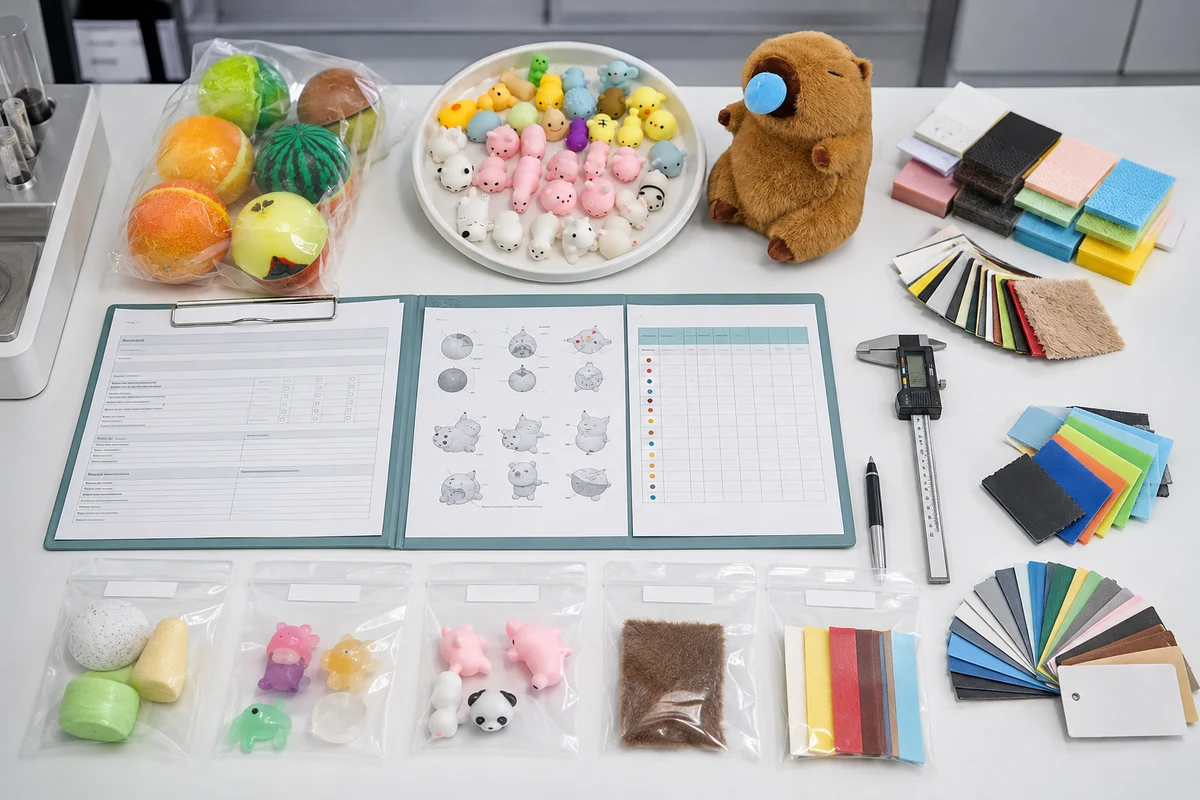
A product-specific compliance file begins with controlled samples, construction details, and a bill of materials.
Step 3: create a product and material map
A bill of materials should identify every accessible and relevant component: base polymer or textile, foam, filling, coating, ink, adhesive, thread, eye, accessory, label, film, closure, electronic part, and packaging where applicable. Give each material a supplier code, color, location, and revision. Photographs or an exploded diagram help the laboratory match components to the submitted sample.
Color matters because pigments and coatings can change the chemical profile. The laboratory may be able to use grouping or composite-testing strategies under permitted conditions, but the buyer should not invent those decisions. Ask the lab to document the rationale. A report that says “blue material” should be traceable to a material code and the blue production component.
When one catalog contains many soft-toy materials, create separate construction families. A PU foam toys manufacturer may control foam body, skin, coating, and print. Custom PU foam toys may also require molding and recovery controls. EVA products involve their own foam, laminate, print, adhesive, and edge risks.TPR or silicone items rely on elastomer formulations, pigments, oils or additives, molding, and decoration. Plush products add fabric, pile, filling, embroidery, seams, and small attachments.
Keep supplier declarations, safety data where relevant, specifications, purchase records, and change notices linked to the material codes. These documents do not replace finished-product testing, but they make investigation and change control far stronger.
Step 4: map hazards to product features
A test request should begin with how the toy can create exposure. Mechanical questions include detachable parts, seams, points, edges, projections, cords, entrapment, projectiles, expanding materials, and compression. Chemical questions include accessible substrates, coatings, inks, plasticized components, surface transfer, and foreseeable mouthing. Flammability, hygiene, electrical energy, magnets, sound, and batteries apply when the design introduces them.
| Product family | Examples of design questions | Evidence to prepare |
|---|---|---|
| PU foam ball or squishy | Size, detachable coating, small pieces after abuse, rebound, artwork, intended use | Foam and coating codes, dimensions, print ink, approved sample, abuse-test scope |
| TPR squeeze or mochi toy | Tearing, leakage or filling, tackiness, small size, deformation, surface transfer | Elastomer formula code, pigment, filling, seam or closure details, conditioning |
| Silicone sensory item | Parts, tear points, hardness, mouth contact, decoration, marketed function | Material identity, construction drawing, pigment codes,intended-use statement |
| EVA foam toy | Cut edges, layers, adhesives, detachable elements, projectiles or flying use | Foam grade, layer map, adhesive, dimensions, print, use instructions |
| Plush toy | Seam strength, filling access, small attachments, cords, pile, flammability | Fabric and filling codes, stitch construction, attachment method, trim list |
This hazard map helps prevent both under-testing and indiscriminate over-testing. Testing irrelevant clauses adds cost and can confuse the file. Missing a relevant clause creates risk. Ask the laboratory to state why each part is included or excluded, especially for hybrid products.
Step 5: choose the U.S. test and certification pathway
For a children’s toy, identify all applicable CPSC-enforced requirements, not only ASTM F963. The CPSC chart is a useful starting point, but the final scope depends on the product. Surface coatings, total lead content, phthalates, small parts, product-specific toy clauses, and other rules may require third-party testing by a CPSC-accepted laboratory. The laboratory’s accreditation scope should match the required tests.
Testing supports the Children’s Product Certificate; the report is not itself the CPC.The certificate identifies the product, each applicable rule, the certifying importer or domestic manufacturer, records custodian, manufacturing date and place, testing date and place, and laboratory information as required. Check that the product identifier and production details match the shipment. A certificate copied from another SKU is not a harmless administrative shortcut.
The test plan should specify whether samples come from pre-production or production, who selects them, how they are sealed, and how they relate to the bill of materials. CPSC rules also address periodic testing and material changes. Build a written procedure for deciding when a new supplier, formulation, pigment, coating, component, design, or manufacturing process requires review or retesting.
Tracking information is a production system
CPSC guidance says children’s products and their packaging should carry visible, legible, permanent identifying marks to the extent practicable. The information must make the manufacturer or importer, production location and date, batch or run, and other source information ascertainable. The importer of record is responsible for overseas products. The guidance recognizes practical limits for very small or difficult surfaces, but firms should document considered reasons when a product cannot be marked.
A tracking code works only if records can decode it. Link the code to purchase order, production line or process, material lots, date range, inspection, test evidence, artwork, and packaging revision. Test the system by selecting a finished unit and asking the team to reconstruct its production history.If the answer depends on one person’s memory, the system is not ready.
Step 6: choose the EU conformity pathway
EU work starts with the manufacturer’s safety assessment. It examines the toy’s chemical, physical, mechanical, electrical, flammability, hygiene, and radioactivity hazards, together with the likely exposure. The European Commission sets out two routes. A manufacturer can use internal production control when harmonised standards cover the relevant requirements and are correctly applied. The alternative is an EC-type examination by a notified body. Product design and the use of standards determine the appropriate route.
The technical documentation should explain how conformity was achieved. It commonly includes a detailed product description, design and manufacturing information, component and material data, safety assessment, standards applied, reports, risk controls, labels, warnings, instructions, Declaration of Conformity, and production-control evidence. Organize the file by SKU and revision. Do not store critical data only inside email threads.
The CE mark is the manufacturer’s declaration that the toy meets applicable EU requirements. It is not a quality award and should not be applied because a vendor supplies a graphic file. The Commission says only toys bearing CE marking can be placed on the EU market and requires traceability, responsible-party information, warnings, and instructions as applicable. Importers must verify that the manufacturer performed the conformity assessment and prepared technical documentation and must keep the required declaration records.
Use the right EN 71 editions
Harmonised-standard references can change through Official Journal decisions. A laboratory may know a newer technical edition, but legal presumption of conformity depends on the standards and transition dates officially referenced. Record the exact version and amendment used for each test. Before shipment, verify that the selected list is still valid for the placing-on-market date.
Do not assume that EN 71-1, -2, and -3 are always the entire scope. Different toy types may involve other parts or legislation. Chemical restrictions outside the Toy Safety Directive may matter. A battery toy, cosmetic play set, finger paint, activity toy, or product with radio equipment brings additional considerations. Build from the product’s hazards and functions.
Step 7: freeze the configuration before final testing
A representative sample should match the intended finished product in material, color, coating, printing, components, construction, size, age grade, and packaging where relevant. Create a test-sample release form. It should list the SKU, revision, bill of materials, artwork version, material codes, package version, quantity, selection date, and seal numbers. The buyer, supplier, and laboratory should refer to the same identifiers.
For a multi-color assortment, ask the laboratory how samples are grouped and why. For a multi-SKU family, document shared and unique components. If composite testing is used, record the method and how a failure would be investigated.Grouping should save cost without breaking the trail from a finished SKU back to its evidence.
Set aside two untouched references: one from the tested configuration and one from the production run. Photograph every side, the package, labels, and codes. Record critical dimensions and mass. Months later, if somebody hands the team a market sample, these references make the answer to “does our report cover this unit?” much easier to defend.
Step 8: control changes after testing
Real production never stays perfectly still. One month a pigment is unavailable; later the brand revises its logo. A fabric mill can change, a mold may need repair, or the team may shrink the box to save freight. Put every proposed change through the same recorded review. A competent reviewer should decide whether it has no relevant effect, needs supplier evidence, calls for a narrow verification, or requires a fresh test.
Use a change form with old and new material codes, reason, affected SKUs, first production date, hazard analysis, supporting documents, laboratory advice, approval, and required certificate or technical-file updates. Block purchasing and production from using unapproved substitutions. A test report remains trustworthy only if the business knows what changed afterward.
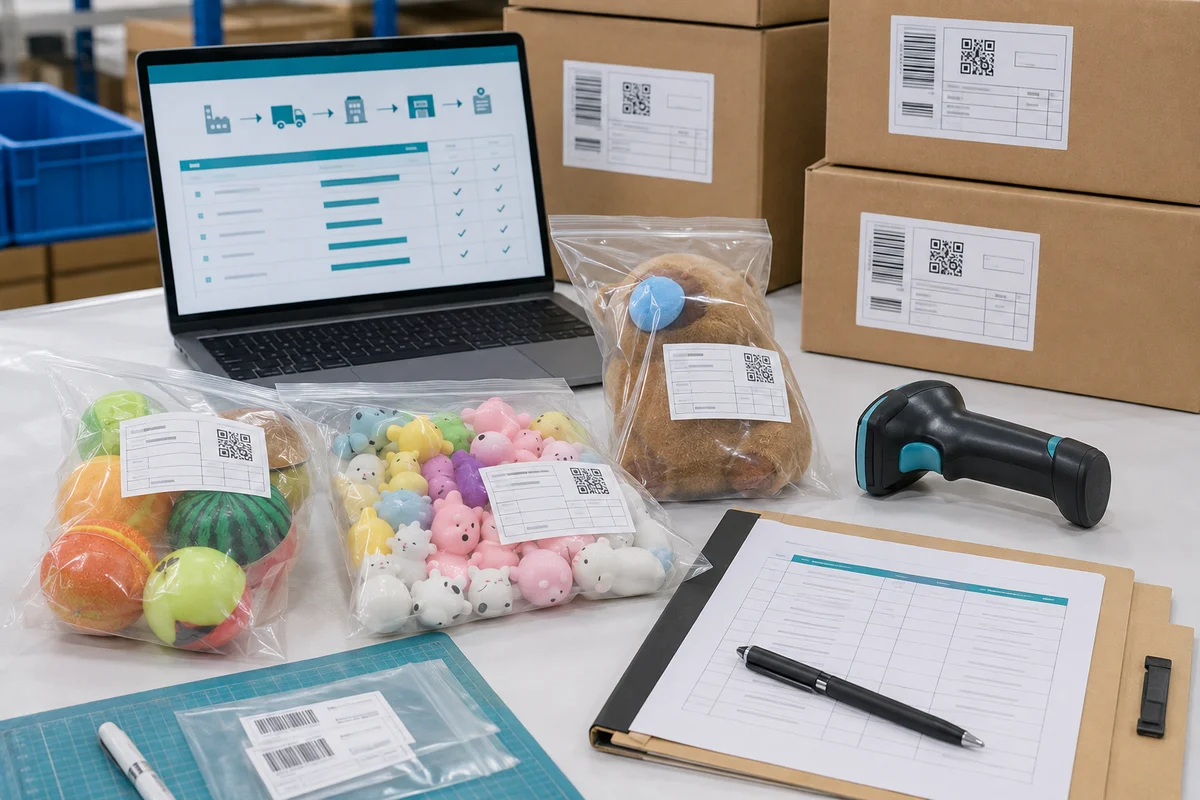
Traceability connects the finished unit, package, production batch, material records, inspection, and compliance evidence.
Step 9: release the shipment against a document matrix
A pre-shipment review should compare the goods and documents side by side. Check product identity, approved sample, bill of materials, test report, certificate or declaration, labels, warnings, instructions, batch code, importer information, barcodes, carton marks, inspection result, quantity, and shipment details. A “document received” checkbox is not enough. Verify revision, scope, product photographs, dates, manufacturing location, and responsible party.
| Release item | Match points | Common failure |
|---|---|---|
| Approved product sample | Shape, color, feel, artwork, components, package | Bulk production follows an earlier sample revision |
| Laboratory report | SKU, sample description, photos, standards, clauses, results | Report covers a similar but different product or color |
| CPC or Declaration of Conformity | Responsible party, product, rules, production and test details | Template fields are incomplete or copied from another order |
| Labels and warnings | Age, language, permanence, placement, readability,market | Artwork approval omitted a required market version |
| Traceability | Product and package codes decode to production records | Printed code exists but cannot be linked to material lots |
| Inspection | Sampling plan, critical dimensions, function, artwork, packing | Inspection checks appearance but not the controlled configuration |
How compliance affects cost, MOQ, and lead time
Compliance cost is not limited to a laboratory invoice. It includes engineering review, sample preparation, test quantities, courier, artwork control, documentation, labeling, change management, possible retesting, inspection, and schedule contingency. The cost is lower when the product family reuses controlled materials and components, but reuse must be proven and traceable.
MOQ can be affected by material minimums, custom colors, molds, printing, labels, and packaging. A test program may require more final samples than the buyer expects, especially when several colors or destructive tests are involved. Reserve these units in the order plan. Ask the supplier and laboratory for sample quantity before producing a tiny pilot.
Lead time should contain gates rather than one optimistic number: design review, reference sample, custom sample, artwork proof, packaging proof, configuration freeze, test sample preparation, laboratory testing, corrective action if needed, production, inspection, and freight. Some steps can overlap, but premature overlap creates rework. For example, printing retail packaging before warnings and importer information are approved can turn a small delay into a large write-off.
Request dates for each gate and identify who owns the decision. The longest delay is often not the factory operation. It may be missing artwork, ambiguous age grading, slow buyer approval, incomplete material data, or an unavailable laboratory slot.
A compliance-ready RFQ
A high-quality RFQ does not demand a generic certificate. It gives the supplier enough information to identify risks, propose a sample route, and quote the actual scope.
- Product: name, function, dimensions, photographs, drawing, reference sample, and desired user experience.
- Audience: intended age, user, channel, and marketing context.
- Markets: countries, retailer protocols, planned placing-on-market date, and language versions.
- Construction: materials, colors, components, coatings, inks, adhesives, filling, attachments, and electronics.
- Customization: mold changes, artwork, print positions, packaging, barcode, warnings, and instructions.
- Compliance responsibility: importer details, laboratory preference, test-sample selection, reports, certificates, declaration, and records.
- Commercial scope: sample quantity, launch quantity, repeat quantities, Incoterm, destination, and target delivery window.
- Quality control: approved sample, critical dimensions, function, visual defects, packaging, sampling plan, and traceability.
- Change control: prior approval for material, process, factory, artwork, or component substitutions.
Get the scope clear before you pay for testing
Share the market, age grade, construction, artwork, package, and order plan. We will help organize the manufacturing brief so your testing partner receives a controlled product configuration.
Send the Product BriefSupplier questions that reveal capability
Ask for evidence and process, not adjectives. “Are you compliant?” encourages a yes-or-no sales answer. “Show how you link an approved material code to a production batch and finished test sample” reveals the operating system.“What changes require buyer approval?” reveals whether substitution control exists. “How is artwork revision A03 prevented from being mixed with A02?” tests document control.
Ask who owns the mold, bill of materials, test reports, and certificates. Confirm whether the named production site in the report is the intended site. Ask how critical suppliers are qualified and how incoming materials are identified. Request an example of a redacted batch record or inspection checklist when appropriate. Protect confidential data, but obtain enough evidence to understand the process.
For high-risk or high-volume programs, consider an audit focused on the actual processes: purchasing control, material identification, equipment, calibration, work instructions, inspection, nonconforming product, traceability, and corrective action. A clean showroom is not a substitute for process evidence.
Material-specific sourcing notes
PU foam and foam sports products
PU foam programs may involve cellular structure, molded skin, coating, paint, print ink, recovery behavior, and pieces created after mechanical abuse. For custom foam sports toys and foam balls wholesale, state whether the item is a toy, promotional premium, or general-use product and describe foreseeable throwing or squeezing. A custom stress balls with logo program must assess the finished decorated item; promotional stress balls wholesale artwork can affect both materials and audience classification.
EVA foam
For EVA foam toys wholesale and custom EVA foam toys, map each foam layer, print, coating, and adhesive. Evaluate cut or molded edges, detachable parts, projectile use, bonding, and age-appropriate dimensions. Do not assume one EVA declaration covers all densities, colors, suppliers, and laminations.
TPR and mochi squeeze toys
A TPR squeeze toy manufacturer should receive requirements for formulation identity, pigments, filling if any, seam or closure design, tear resistance, surface behavior, and packaging contact. Buyers sourcing mochi squishy toys wholesale should address small size, stretch, foreseeable mouthing, tackiness, surface transfer, and contamination control as applicable to the product.
Slow-rising PU squishies
Slow rising squishy toys wholesale programs need controlled foam, coating, ink, cure, recovery, and package conditioning. Ask the squishy toy manufacturer to identify the approved sample code and material revisions.If a scent is proposed, treat it as a deliberate additional component requiring assessment rather than an informal production preference.
Silicone products
A silicone squishy toy manufacturer should not market a toy as “food grade” merely because silicone is used. The applicable requirements follow intended use, market, age, construction, and claims. For custom silicone sensory toys, control material identity, color, hardness, part geometry, tear points, decoration, and any intended mouth contact.
Plush
A custom plush toy manufacturer manages a textile bill of materials, including outer fabric, pile, backing, thread, embroidery, filling, labels, trims, eyes, and accessories. Plush toys OEM projects need seam and attachment specifications, filling access controls, needle or sharp-object controls, component traceability, and packaging that protects pile appearance.
Mixed sensory assortments
For sensory toys wholesale, avoid testing one representative item as if it covers every material family. A sensory toy manufacturer should help separate common and unique components across the assortment.Each SKU still needs a defensible classification, age grade, hazard assessment, and evidence path.
A practical hypothetical case
Imagine a retailer sourcing a three-piece calming-toy set for the United States and the EU: one coated PU foam ball, one TPR squeeze figure, and one small plush animal. The first supplier reply offers an “EN 71 and ASTM certificate” from the previous year. The buyer could accept the file at face value, but the report photographs show only an undecorated foam shape. It does not identify the TPR figure, plush components, current colors, retailer artwork, or production site.
The buyer pauses quotation comparison and builds a product matrix. Each item receives a SKU, intended age, material map, artwork version, package position, and market. The laboratory reviews the three constructions and proposes a scope. Shared print ink is recorded, but the foam coating, TPR formula, fabric, filling, embroidery, and attachments remain separately traceable. The buyer simplifies one plush accessory that could detach under foreseeable use and enlarges the TPR figure after age-grade review.
Custom samples are approved, and the retail package is revised to provide market-specific economic-operator details, warnings, instructions, and tracking fields. Final test samples are sealed from the controlled configuration. The U.S. importer prepares the CPC from the applicable evidence. The EU manufacturer prepares the safety assessment, technical documentation, Declaration of Conformity, and CE-marking basis. Pre-shipment inspection checks the batch codes and revisions against the file.
The result is not merely “more testing.” It is a smaller set of better-controlled decisions. The team avoids testing obsolete samples, printing unusable packaging, and relying on a report that never covered the assortment.
Questions to put in the purchase order
- No material, component, pigment, coating, ink, adhesive, filling, factory, mold, construction, or packaging substitution without written approval.
- Production must match the identified approved sample and current artwork revision.
- The supplier must preserve lot and batch traceability for agreed components and finished goods.
- Required test samples, retained samples, and production samples must be selected and identified using the agreed method.
- Labels, warnings, codes, instructions, and economic-operator information must match the approved market artwork.
- Nonconformities must be reported before shipment, with containment and corrective action agreed in writing.
- Reports and supporting documents must identify the product and manufacturing information accurately.
Contract terms should be reviewed by the buyer’s legal and compliance teams. The list above is operational guidance, not a complete legal clause.
Frequently asked questions
Is ASTM F963 the same as CPSIA?
No. ASTM F963 is a toy safety standard incorporated into the U.S. mandatory toy safety rule.CPSIA is legislation covering multiple children’s-product requirements, including testing, certification, lead, phthalates, tracking information, and toy safety. A U.S. toy compliance plan may involve ASTM F963 sections and other CPSIA-related requirements.
Does an EN 71 report allow a toy to use CE marking?
An EN 71 report can be part of the evidence, but CE marking requires the manufacturer to complete the applicable EU conformity process. That includes a safety assessment, relevant standards and tests, technical documentation, Declaration of Conformity, production control, traceability, and other applicable requirements. One report does not automatically complete the file.
What ASTM edition belongs on a current U.S. test request?
Use F963-23 for toys made after April 20, 2024; that is the edition named in CPSC’s current guidance. At order release, check the agency page again and have the laboratory list the clauses it selected for the design.
What dates matter for the new EU Toy Safety Regulation?
The Commission gives two dates for Regulation (EU) 2025/2509: it entered into force on January 1, 2026, and begins to apply on August 1, 2030. A toy placed on the market during the transition follows the rules that apply on that date. Use the intervening years to follow implementation work and organize the data that the digital product passport will need.
Can an old test report be used for a new color?
Do not assume so.The answer depends on the material, pigment, coating, applicable requirement, report scope, and change assessment. Give the laboratory the old and new material codes and ask for a documented decision. Keep that decision with the product file.
Who issues the Children’s Product Certificate?
For an imported children’s product, the U.S. importer generally issues the certificate using passing evidence from a CPSC-accepted laboratory for the applicable requirements. A factory can supply records and test support. The importer, however, should prepare and retain the CPC rather than assume the overseas vendor owns that duty.
Must a laboratory test every ASTM F963 section for every toy?
No. Some sections are broad; others belong only to particular toy types, and third-party testing treatment differs. CPSC’s chart makes those distinctions visible. Give a competent laboratory the finished design and let it build the relevant scope. Ordering every clause wastes money, while choosing only the cheapest clauses can miss the actual hazard.
What is the minimum information needed for a compliance quote?
Provide clear product photos or drawings, dimensions, intended age and use, countries, all materials and colors, components, construction, artwork, package, warnings, batteries or special functions, and expected placing-on-market date. State whether the quote should include lab testing, inspection, and documentation support.
Can one report cover a family of toys?
Sometimes products can share evidence when the construction and materials are genuinely common and the laboratory supports the grouping. Unique components, colors, sizes, functions, or hazards may need additional samples or tests. Document the family rationale and map every SKU to the evidence. Do not use visual similarity as the only basis.
How often should a compliance file be reviewed?
Review it before launch, before each meaningful change, when standards or laws change, when production moves, when a supplier or material changes, after a failure or complaint, and at defined periodic intervals. Align the review with applicable legal testing and record-retention duties and retailer protocols.
Official references
The following agency pages were checked for this guide. Buyers should revisit them when the product and shipment dates are known.
- U.S. Consumer Product Safety Commission: ASTM F963 Requirements
- U.S. Consumer Product Safety Commission: Consumer Product Safety Improvement Act overview
- U.S. Consumer Product Safety Commission: Tracking Label guidance
- U.S.Consumer Product Safety Commission: Promotional Products guidance
- European Commission: Toy safety and the transition to Regulation (EU) 2025/2509
- European Commission: Placing toys on the EU market
- European Commission: Harmonised standards for toy safety
Prepare a manufacturing brief before the laboratory quote
Hines’ public catalog spans PU foam, EVA foam, soft TPR, silicone, plastics, plush, balls, stress-relief items, promotional gifts, and sports products. For custom toy manufacturing, start a fresh project file. Put the material list, process, sample route, test scope, documents, MOQ, and timetable there. Those details belong in the quotation, not in a blanket website promise.
A productive first inquiry includes the intended user, market, product drawing or reference, bill of materials if available, colors, artwork, package, order quantities, and target dates. That information makes it possible to identify unanswered manufacturing questions before the buyer commits to tooling, packaging, or testing.
Build a traceable toy program from the first RFQ
Share the product, age grade, markets, materials, artwork, package, quantities, and launch date. We will review the sourcing brief and help organize the information needed for sampling and a project-specific quotation.
Submit an RFQ and Request the Sourcing Checklist