Updated: September 1, 2026 · 19-minute buyer’s guide
Custom Plush Toys Cost: Sample Fees, MOQ, Fabric, Filling, and Packaging
A useful custom plush toy quotation is not a price attached to a picture. It is the commercial result of a pattern, finished size, fabric and pile direction, filling level, embroidery and appliqué, accessories, sewing operations, sample revisions, order quantity, quality plan, packaging, testing, and shipping terms. Change one of those elements and the cost can move even when the character still looks “the same” on screen.
This guide is for brands, licensors, museum shops, promotional distributors, retailers, hospitality buyers, educational suppliers, and importers comparing a custom plush toy manufacturer or planning plush toys OEM. It explains how to build an RFQ that produces comparable offers, how to judge sample fees and MOQ, where avoidable cost hides, and which cost reductions are least likely to damage the character or increase quality risk.
Short answer for buyers
Look first at the pattern. Its pieces, finished dimensions and weight determine much of what follows: fabric yield, filling, decoration, sewing time and hand finishing. Packaging, volume, inspection and compliance complete the cost picture. Sample charges reflect the actual development job—pattern work, small material purchases, artwork setup, hand sewing and revisions. The MOQ may come from dyed fabric, embroidery, labels, boxes or setup even when the sewing room could make fewer pieces.
Why buyers receive very different plush quotations
An illustration does not tell the workshop where a seam should run. It says nothing about grain, stuffing pressure or the point at which the finished character will balance. The pattern maker has to invent a repeatable three-dimensional object from that flat art. A head might take six panels, or eight if the cheeks and forehead need more control. Facial features could be sewn directly into a main panel or built with appliqué. Both interpretations may work, but their labor, look and weak points are not identical.
Price comparisons also become distorted when suppliers make different assumptions about fabric. “Soft plush” might mean short velboa, minky, a long-pile faux fur, stretch plush, fleece, or another textile. Pile length changes visual volume, seam appearance, embroidery behavior, cutting yield, and trimming time. Color can come from available stock, a special order, printing, or dyeing. Filling may be loose and light for a floppy item or tightly controlled for a sculpted mascot. A box that protects a delicate feature costs and ships differently from a simple bag.
Ask every supplier to quote the same revision and list assumptions. If a detail remains open, request priced alternatives. A structured comparison often shows that the lowest number excluded the custom label, embroidery, insert, test cost, individual packaging, or delivery term that the buyer expected.
A buyer-friendly custom plush cost structure
Separate the project into fixed development cost, variable manufacturing cost, and landed-cost items. The following table can be used in an internal sourcing sheet.
| Cost area | Typical drivers | Evidence to request |
|---|---|---|
| Pattern and development | Character complexity, 3D interpretation, pattern pieces, prototypes, revisions | Revision plan, sample scope, ownership and approval rules |
| Fabric and trims | Fabric family, pile, stretch, color, usable width, yield, minimum purchase | Swatches, supplier reference, color approval and substitutions policy |
| Decoration | Embroidery area and stitches, appliqué layers, printing, patches, labels | Embroidery proof, artwork limits, adhesion and color references |
| Cut, sew and finish | Number of panels, curves, small parts, turning, stuffing, hand closure, grooming | Construction drawing, seam and attachment requirements |
| Filling | Material, grams per unit, firmness, multiple fill zones, pellets or inserts | Approved weight range and hand-feel sample |
| Packaging | Bag, belly band, tag, box, display, protection, vacuum compression | Dieline, pack-out sample, carton dimensions and recovery check |
| Compliance and logistics | Age grade, market, tests, inspection, freight volume, duty and delivery | Test plan, inspection criteria, Incoterm, port and quote validity |
For planning, use: landed cost per sellable unit = manufacturing price + allocated development + packaging + testing and inspection allocation + freight and import charges + expected loss from defects, damage, or unusable packaging. Buyers often leave that risk allowance at zero. Then a bargain ex-factory price becomes costly when faces wander, seams open, accessories detach, cartons crush or compressed toys refuse to recover.
Pattern complexity drives labor and character accuracy
A simple round animal with printed eyes may use relatively few panels. A standing mascot with shaped cheeks, muzzle, paws, tail, clothing, hair, layered ears, and embroidered features can require many more. Each additional panel creates cutting, matching, sewing, turning, alignment, and inspection work. Tiny parts can be slower than large ones because they are harder to sew and turn consistently. Long curves and narrow limbs may need controlled seam allowance to avoid twisting.
The goal is not to minimize panel count at any cost. Removing a seam can flatten a muzzle or change the silhouette. A slightly more complex pattern may reduce stuffing distortion and produce a stable character. During the pattern review, point to every visible seam. Why is it there? Where does the pile turn, and what reference keeps the left side from drifting away from the right?
One front view leaves too much to imagination. Add the back, side and a three-quarter angle when possible. Circle the details that make the character recognizable and label the ones open to simplification. Also describe the pose: sitting without help, standing with support, lying flat or hanging from a loop. When a sculpt is the source, measure repeatable landmarks rather than supplying only the overall height.
Intellectual property belongs in the brief
Do not send a supplier another brand’s mascot to copy unless the rights are in place. The brief should say whether the artwork is owned or licensed and which confidentiality rules apply. Settle who keeps the drawings, paper patterns, embroidery files, tools and samples. “Exclusive” is too loose on its own; name the product, territory, customer group and time period.
What a plush sample fee should cover
Sample work may include artwork review, pattern development, sourcing small quantities of fabric and trims, embroidery digitizing, cutting, sewing, stuffing, hand finishing, internal review, buyer feedback, and revision. A sample fee can therefore be higher than the later unit cost. Think of the sample room as a workshop solving a puzzle once. The production line earns its efficiency only after that puzzle has a signed answer.
Before paying, get the boundaries in writing. Does the fee buy one prototype, or one prototype plus named revisions? Are special fabric, embroidery setup and packaging proof included? Is courier cost extra, and can any amount be credited to a qualifying order? The answer should also cover a very common event: the buyer sees the first sample and changes the character. That redesign is not the same as correcting work that missed the approved art.
Do not approve a sample only because it is cute. Check the dimensioned specification, silhouette, symmetry, face position, expression, pile direction, color, filling weight, firmness, seam quality, embroidery, small parts, label placement, sitting balance, package fit, and any functional accessories. Photograph the approved sample from consistent angles and identify it by revision.
Fabric: price, yield, appearance, and availability
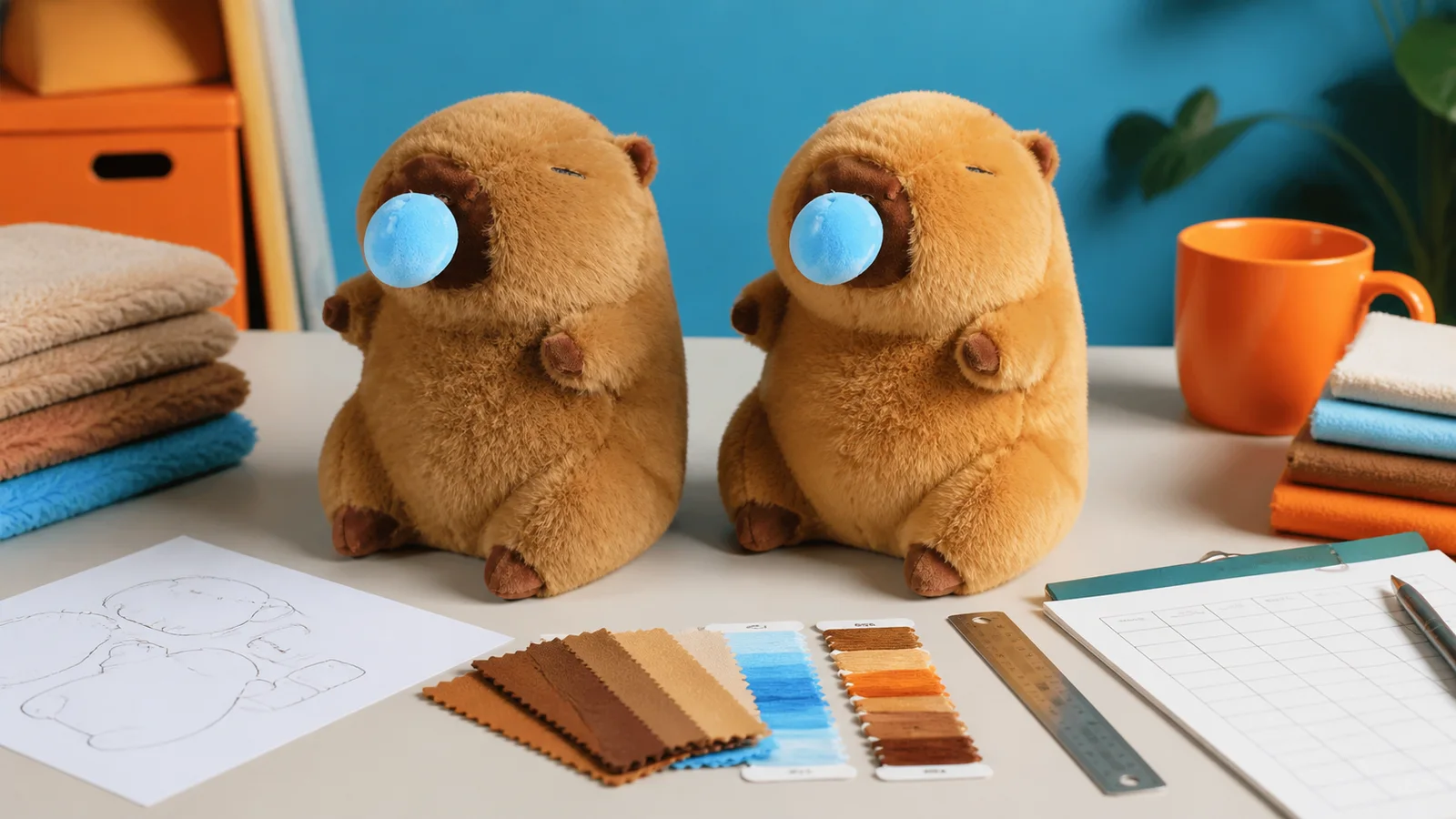
Fabric cost is affected by fiber content, construction, pile height, density, stretch, backing, usable width, color, finish, purchase quantity, and supplier availability. The purchase price per meter is only part of the calculation. Pattern layout determines yield. Directional pile must usually run consistently, which can prevent pieces from being rotated to fill empty space. Large heads or long limbs can create offcuts. Striped, checked, printed, or one-way designs may require pattern matching.
Stock colors reduce development time but may not match a brand palette. Custom dyeing or printing can create a closer match, but it adds minimums, lead time, lab dips or strike-offs, and batch-variation control. A buyer planning repeat orders should ask how the fabric reference will be recorded and whether the same supply can be reserved. If substitution is allowed, the permitted differences in shade, pile, weight, stretch, and hand feel must be defined.
Long pile can hide seams and create a luxurious look, yet it can obscure embroidery, require trimming around the face, complicate small pieces, and change the perceived shape. Stretch fabric can form smooth rounded surfaces but may distort embroidery or finished dimensions if cutting and sewing tension vary. Short pile can support crisp detail, while its seams may be more visible. Choose fabric with the character, process, and retail use in mind.
Filling: grams, distribution, and recovery
“PP cotton” is often used as a broad commercial term, but buyers need a clearer approved material reference, weight, feel, and distribution. Filling quantity changes softness, shape, shipping volume, and unit cost. A lightly filled toy can be floppy and compressible; a firmly filled mascot holds a defined silhouette. Overfilling can strain seams and distort embroidered features. Underfilling can create wrinkles, unstable posture, or an uneven face.
Specify a finished weight tolerance together with a golden sample. For a multi-zone design, map the firm and soft areas; the muzzle does not always need the same fill as the body or tail. Pellets, foam inserts, plastic forms, squeakers, magnets, sound units and weighted pieces turn a simple stuffed shell into a more complicated product. They affect construction, cost, labels and the safety review, and each insert needs its own material and attachment control.
If the item will be compressed for transport, test recovery after the intended compression duration and an agreed conditioning time. Some pile and shapes recover easily; others crease, flatten, or need manual grooming. There is little freight saving left after a warehouse team has to massage every toy back into shape—or after a retailer refuses the flattened ones.
Embroidery, appliqué, printing, and accessories
Embroidery integrates the artwork with the toy and gives good color control. Its price follows the work: area, density, thread changes, thread type, awkward placement, backing and cleanup. A small, heavily filled eye can become surprisingly stiff. Broad stitched areas may pucker a stretch fabric, while fine lines disappear into deep pile. First approve a sew-out on the real cloth. Then check it again after that cloth has been cut, sewn and stuffed.
Appliqué is useful for a large block of color or a contrasting texture, though every layer has to be cut, positioned and finished at the edge. Printing handles some detail that thread cannot, but its color, wear, feel and possible migration need evaluation on the selected cloth. Plastic eyes, noses, buttons, zippers, hooks, cords, rings, batteries and electronics add sourcing and attachment checks. On a child’s product, detachable pieces and accessible features need a design-specific review.
Brand labels, care labels, law labels where applicable, hangtags, woven tabs, and packaging copy should be part of the same approval package. The importer is responsible for confirming the labeling required for its product and market. Do not let label art begin only after the goods are sewn; label dimensions and seam placement can affect the pattern.
MOQ: find the actual constraint
Plush MOQ can come from fabric mills, custom color, print setup, embroidery digitizing and machine time, woven labels, hangtags, boxes, accessories, cutting efficiency, or production-line setup. The final sewing operation is only one piece of the system. A project with standard fabric and a printed paper tag may support a smaller pilot more easily than one requiring custom-dyed long pile, molded accessories, and a full-color retail box.
Ask for the MOQ by design and by color, then ask whether the annual forecast can be split into releases. Reserving material or using a blanket order sometimes helps, but it opens a new set of questions: who owns the stock, pays for it, stores it, accepts shade-lot variation and carries the obsolete balance? Put those answers in the agreement. Custom fabric cannot sit on a supplier’s shelf forever as free, riskless inventory.
If launch quantity is below the economic minimum, consider a stock fabric, fewer colorways, simplified packaging, an embroidered or tagged stock body, or a paid development pilot. The purpose of a pilot is to validate demand and production, not to obtain mass-production economics at sample-room volume.
Turn artwork into a quotation suppliers can compare
Send artwork views, finished size, intended age and market, fabric direction, filling feel, decoration, labels, packaging, quantity by design, inspection needs, destination and delivery window. Hines can identify the choices that still affect feasibility and cost.
Packaging and freight: plush is mostly air until it is not
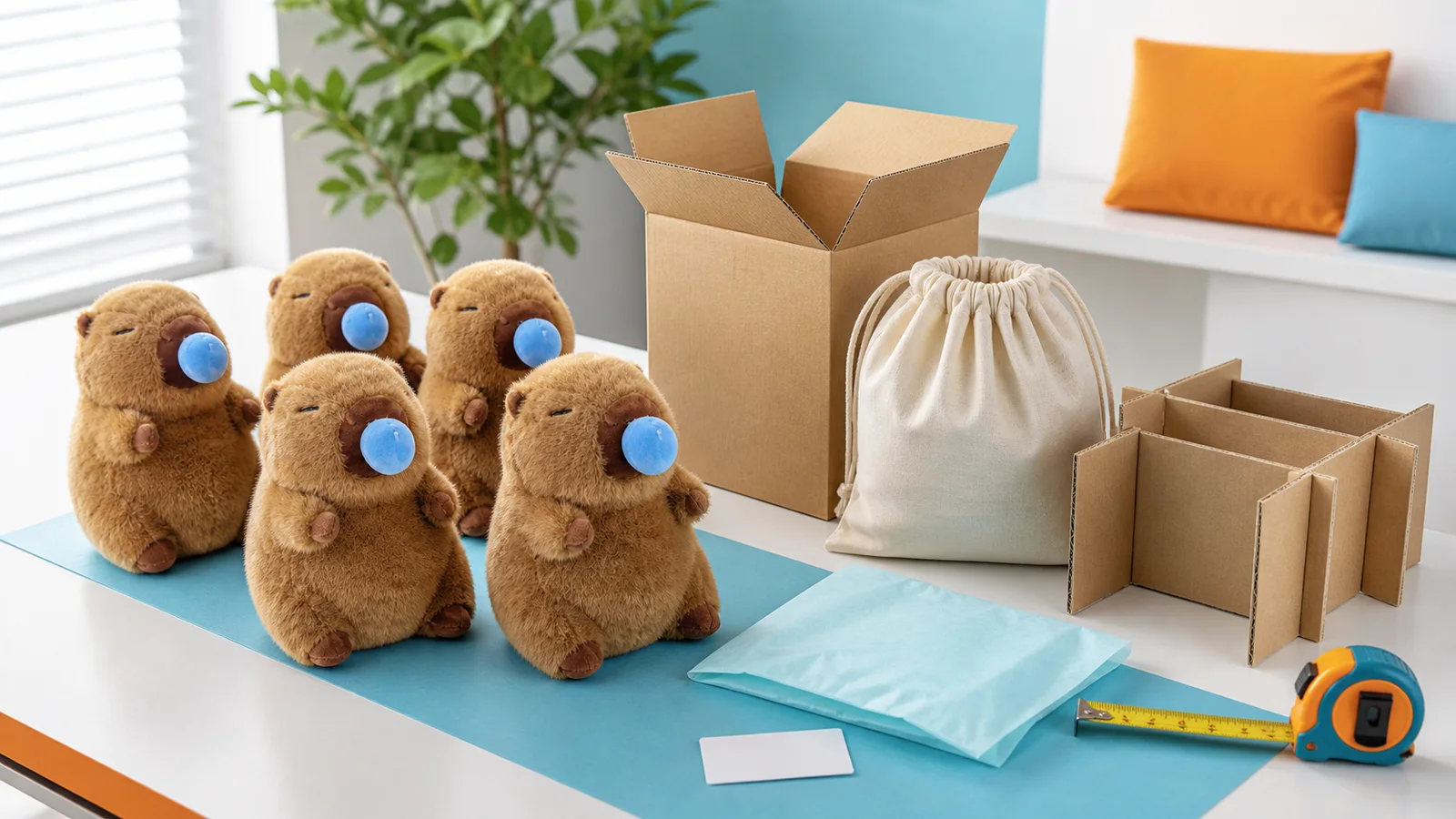
A plush toy is lightweight relative to its volume, so freight may be charged by dimensional weight or container space long before actual weight becomes the limit. Package design should protect presentation while using space intelligently. The shortlist might include a bulk or individual bag, belly band, hangtag, drawstring pouch, open display, closed box, window box or carton divider. Choose by channel. Dust protection, shelf display, barcode location, gift appeal and local packaging rules will quickly narrow the list.
Vacuum or compression packing can reduce volume, but test fabric recovery, filling distribution, embroidery, rigid accessories, sound units, and the character’s silhouette. Define how long the package may remain compressed and how the buyer will restore the item. A process suitable for a floppy pillow may not suit a sculpted licensed mascot.
Request a final pack-out sample, carton dimensions, gross and net weights, units per carton, carton material, marks, pallet assumptions if needed, and photographs of the closure and protection. Calculate cost under the intended Incoterm and destination. A cheaper unit in an oversized display box can produce a higher delivered cost than a slightly more expensive product in an efficient package.
A disciplined sampling and approval sequence
- Artwork review: confirm rights, views, dimensions, posture, essential features, target age, channel, market, and budget.
- Material board: approve fabric options, pile direction, color references, thread, labels, trims, filling, and accessories.
- First pattern sample: evaluate silhouette, proportion, balance, construction, and major facial placement before polishing every detail.
- Revision sample: close documented gaps; identify which changes came from the buyer and which correct supplier deviations.
- Decoration and package proof: approve embroidery, printing, tags, labels, dielines, warnings, barcode area, and carton marks.
- Pre-production sample: verify the final combination made with intended materials, processes, filling level, and packaging.
- Production start authorization: link the signed sample to the drawing, bill of materials, quality plan, artwork files, and purchase order.
Keep change control simple. Every comment should identify the sample version, location, requested change, dimension or visual reference, owner, due date, and approval result. Annotated photographs are better than messages such as “make it cuter.” If the expression is wrong, identify whether the cause is eye angle, spacing, muzzle height, head width, stuffing, pile trimming, or embroidery scale.
Quality control for repeatable plush production
A golden sample is important, but it is not a complete quality specification. Plush needs measurable and visual controls for finished dimensions, weight, fabric and pile direction, color, panel alignment, seam allowance, stitch security, filling distribution, symmetry, embroidery placement, print appearance, accessories, labels, cleanliness, metal detection where required by the buyer, package condition, assortment, and carton count. Define critical, major, and minor defects before inspection.
Incoming checks should verify fabric, trims, thread, labels, filling, and accessories against approved references. First-piece review should confirm cutting direction, embroidery placement, pattern assembly, dimensions, and weight before volume production. In-process review can catch twisted limbs, uneven faces, open seams, trapped pile, missed backstitching, or wrong labels while correction is still possible. Final inspection then samples finished goods and packaging using the agreed plan.
Attachment strength and seam tests must reflect the construction and intended user. A single universal pull force should not be copied into an RFQ without product-specific review. The responsible compliance team and laboratory should identify applicable performance tests and conditioning. The supplier should record failures, isolate affected lots, correct the cause, and provide re-inspection evidence.
US and EU toy-safety planning
Product classification and age grading come before test selection. The U.S. Consumer Product Safety Commission states that ASTM F963 is mandatory for children’s toys through 16 CFR part 1250 and explains that firms must identify the sections applicable to the specific product. Its guidance covers material quality, flammability-related obligations, toxicology, small objects, accessible edges and points, cords, fasteners, and other provisions that may matter depending on the plush design. Review the CPSC Toy Safety Business Guidance and obtain product-specific advice.
The Commission’s EU toy-safety page describes the safety duties and CE marking linked to market access. It also gives the transition dates for Regulation (EU) 2025/2509: entry into force on January 1, 2026 and application from August 1, 2030. A plush program meant to stay on sale for years should address documents, materials, labels and future digital-product-passport needs with qualified specialists well before the last reorder. See Toy Safety in the EU.
Neither page is a substitute for the legislation, applicable standards, risk assessment, testing by a qualified laboratory, retailer protocols, or the importer’s legal responsibilities. Reports should match the actual SKU, materials, colors, accessories, age grade, destination, and production sample. A fabric certificate alone cannot demonstrate the safety of the sewn, filled, decorated, packaged product.
How to compare custom plush suppliers
A professional quotation should make uncertainty visible. If the artwork lacks a side view, the supplier should say how it interpreted the shape. If the requested pile obscures embroidery, it should offer an alternative or trimming method. If the box MOQ exceeds the plush quantity, the offer should explain the surplus or substitute. If compliance depends on age grade and market, those fields should not be left blank.
- Does the supplier ask about the buyer, channel, intended age, market, launch timing, and IP rights?
- Can it show a controlled sequence from artwork, pattern and sample to signed production specification?
- Are fabric, pile, color, filling, trims, labels, embroidery, packaging, and substitutions documented?
- Does it explain MOQ by component instead of presenting one unexplained number?
- Are sample fee, revision scope, production price, packaging, testing, inspection, and freight separated?
- Does the quality plan cover incoming material, first piece, in-process sewing and final pack-out?
- Are compliance claims limited to verified products, reports, markets, and dates?
- Are communication, change control, delivery milestones, claims handling, and traceability clear?
Hines gives 2011 as its establishment year on the company website. The same page describes work across PU foam, EVA, TPR, silicone, stress-relief goods, gifts and plush-related products. That is useful background, not project proof. For the actual plush order, ask for evidence behind the proposed material, process, test scope, available capacity, MOQ and schedule.
Related Hines sourcing paths
Some buyers plan a collection that mixes plush with tactile, foam, promotional, and outdoor items. The links below connect Hines product families using the requested B2B search terms. Each category needs a separate specification and verified commercial offer.
Copy-and-send plush RFQ checklist
- Buyer company, country, website, sales channel, and project contact
- Artwork ownership or license confirmation and confidentiality needs
- Front, back, side and three-quarter artwork; vector files where available
- Finished sitting, standing or total dimensions and target weight
- Intended age, use, target market, retailer protocol and launch date
- Fabric family, pile length, stretch, color references and acceptable alternatives
- Filling material, firmness, grams per unit, weighted or sound components
- Embroidery, appliqué, print, patches, clothing, accessories and attachment needs
- Brand labels, care or law labels, hangtags, warnings, barcodes and lot codes
- Individual packaging, display requirement, carton limits and compression policy
- Quantity by design and color, pilot quantity, annual forecast and release schedule
- Sample scope, revision allowance, required reports and inspection plan
- Incoterm, port or delivery address, shipping mode and required delivery window
- Payment milestones, quote validity, change control, patterns and file ownership
A cost-down review that protects the character
When the first quotation is above budget, do not ask for an unexplained percentage reduction. Put the material list and operation sequence on the table with the supplier. Sort features into three buckets. Some define recognition or safety; some add value but can move; others are practically invisible to the customer. Eyes, silhouette and a signature color may belong in the first bucket. A hidden panel, second hangtag or very dense embroidery may not. The discussion then becomes design work rather than a tug-of-war over margin.
Request a small option table. Option A should preserve the approved sample. Option B might use an available fabric color, reduce an embroidery fill area, combine two labels, and replace a full box with a belly band. Option C might change size or construction more substantially. For each option, require the supplier to show the unit-price effect, any development charge, MOQ change, appearance change, compliance implication, freight effect, and new sample requirement. An option is not a saving if it triggers an expensive resample or raises damage rates.
Size reduction deserves special care. Reducing height does not scale every cost equally. Very small limbs become harder to turn, embroidery has less room, seam allowance occupies a larger share of the panel, and the face may need to be redesigned. A modest reduction in overall dimensions may save fabric and freight; an aggressive reduction can increase sewing difficulty or remove the features that make the character recognizable. Ask for a dimensioned proposal and a new physical sample.
Packaging optimization is often productive because plush freight is volume-sensitive. Compare a box, belly band, pouch and bag using the same retail and protection requirements. Measure carton utilization, recovery after transit, barcode visibility, shelf presentation, and packing labor. If the program sells online, confirm whether the retail pack will also survive parcel shipping or needs an outer mailer. If it sells through a gift shop, display efficiency may matter more than the smallest possible pack.
Finally, use forecast visibility. A buyer may not be ready to place the annual volume at once, but sharing a credible launch quantity and reorder range helps the supplier plan fabric, labels and production capacity. Any blanket-order, material-reservation, or phased-release proposal should state deposit, storage, shelf-life, shade-lot, cancellation, ownership and final-release dates. Undefined inventory risk does not disappear; it merely lands on whichever party has less leverage later.
Frequently asked questions
How much does a custom plush sample cost?
Pattern difficulty is only the beginning. Small material purchases, embroidery or print setup, accessories, package proofs, hand sewing and revisions all take time. Ask for the fee’s written scope. Tweaking a stock pattern is a different job from building an original mascot out of artwork, so their sample charges are not useful comparisons.
Why is the sample more expensive than one production unit?
The sample room performs one-off pattern work, sources small material quantities, sets up decoration, sews and finishes by hand, documents feedback, and may rebuild the item. Mass production spreads that solved development work across many repeated pieces.
What MOQ should a buyer expect?
There is no universal plush MOQ. It can be driven by fabric, color, embroidery, labels, accessories, packaging, cutting, line setup, and the quantity per design. Share the full specification and quantity split, then ask which component sets the minimum and what lower-volume alternatives exist.
Can a supplier quote accurately from one front-view image?
Only a provisional range. The side and back shape, finished dimensions, construction, fabric, filling, decoration, packaging, quantity, compliance scope, and delivery terms remain unknown. A responsible supplier will list assumptions and refine the offer after pattern and material review.
How can a buyer protect facial consistency?
Define eye, nose, mouth, muzzle and ear positions from repeatable seam or center references; approve embroidery and pattern files; retain a signed golden sample; establish placement tolerances; verify first pieces; and inspect symmetry during production. Stuffing level and pile trimming must also be controlled because they change the expression.
Is vacuum packing always a good cost-saving choice?
No. Compression may cut volume and still leave an expensive mess: flattened pile, migrated filling, creased features, damaged rigid inserts or hours of recovery work. Put the exact product through the proposed pressure and duration, then judge it after the real unpacking and recovery process.
Can one toy test report cover all plush colorways?
Do not assume so. Review whether materials, dyes, prints, threads, accessories, fillings, labels, age grade, construction and destination are covered. Product-level mechanical and physical testing applies to the finished design. The importer and qualified laboratory should approve the sampling and grouping logic.
What cost reductions are usually safer?
Use available fabric colors, reduce unnecessary appliqué layers, simplify hidden pattern detail, standardize shared trims, optimize embroidery without losing the expression, combine labels, improve carton efficiency, and order at genuine material or production breaks. Do not remove secure attachments, essential seams, required labels, approved filling, inspection, or testing.
What should be signed before production?
The drawing and pattern revision, bill of materials, fabric and color, embroidery or print, filling weight and feel, golden sample, labels, package dieline and pack-out, quality criteria, inspection and test plan, quantity and assortment, delivery term, approved deviations, and ownership or confidentiality terms.
Cost control starts with a faithful product definition
The cheapest-looking plush quotation is often the one with the most unanswered questions. A well-defined product lets suppliers engineer the character, explain alternatives, plan materials, and price the same scope. It also gives inspectors something objective to verify. That is how a buyer protects both the expression that makes the toy sell and the commercial details that make the order repeatable.
Ready to develop a custom plush toy?
Send your artwork, target size, fabric direction, filling feel, decoration, packaging, quantity, market and delivery window. Hines can review the concept and prepare a project-specific response without inventing unsupported MOQ, price or compliance promises.