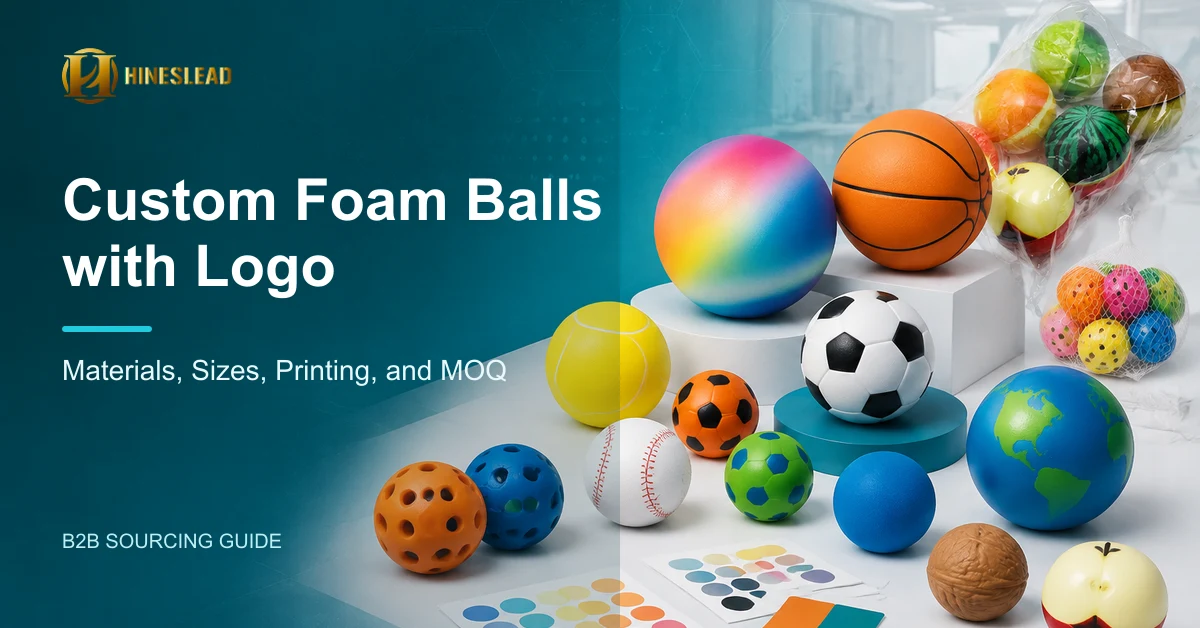
Short answer: begin with the job the ball has to do. The logo comes later. Is this an adult conference giveaway that people squeeze at a desk? Is it a soft indoor play ball, a pocket-size sports replica, a throw-and-catch toy, or a child-directed premium? Once that is clear, decisions about foam, density, diameter, surface, artwork, testing, packing, and order size become much less subjective. Ask suppliers to price the same written specification instead of requesting “one foam ball with our logo.” Comparable offers are easier to judge, and a cheap quote is less likely to end in a remake.
This guide is written for promotional-products distributors, toy importers, sports-event buyers, retailers, schools, and private-label teams sourcing custom foam sports toys. It explains the commercial choices behind samples and bulk production without presenting generic values as guaranteed specifications. Actual minimum order quantity, tooling, print method, test scope, packaging, and lead time must be confirmed for the selected design and destination market.
Need a comparable foam ball quotation?
Send the target diameter, use case, artwork, quantity, destination market, packaging, and requested delivery window.We can review the brief and identify the sample information still needed.
Request Performance Samples and a Bulk QuoteWhat buyers are really purchasing
A foam ball looks simple until two samples arrive. One snaps back, the other rises slowly. One has a dry matte skin; the other feels slick after an hour in a sealed bag. The print on one survives repeated squeezing while the other begins to crack. Those differences come from the foam chemistry, density, cells, molded skin, cure, coating, and decoration. Diameter alone tells the buyer very little, and a catalog photograph tells even less.
The most useful first step is to write an acceptance statement in ordinary language. For example: “A 63 mm hand-squeeze promotional ball for adult conference giveaways, soft enough for repeated squeezing, low rebound, one-color logo on one side, individually packed, with artwork and packaging suitable for the United States.” That sentence gives the manufacturer more useful direction than a long list of disconnected adjectives. It also helps the buyer decide which requirements are essential and which are optional.
Use the same statement when requesting samples. If the sample is evaluated against a written purpose, feedback becomes specific: too firm, too glossy, print area too small, recovery too slow, seam too visible, or carton presentation unsuitable. “We do not like it” gives a supplier no stable target.A measurable or observable comment does.
Step 1: classify the end use before selecting foam
End use affects both engineering and compliance. An adult desk giveaway and a ball sold in the toy aisle may look alike, yet their regulatory treatment can differ. For U.S. classification, CPSC looks at the manufacturer’s reasonable statement of intent, the way the item is marketed, how consumers commonly recognize it, and the agency’s age-determination guidance. Artwork matters too. CPSC’s promotional-products guidance warns that child-directed decoration can change how the finished item is viewed. Review the decorated product and its marketing, not just the blank ball.
Do not solve classification with a disclaimer alone. A small “not a toy” line does not automatically overcome child-directed size, imagery, placement, packaging, or advertising. The importer should document the intended user, sales channel, marketing presentation, foreseeable use, and age grading. The supplier needs this information early because the design and test sample configuration may depend on it.
| Program type | Primary buyer concern | Questions to settle before sampling |
|---|---|---|
| Adult promotional stress ball | Logo clarity, hand feel, campaign date | Audience, distribution event, print colors, individual packing |
| Child-directed toy or premium | Age grading, mechanical and chemical requirements | Destination, age group, foreseeable play, artwork, warnings, test plan |
| Soft indoor sports ball | Impact feel, rebound, durability | Throwing distance, indoor surface, target mass, compression, use supervision |
| Mini replica or collectible | Shape fidelity, graphics,retail presentation | Reference geometry, panel lines, print registration, package display |
Step 2: choose the material system around performance
Polyurethane foam is commonly used for squeezable promotional shapes and soft balls because it can combine low mass, compressibility, molded detail, and a paintable surface. “PU foam,” however, is a family description rather than a finished specification. A buyer still needs to define the intended softness, recovery behavior, skin, color, coating, odor expectation, and durability. The same caution applies when speaking with a PU foam toys manufacturer about custom PU foam toys: the useful conversation concerns the actual sample and controlled production variables, not the material name by itself.
EVA foam is another useful route for certain sports, outdoor, craft, and structured foam products. It often serves applications that need a different balance of resilience, shape retention, and cut or molded construction. A request for EVA foam toys wholesale should therefore state whether the project involves sheets, laminated parts, molded shapes, flying items, balls, or other constructions. Buyers seeking custom EVA foam toys should ask how seams, bonding, edges, print adhesion, and repeated flexing will be evaluated for the proposed design.
TPR and silicone can create soft or squeezable products, but they do not behave like cellular PU foam. Their mass, tactile feel, stretch, molding detail, rebound, surface energy, and decoration options differ. A buyer comparing a foam ball with a gel-like squeeze item should not assume that identical dimensions will produce identical cost, shipping weight, or hand feel. The material decision should follow the user experience and target market, not a trend name.
Density, hardness, and recovery are related but not interchangeable
Buyers often ask for a “soft” ball, but softness can describe several observations. It may mean low force at first squeeze, deep compression under the palm, a slow return to shape, a velvety surface, or low impact when thrown. These are different properties. A dense foam can still feel compliant at the surface. A low-density ball can rebound quickly. A thick coating can make a soft core feel less pleasant. A supplier needs a reference sample or a defined test method when the feel is central to the purchase.
For a practical comparison, approve at least three things separately: initial hand force, compressed recovery time, and rebound or bounce behavior. Use consistent conditioning, room temperature, deformation, release method, and timing. A smartphone video can support sample review, but the purchase specification should record the method in words. Otherwise, a later inspector cannot reproduce the buyer’s judgment.
Surface skin and coating influence print quality
Molded foam may have a natural skin, a painted coating, or a more complex decorative finish. Surface texture affects how fine artwork prints, how colors appear, and how well the decoration resists rubbing or repeated squeezing. A very soft, highly deformable ball creates a more demanding print surface than a rigid promotional item. Fine reverse text, hairline strokes, and large solid blocks can expose distortion or coverage variation.
Ask the supplier to identify the proposed sequence: base foam color, surface preparation, base coat if any, decoration, curing, and packing. The sequence matters because insufficient cure time before bagging can produce blocking, odor retention, gloss marks, or transfer to the package. Buyers should approve not only the visual color but also the acceptable tactile finish and any unavoidable variation caused by a flexible surface.
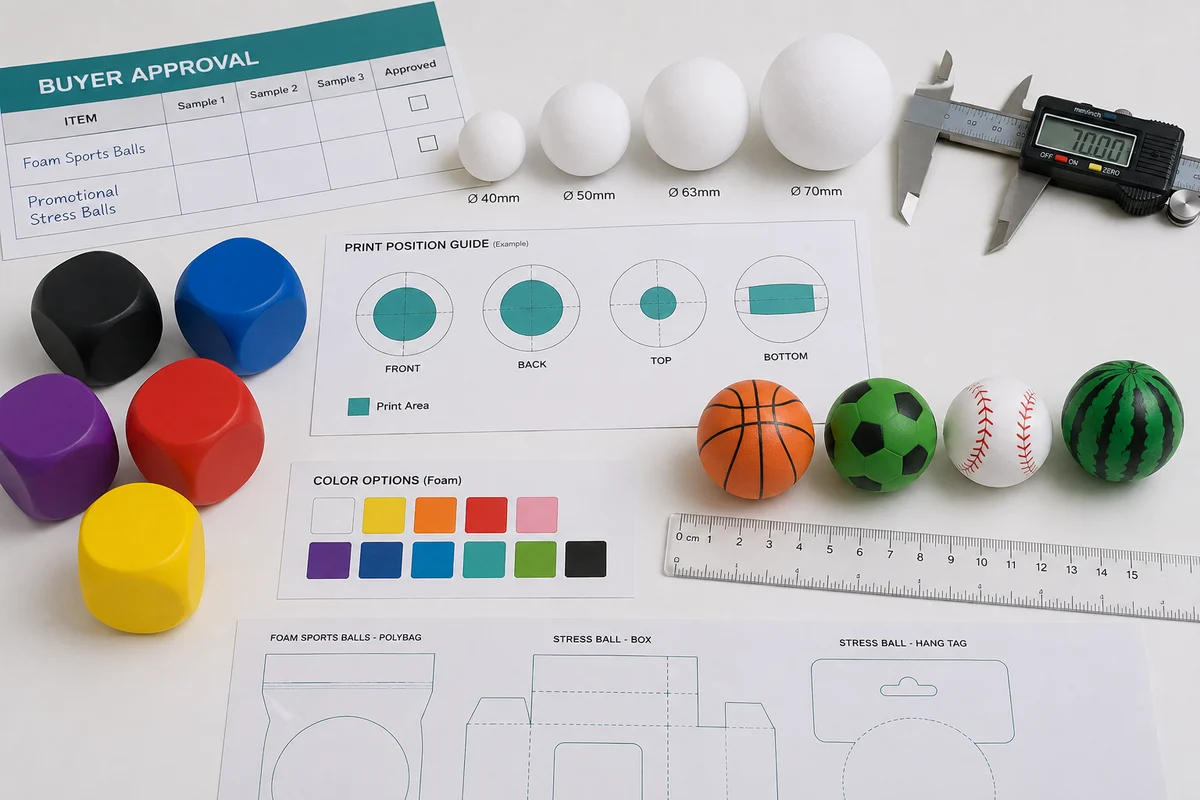
A useful approval set compares diameter, hand feel, artwork area, color, and package format together.
Step 3: specify diameter, mass, and shape tolerance
Diameter changes more than visual scale. It affects grip, perceived value, print area, carton efficiency, sample feel, and small-parts analysis.A 40 mm mini ball, a 63 mm stress ball, and a palm-size sports replica are different products even if all are called foam balls. State the nominal diameter and the measurement method. Flexible foam can deform under caliper pressure, so a rigid-product technique may give inconsistent readings.
Mass should be specified when throwing behavior, freight, vending, or set consistency matters. Foam is cellular, and process variation can affect mass. A buyer can define an acceptable range after reviewing representative samples and capability data. Do not select an arbitrary tight tolerance only because it looks professional on a drawing. An unnecessarily narrow tolerance may increase scrap and cost without improving the user experience.
Sports replicas also need shape language. Is the ball expected to be spherical, oval, or intentionally stylized? Are molded panel lines decorative or functional? Should a football stand on a display surface? Is the logo centered between seams? Provide a marked-up view showing front, back, top, and any keep-out areas. One flat logo file cannot answer those spatial questions.
Step 4: select the logo method by artwork and use
The best decoration method is the one that reproduces the approved artwork on the selected surface at the required quantity and durability. Buyers sometimes specify a process before the manufacturer sees the artwork. That can restrict the solution unnecessarily. Share vector artwork, target colors, printed size, number of locations, and durability expectation first. Ask the supplier to recommend the method and explain its limits.
| Decoration route | Often suited to | Approval questions |
|---|---|---|
| Pad printing | Compact artwork on curved surfaces | Maximum printable area, line weight, distortion, registration, ink adhesion |
| Screen printing | Suitable surfaces and relatively simple graphics | Surface curvature, screen contact, coverage, deformation during printing |
| Transfer or digitally assisted decoration | Projects needing more color or detail, when technically suitable | Compatibility with coating, edge behavior, flexibility, abrasion,setup cost |
| Molded relief or recessed mark | Long-life branding integrated into a custom mold | Tooling, minimum feature size, demolding, ownership, visibility without ink |
For custom stress balls with logo, a buyer should request a print proof at actual size, not only a screen preview. Curvature can compress the visual proportions. Small legal text may become unreadable. A registration shift that is invisible on a rectangle may be obvious beside a molded seam. If the program involves promotional stress balls wholesale, also approve the appearance after individual packing and carton compression, because packaging pressure can affect fresh coatings.
Give the printer production-ready artwork
Supply vector artwork whenever possible. Convert fonts to outlines or include the licensed font files. Identify spot colors using an agreed color reference, but recognize that a specified ink color may look different on a colored or textured foam surface. State whether the background foam is intended to show through. Mark minimum clear space and orientation relative to seams or molded details.
A complete artwork note should include version number, date, product size, imprint width and height, location, orientation, color references, acceptable trapping or overlap, and approval authority. File names such as “logo_final_final2” invite mistakes. A controlled revision such as “BrandX_FoamBall_63mm_Print_A03_2026-09-07” is easier to trace.
Ask for a digital proof before physical sampling, then approve the physical sample under normal viewing distance and lighting. Magnified photography can reveal process variation that consumers will never see, while a distant photo can conceal a serious registration error. Use both views and define acceptance at the scale relevant to the product.
Step 5: understand the cost stack
A useful quotation separates the cost drivers that may change. The quoted unit price is only one line. Tooling, decoration setup, sample charges, packaging, testing, inspection, freight, duties, and rework risk can change the landed result. Buyers should compare suppliers at the same specification, quantity, Incoterm, and packing configuration.
Material volume and density affect consumption. Product size affects cavity count, cycle behavior, drying or curing, and carton utilization. Complex molded details can increase tooling or finishing work. Large print areas and multiple colors add setup, alignment, curing, and inspection steps. Individual boxes cost more and occupy more volume than bulk packing, but they can improve presentation and protect the surface. A low-cost loose pack can be a poor choice if printed balls rub against each other in transit.
| Cost element | What changes it | How to make quotes comparable |
|---|---|---|
| Foam body | Size, density, formulation, color, shape, finish | Approve a referenced sample and measurable dimensions |
| Tooling | Stock shape versus custom geometry, cavity plan, detail | Request tooling scope, ownership, change policy, and storage terms |
| Decoration | Colors, locations, area, method, setup, reject allowance | Attach the same artwork and printed-size specification |
| Packaging | Bag, insert, box, label, carton,protection | Quote unit pack and master carton as one approved configuration |
| Verification | Market, age grade, materials, artwork, lab, inspection scope | Define the applicable test plan and who pays before order approval |
| Logistics | Carton cube, gross weight, destination, mode, Incoterm | Compare landed scenarios using the same date and route assumptions |
Use a landed-cost worksheet, not memory
Record the supplier price, setup and tooling, sample and courier, inspection, testing, unit packaging, export cartons, freight, insurance, duty, brokerage, domestic delivery, and a reasonable risk allowance. Divide the total program cost by the sellable units, not merely ordered units. If a retailer requires spare parts, reserve samples, display units, or destructive testing samples, exclude those from sellable quantity.
Calculate at more than one order quantity. A stock-size one-color ball can have a different economical range from a new custom shape with multi-color decoration. The “cheapest” quantity is not automatically the correct quantity. Excess inventory, campaign obsolescence, storage, and cash use can outweigh a small unit saving.
Step 6: treat MOQ as a production equation
Minimum order quantity is often the result of several minimums: material preparation, mold loading, decoration setup, packaging print, carton order, and the supplier’s efficient production run. These minimums may not align. A stock ball with a standard polybag may support a different threshold from a custom box whose printer requires a larger run.
When a quoted MOQ is higher than the launch requirement, ask which component is setting the floor. The answer may reveal workable options. The buyer might use a stock diameter, reduce print colors, choose a standard package, combine colorways that share the same artwork setup, or purchase plain spare packaging later. Each option changes something real, so request a revised specification and price rather than assuming the original quality at a smaller run.
For a first order, balance the number of units needed to test demand against the realities of production and freight. A tiny handmade pilot can be misleading if the factory uses a different route for bulk work. Starting with a container-sized commitment creates the opposite problem: demand, packaging, and the product itself are still unproven. Put a direct question in the RFQ: which mold, foam system, coating, print process, and packing method will be used at the sample, pilot, and bulk stages?
Step 7: use samples as decision gates
Put every sample to work. A reference piece answers one question, while a printed pre-production unit may answer five.Separating appearance, engineering, decoration, packaging, and final approval makes it clear what has been proved and what remains open.
- Reference sample: confirms approximate size, material family, hand feel, and finish. It may use another color or logo.
- Digital artwork proof: confirms location, scale, orientation, color callouts, and file version.
- Custom appearance sample: confirms shape, base color, print, and visual standard. Record any process differences from bulk production.
- Packaging sample: confirms fit, presentation, label content, barcode position, warnings, and transit protection.
- Pre-production sample: represents the approved bulk process and becomes the signed comparison standard.
- Production retention sample: preserves a traceable unit from the manufactured batch for later investigation.
At every gate, document “approved,” “approved with correction,” or “rejected,” plus the exact revision. A photograph marked with arrows is helpful, but retain the physical approved sample when color, feel, rebound, or coating is important. Those attributes are difficult to settle from a screen.
Send a sample brief that can be answered
Include intended user, market, diameter, target feel or reference, artwork, quantity tiers, packaging, compliance assumptions, and deadline. A complete brief produces a more useful reply than asking only for the lowest price.
Send Your Foam Ball RFQStep 8: approve a measurable quality plan
Quality control should follow the risks of the product. A foam ball inspection may cover dimensions, mass, color, surface, print, odor, compression and recovery, rebound where relevant, packaging, labels, quantity, and carton condition. The buyer should define how samples are selected and what counts as critical, major, or minor. A vague requirement for “good quality” cannot guide production or inspection.
Visual standards need practical boundaries. Look closely at flexible foam and small pores, a parting line, slight coating variation, or curved-surface print distortion may appear. The same marks would look very different on polished rigid plastic. Let the approved foam sample establish the commercial standard.Photograph defects once at normal viewing distance and again close up, then classify each one by safety, function, brand appearance, or harmless cosmetic variation.
Compression and recovery
Define the conditioning time before testing, the amount of compression, the hold duration, the release method, and the recovery measurement. If “slow rising” is a feature, specify how recovery time is observed and what range is acceptable. If fast recovery is needed for play, state the rebound or response target instead. A single hand squeeze by different inspectors is not a repeatable method.
Print adhesion and rub resistance
Decoration on a compressible surface experiences flexing. Agree on a representative rub or flex check and the acceptance condition. The test should reflect expected handling without inventing a destructive severity that the product will never encounter. Test both the approved sample and production units after the same cure period. Ink that appears sound immediately after printing may behave differently after full curing or after confinement in a bag.
Odor and packaging condition
Odor evaluation is sensitive to time, temperature, ventilation, and individual perception. If odor matters, agree on sample conditioning and assessment conditions. Ask when the product is packed after manufacturing and decoration. Consider whether the consumer opens a sealed package immediately or whether the goods air during distribution. Avoid absolute marketing statements such as “odor-free” unless a defined, supportable basis exists.
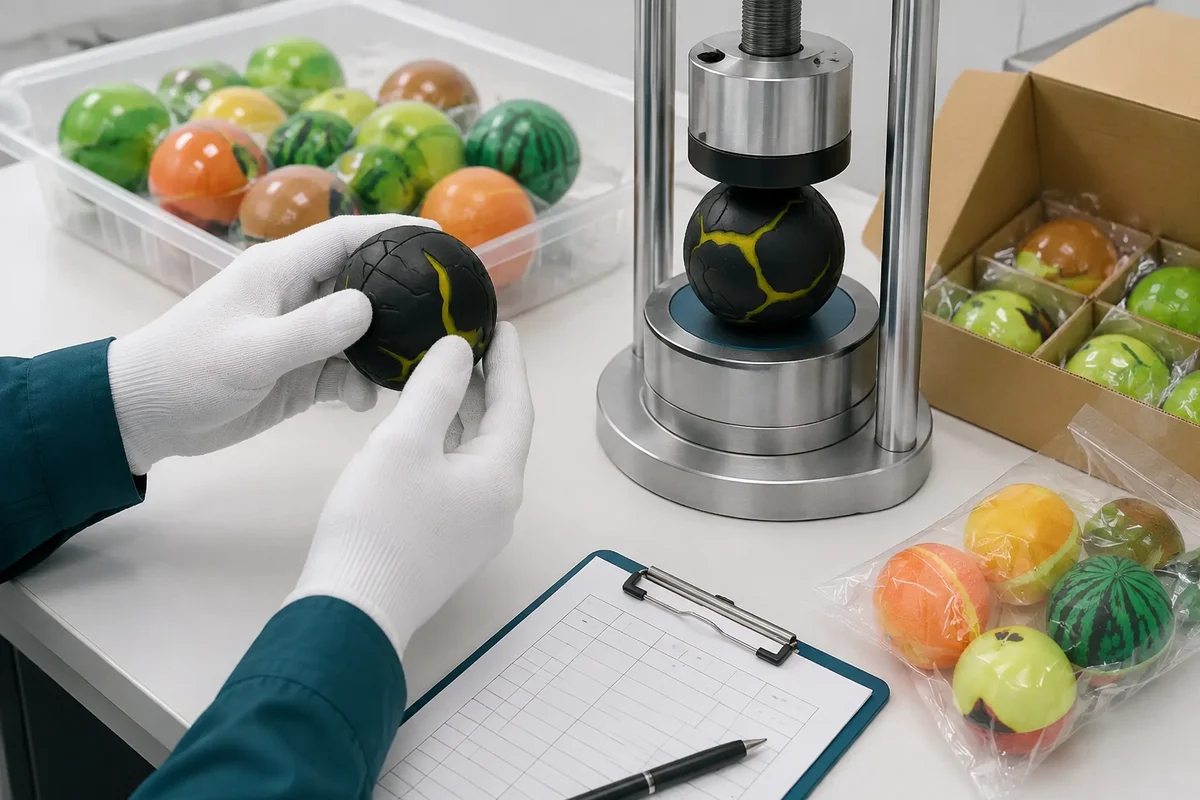
Inspection criteria should match the approved sample, intended use, and packaging process.
Step 9: connect decoration and compliance
Compliance is determined for the finished product and its market. The foam body, coating, ink, adhesive, label, accessible decorations, components, age grading, and packaging can all matter. A previous report for a different color or undecorated sample is useful background, but it does not automatically establish that a new finished SKU meets every applicable requirement.
For U.S. children’s toys, ASTM F963 is incorporated into federal requirements through 16 CFR part 1250. The CPSC’s current guidance explains that ASTM F963-23 became effective for toys manufactured after April 20, 2024. Its public requirements chart shows sections that apply to most toys, including material quality, surface coatings, substrate materials, small objects, edges, points, and producer markings, together with product-specific sections. The same chart lists a section for balls and a separate section for squeeze toys, illustrating why the actual design and function must be classified rather than tested against a generic one-line request.
CPSIA is not a substitute name for ASTM F963. It is U.S.legislation that includes requirements involving lead, phthalates, toy safety, third-party testing and certification, tracking information, and other subjects. The importer or domestic manufacturer is generally responsible for certification. A buyer should obtain the applicable test basis and certificate information for the actual finished item, not ask a supplier for a vague “CPSIA certificate.”
Promotional artwork deserves special attention. CPSC guidance for promotional products says that decoration designed primarily to appeal to children can affect product classification. It also notes that inks used on screen-printed children’s items must meet applicable requirements. This is one reason to freeze artwork before arranging final testing and to control ink or coating changes after approval.
For the European Union, the Toy Safety Directive 2009/48/EC continues to apply during the transition to the Toy Safety Regulation (EU) 2025/2509. The European Commission states that the new regulation entered into force on January 1, 2026 and will apply from August 1, 2030. Current EU placement obligations include a safety assessment, appropriate conformity assessment, technical documentation, an EU Declaration of Conformity, CE marking, traceability, warnings, and instructions as applicable. Harmonised EN 71 standards can support a presumption of conformity when the relevant standards and versions are correctly applied, but “EN 71 tested” is not a complete compliance file.
Requirements change and differ by destination, age group, materials, and product features.Work with competent compliance professionals and qualified laboratories for the final determination. This article provides sourcing structure, not legal advice or a declaration that any product is compliant.
Packaging decisions that protect margin
Packaging performs four jobs: protect the surface, present the brand, carry required information, and fit logistics. Start with the retail channel. A conference giveaway may need a simple individual bag or bulk arrangement. An online retail product may need a labeled bag or box that photographs well and survives parcel handling. A school or program kit may need counted sets, color identification, and outer-carton organization.
Fresh foam and decoration can be sensitive to pressure, temperature, and confinement. Test whether adjacent products transfer color or develop gloss marks. Confirm whether printed areas touch the bag or neighboring units. For a soft ball, a tightly fitted package may distort the shape during storage. A package that is too loose can allow abrasion. The correct solution is demonstrated through packing trials and transit simulation appropriate to the route.
Ask for an export carton specification showing units per inner pack, units per carton, carton dimensions, gross and net weight, stacking orientation, and carton marks. Use those figures to model freight before approving retail packaging. A small increase in individual box dimensions can materially change carton cube across a bulk order.
A buyer’s RFQ template
Copy the fields below into your request.If a field is unknown, say “supplier recommendation requested” instead of leaving it ambiguous.
| RFQ field | Buyer input | Why it matters |
|---|---|---|
| Intended use and user | Promotional squeeze item, play ball, replica, age group | Drives material, function, classification, and test plan |
| Destination and channel | Country, retailer, event, school, e-commerce | Controls documentation, warnings, packaging, and timing |
| Geometry | Diameter or drawing, shape reference, tolerance priorities | Determines stock mold versus custom development |
| Performance | Softness reference, recovery, rebound,surface | Creates a sample target that can be evaluated |
| Artwork | Vector file, size, colors, positions, revision | Allows process, setup, and print-risk review |
| Quantities | Launch quantity and two future tiers | Shows price breaks without forcing excess inventory |
| Packaging | Unit pack, label, insert, carton, barcode | Affects presentation, protection, compliance, and freight |
| Verification | Applicable standards, lab, inspection, records | Prevents scope disagreements after development |
| Commercial terms | Incoterm, destination, sample deadline,delivery window | Makes timing and landed-cost assumptions comparable |
How to compare supplier replies
Create a bid table in which each row is a supplier and each column is a fixed requirement. Separate “confirmed,” “alternative proposed,” and “not answered.” A fast quote that omits the print method, testing scope, carton information, and sample basis is not directly comparable with a detailed quote that includes them.
Review the questions a supplier asks. Useful questions often reveal production understanding: intended age, compression target, artwork line weight, ink colors, print location, packaging contact, destination requirements, and deadline. A supplier that challenges an impractical feature early may reduce risk more effectively than one that agrees to everything without qualification.
Ask who controls artwork, mold revisions, production samples, test samples, and inspection documents. Confirm communication time zones and the person authorized to approve changes. Many disputes begin when a sales discussion, artwork email, and purchase order contain different specifications.
Common failures and how to prevent them
The bulk ball feels different from the sample
Possible causes include a different foam batch, density variation, cure or conditioning differences, coating thickness, sample aging, or a pilot made by another process.Prevention starts by recording the sample code, material system, key performance method, production process, and permitted range. Retain both the approved sample and a production sample.
The logo cracks, smears, or distorts
The print may be incompatible with the coating, insufficiently cured, too large for the curvature, or repeatedly stressed beyond the approved use. Review artwork geometry and production sequence before changing ink alone. Test the finished decorated ball after representative flexing and packaging.
The color is approved on screen but rejected in person
Monitors, room light, foam substrate, coating gloss, and surrounding colors alter perception. Approve a physical color standard under agreed lighting. State whether the target is a color reference, a master sample, or a defined tolerance measured by instrument. For small launches, a visual master may be more practical, provided the parties understand its limitations.
The ball arrives misshapen
Over-tight individual packing, carton compression, stacking, heat, and insufficient recovery time can affect shape. Conduct a packed-product trial. Measure recovery after unpacking and state any conditioning period. Revise carton quantity or separators if pressure is the cause.
Testing is ordered too early
A test on an undecorated sample, old material, wrong size, or preliminary package may not support the final SKU. Freeze the bill of materials, artwork, colors, construction, age grade, and packaging before final compliance samples are selected.Control later changes through a documented review.
A realistic development sequence
Consider a hypothetical event distributor planning a 63 mm one-color foam ball for a mixed adult audience. The first brief asks for three quantity tiers, a stock spherical mold, a dark base color, a light logo, individual packing, and delivery to one destination. The supplier flags that the thin logo strokes may fill on a textured flexible surface and requests a minimum line-weight change. The buyer approves a slightly simplified mark for the product while retaining the full brand mark on the package.
A reference sample confirms the size but feels too firm. The buyer returns a short video using a consistent compression method and sends an existing sample that represents the desired hand feel. The second sample is accepted for compression and recovery. A printed sample then reveals that the logo looks smaller than expected because of curvature. The artwork is enlarged within the manufacturer’s safe print area and the approval file is revised.
Before the order is released, the buyer confirms the product classification, destination requirements, final artwork, packing, inspection checklist, sample retention, and carton data. The test sample is taken from the final configuration. This sequence adds decisions, but it removes ambiguity. The project is easier to quote, inspect, and repeat.
Related sourcing paths for mixed toy programs
A foam ball may sit inside a larger sensory, promotional, or private-label assortment. Keep each material family on its own specification and test matrix.For category planning, explore sensory toys wholesale and discuss the program with a sensory toy manufacturer. For gel-like formats, review options with a TPR squeeze toy manufacturer and compare mochi squishy toys wholesale. For cellular slow-recovery products, visit slow rising squishy toys wholesale and the squishy toy manufacturer category.
Projects needing molded elastomer detail can be discussed with a silicone squishy toy manufacturer, including custom silicone sensory toys. Soft sewn items follow a different process, so use the custom plush toy manufacturer and plush toys OEM pages for textile construction. Buyers comparing foam balls wholesale with a broader assortment can also review an OEM toy manufacturer China portfolio and discuss custom toy manufacturing requirements by SKU.
Hines’ public catalog spans PU foam, EVA foam, soft TPR, silicone, plastics, plush, stress-relief items, balls, promotional gifts, and sports products. Start a separate file for the proposed SKU. Its material, process, documents, testing, MOQ, sample schedule, and delivery commitment belong in the quotation and purchase specification, where both parties can approve them.
Frequently asked questions
How should a buyer choose foam ball size?
There is no universal best diameter. Select a size that fits the intended hand, artwork, package, distribution method, and classification. A common existing reference can accelerate sampling, but approve the actual diameter, mass, feel, and print area. If children are an intended audience, size and foreseeable use must be reviewed in the compliance assessment.
Can a foam ball carry a multi-color logo?
It may be technically possible depending on artwork, curvature, coating, process, registration tolerance, quantity, and durability. More colors can add setups and alignment risk. Send vector artwork and request a process recommendation, maximum print area, sample, and written tolerance before committing the campaign.
Why does MOQ change with packaging?
The product, printing, label, bag, insert, and retail box may have different production minimums. A custom printed box can set a higher effective MOQ than the foam ball itself. Ask which component drives the minimum and request alternatives using standard packaging or labels if the launch volume is smaller.
Should a buyer use a stock ball or open a custom mold?
Use a stock form when speed, lower development cost, and a standard silhouette matter more than exclusivity. Consider custom tooling when geometry, molded branding, functional behavior, or recognizable product identity creates commercial value. Confirm tooling scope, ownership, revision fees, maintenance, storage, and what happens at the end of the project.
How should foam softness be specified?
Start with an approved reference and a repeatable comparison method. Separate initial squeeze force, depth of compression, recovery time, surface feel, and rebound. Record conditioning and test conditions. Avoid relying only on a generic hardness word because it may not describe the consumer experience.
When should compliance testing occur?
Plan the test scope during design, but submit the final representative configuration after the bill of materials, colors, coatings, artwork, construction, age grade, and packaging are controlled. Ask a qualified laboratory or compliance professional to determine applicable requirements for the destination and product. A change after testing may need a documented material-change review and possibly new testing.
What information speeds up a foam ball quote?
Provide intended user and use, destination, diameter or drawing, target hand feel, artwork, colors, print locations, quantity tiers, package, delivery window, and requested Incoterm. Attach a reference photo or sample when feel and finish are difficult to describe.State which fields are flexible so the supplier can propose cost-saving alternatives.
Can Hines confirm MOQ and lead time immediately?
Not from the product name alone. Hines will need the design, material, mold route, decoration, packaging, sample approvals, quantity, destination, and requested window before confirming those figures. Send that information in the RFQ and use the resulting quotation as the commercial reference.
Official references
These are the agency pages checked for the compliance points in this guide. Revisit them when the market and production dates are fixed.
- U.S. Consumer Product Safety Commission: ASTM F963 Requirements
- U.S. Consumer Product Safety Commission: Promotional Products guidance
- U.S. Consumer Product Safety Commission: Consumer Product Safety Improvement Act overview
- European Commission: Toy safety
- European Commission: Placing toys on the EU market
Turn your foam ball idea into a quotable specification
Share the use case, size, a performance reference, artwork, quantities, market, package, and timing. We will read the brief, flag unanswered production questions, and come back with the inputs needed to sample and quote the chosen design.
Request Performance Samples and a Bulk Quote