TPR Squeeze Toys Manufacturer: Material, Molding, Filling, and OEM Guide
The sample on the meeting table can be dangerously persuasive. It is clean, soft, neatly printed and—because everybody has handled it only a few times—completely dry. Eight weeks later, a buyer may be opening production cartons and finding three different problems: one color looks dull, a handful of seals feel damp, and the odor inside the retail bag is stronger than it was in the sample room. None of that is fixed by writing “good quality” on the purchase order. The useful work happened earlier, or it did not happen at all.
This is a working guide for importers, promotional distributors, sensory brands, wholesalers and private-label teams preparing a brief for a TPR squeeze toy manufacturer. The emphasis is deliberately practical: what must be decided before the mold is cut, what a quotation is silently assuming, and what evidence deserves a place in the approval file. Filled and unfilled toys are treated separately where the distinction matters. Legal requirements still need market-specific review, and a qualified laboratory must determine the applicable test plan.What follows is the buyer's side of the job—the questions that stop a vague RFQ from becoming an expensive surprise.
- TPR material choices, feel, color, odor, and migration considerations
- Solid, hollow, gel-filled, liquid-filled, and foam-filled constructions
- Concept review, mold design, trial molding, filling, sealing, decoration, and packing
- Age grading, chemical and mechanical compliance planning
- MOQ, tooling, cost drivers, lead-time logic, QC, and supplier evaluation
- A ready-to-use RFQ checklist and buyer-focused FAQ
1. Start with the product architecture, not a catalogue photo
A typical first message contains a screenshot and one line: “Please quote this animal in our colors.” From a sales point of view, the request makes sense. From a production point of view, almost everything is still blank. The screenshot says nothing about the wall, compound, filler, closure, surface treatment, intended age or the bag in which the toy will spend a month at sea. A factory can guess, but each guess belongs in the price and the risk. Ask for a cross-section proposal before asking which color is cheapest.
Five constructions that buyers often group under one name
Put five similar-looking squeeze animals on a desk and they may behave like five different products. One is solid and resists through its mass and shape. Another is hollow, so the wall and trapped air do most of the work. A third holds gel or liquid behind a closed port. A fourth has a foam core.The last may hide an insert or wear a mesh sleeve. The buyer sees five animals; production sees five bills of material, five failure patterns and, quite possibly, five different inspection plans.
| Construction | Typical buyer priority | Main engineering question | Frequent failure to prevent |
|---|---|---|---|
| Solid molded TPR | Durability, simple packing | Can geometry deliver the target squeeze force without excess weight? | Sink marks, tackiness, deformation |
| Hollow / air-filled | Lightweight, soft squeeze | Is the wall uniform and is any air path intentionally designed? | Thin spots, collapse, seam split |
| Gel- or liquid-filled | Distinct hand feel and visual effect | Are shell, filler, plug, adhesive, and print mutually compatible? | Leakage, sweating, filler migration |
| Foam-filled shell | Controlled recovery | Does the core bond and recover consistently through temperature changes? | Void, delamination, uneven rebound |
| Hybrid / decorated | Novelty and brand differentiation | Can every insert and attachment survive foreseeable use? | Detachment, sharp edge, print rub |
A rough sketch is enough to start. Draw the shell, shade the fill, point to the closure and write the handling that worries you beside it. Will schoolchildren twist the ears? Will office users keep it in a hot car? Does a clear filler need glitter to remain evenly dispersed? A buyer does not have to solve the engineering.The sketch simply prevents the words “squeeze toy” from doing too much work. When the supplier replies, ask it to redraw the proposed construction and list every open assumption.
Need a construction review before you pay for a mold?
Send Hineslead your reference, target market, size, estimated quantity, packaging idea, and required hand feel. A useful reply should identify open decisions—not merely return a unit price.
Request a TPR sample set and OEM quote →2. What TPR means—and what the label does not tell you
TPR is a family name. In toy sourcing it is sometimes used so broadly that two suppliers can both say “TPR” while offering pieces that do not feel, smell or age alike. The base grade matters, but so do the oil level, additives, pigment system and the way the material has been processed. For that reason, “Material: TPR” belongs on a catalogue card, not at the end of a technical discussion. The production specification needs the supplier's controlled material code and a physical piece against which the finished feel can be judged.
Hardness is only one part of hand feel
Hardness numbers help, but they do not replace the hand. A reading taken on a standard plaque cannot describe what a thin hollow belly or a thick paw will feel like. Nor will it explain the effect of a cold sample, a textured skin or a viscous filler. If a Shore value is used, record the scale, method, specimen, conditioning and tolerance. Then keep a real sample. Mark it, date it, bag it and leave its twin with the factory.Six months later, that modest piece of material will settle a discussion faster than the phrase “same softness as before.”
Everyday language is useful when it describes an action. “An adult should press the body to half-height with one hand” is more informative than “super soft.” So is a ten-second phone video. Show where the fingers go, how far the sample closes, whether it stays folded and how it returns. The video is not a laboratory method, but it gives the engineer a target that adjectives rarely provide.
Tack, oil bloom, dust pickup, and odor
Here is a simple mistake worth avoiding: opening a fresh sample, touching it for a minute and approving “no tack.” Some soft formulations change with time. Heat, contact with packaging and neighboring materials can make oil bloom or dust pickup much easier to see. Put one sample on the shelf, one through the agreed warm-storage trial and one in the actual printed bag. Label the dates. When the team opens them later, write down what is observed. Memory becomes generous when a launch date is close.
Odor is similarly contextual. Define who assesses it, how long after opening, at what distance, and against which reference. Avoid absolute marketing claims unless supported and legally appropriate. If a low-odor experience matters, state it as an acceptance criterion and confirm the packaging will not add its own smell.
Color is a compound decision, not a screen color
A color picked from a laptop is only a direction. The same code can look different in a translucent shell, an opaque body or a glossy coating.First say which surface must match—the mixed compound, the molded toy or the finished painted piece. Review it under agreed light and sign a real sample. If slight variation is acceptable, keep a light and dark boundary too. That gives production something more useful than a screenshot whose brightness changes from one office to another.
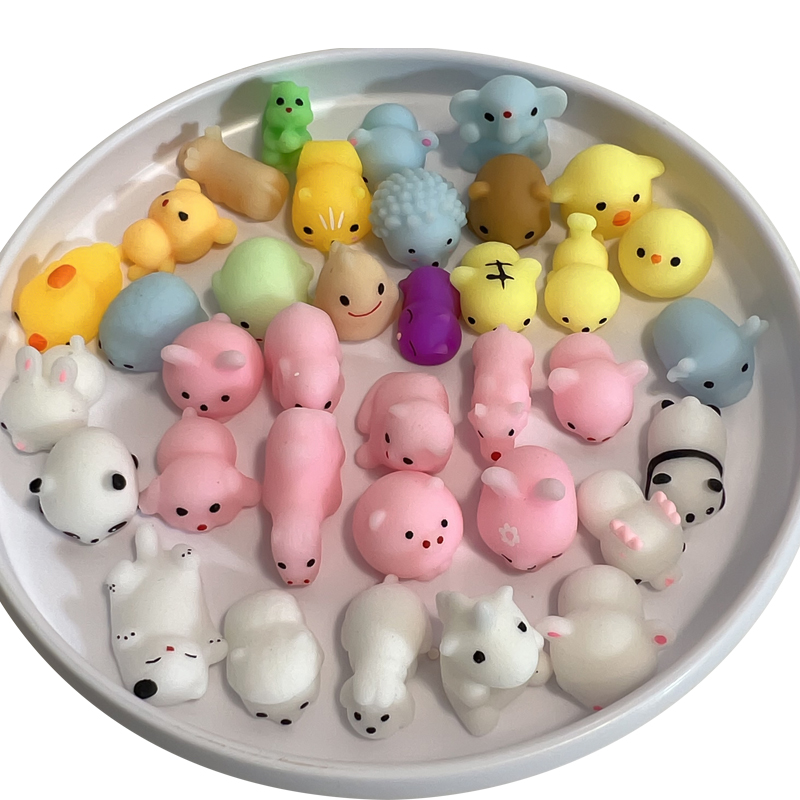
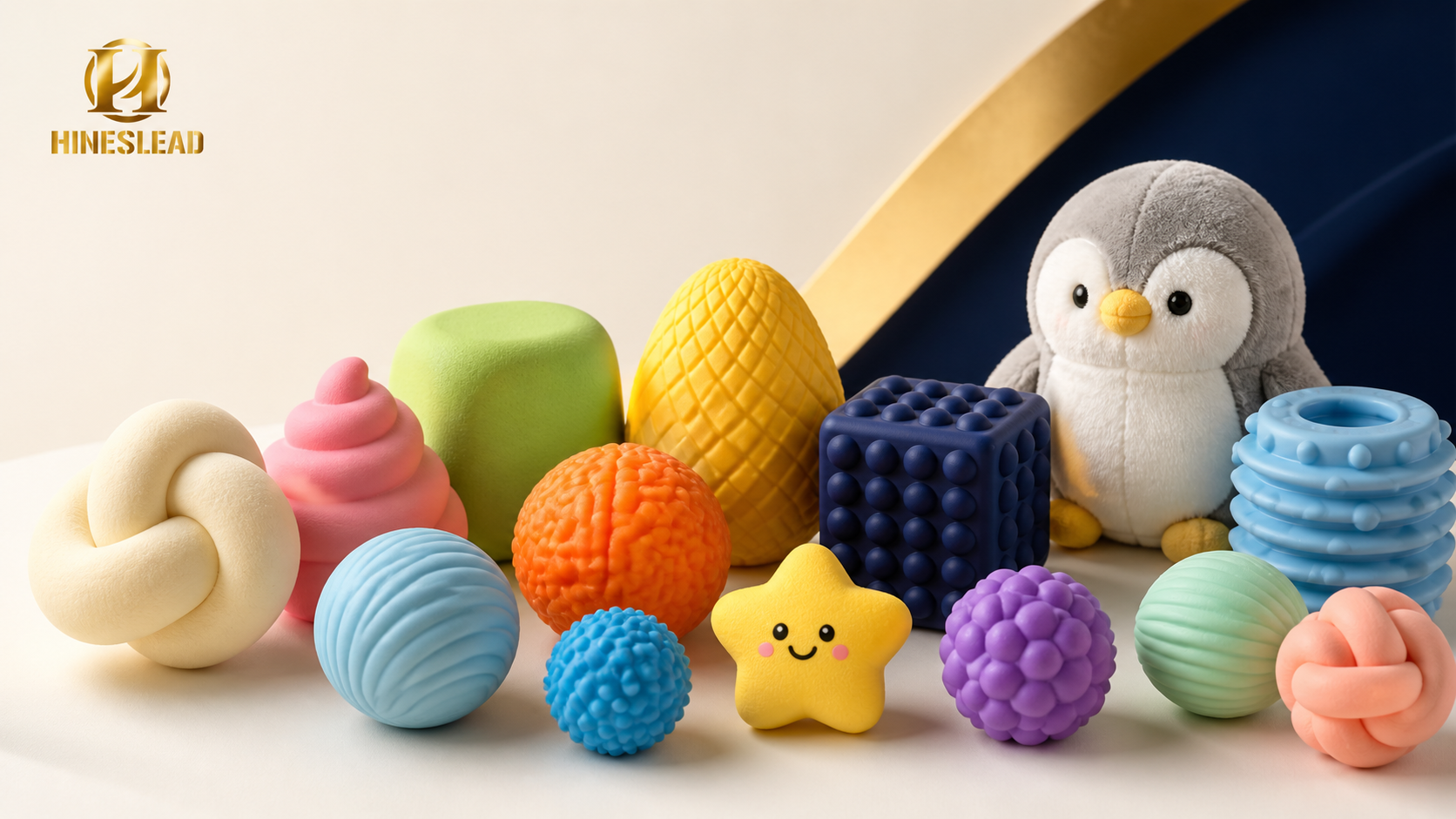
A family of similar characters still needs controlled color, surface, face placement, and feel standards.
3. Turn the concept into a factory-ready design brief
The brief need not pretend the buyer is a mold engineer. It should state the commercial facts the engineer cannot invent: where the logo must sit, how the toy is squeezed, which feature makes the character recognizable, what package it must fit and where it will be sold. The supplier can then mark conflicts. Discovering that a narrow tail will tear is useful news during a 3D review; it is expensive news after printed cartons arrive.
Dimensions, mass, and squeeze zone
List overall length, width, height, target mass, and tolerance. Identify the primary squeeze zone and any features that must remain visually stable. A cute ear, tail, or antenna may be too thin for reliable molding or may act as a tear initiator when pulled. If the toy must fit a countertop display, mailer, vending capsule, or gift set, include the internal package dimensions at the beginning—not after the mold has been cut.
Use conditions and buyer-defined abuse cases
Describe expected use in ordinary language. Will the item sit on an office desk, be handled in a classroom, ship as a promotional giveaway, or sell as a children's toy? Is it likely to be twisted, stretched, bitten, thrown, or carried in a bag with paper and fabric? Foreseeable behavior informs construction and assessment. The target market and age grading determine which requirements may apply, but real handling patterns help the team design beyond a minimum checklist.
Decoration map and “no-go” areas
Supply vector artwork and a marked drawing showing print size, location, orientation, colors, and allowable movement. Curved, soft surfaces distort. A logo that looks centered on a flat rendering may stretch when the toy is squeezed or sit unevenly over a parting line. Ask the supplier to state the printable area and to show a decorated sample from front, side, and top views. For complex character faces, agree feature-to-feature tolerances rather than saying “match artwork.”
4. Mold design: where durability is quietly decided
Tooling discussions often collapse into one number. That is a shame, because a slightly cheaper mold may put the parting line through the face or leave the gate where a thumb rubs it on every squeeze. Ask to see those locations. Ask how a narrow feature fills and releases. Ask where the wall changes sharply. The buyer is not choosing cutting parameters; the buyer is approving what the tool will make visible and what the finished toy will be asked to survive.
Parting line and gate location
The parting line should avoid critical face graphics and high-stress zones when feasible. The gate location affects material flow, appearance, trimming, and local properties. Ask for a mold-flow rationale or at least a marked tooling drawing for complicated shapes. Confirm how the gate vestige will look and whether it can contact the user's hand.
Wall transitions and thin features
Abrupt thickness changes can create uneven cooling, sink, weak zones, or inconsistent feel. Fine facial details may not reproduce as expected in a very soft compound. Deep undercuts may complicate release. Before approval, request a design-for-manufacture review that lists features the supplier proposes to thicken, soften, simplify, or move. Require written approval for those changes; otherwise, a harmless factory adjustment can become an unwanted brand change.
Tool ownership and change control
Your purchase order should state who owns the mold, where it will be stored, whether it is exclusive, how many cavities it contains, what maintenance is included, and what happens if the relationship ends. Identify every revision with a date or version number. If the tool is modified after approval, record the reason and reapprove affected samples. Intellectual-property files, molds, print plates, and packaging dies should have clear custody rules.
5. A realistic manufacturing flow
There is no single line layout for every squeeze toy, and the chemistry may differ as well. Still, an order moves through recognizable hand-off points. Use the sequence below as a factory-walk prompt.At each step ask, “What record or sample tells us this went correctly?” The answer is more revealing than the brand name on a machine.
- Incoming material verification: confirm supplier, grade or internal code, color batch, documentation, and storage status.
- Compounding or preparation: meter color and approved additives under controlled conditions.
- Molding: process within a validated window for temperature, pressure, time, and cooling.
- Demolding and trimming: remove gate or flash without cutting into the functional wall.
- Conditioning: allow the part to stabilize before decisions that depend on dimensions or feel.
- Filling and sealing, if applicable: control fill mass, port condition, plug, weld, or adhesive parameters.
- Decoration: clean or pretreat the surface as needed, print or coat, then cure.
- Assembly and inspection: add only approved components and check critical characteristics.
- Packing and release: use verified packaging, lot identification, and agreed sampling or 100% checks.
Why a “golden sample” is not enough
One polished sample proves that one polished sample exists. It says little about Tuesday's second cavity or the final hour of a long run. Ask for pieces taken across the trial, with cavity identity kept where practical. Lay them side by side and write down what changes. A weak cavity is easy to miss when the supplier chooses the nicest piece from every tray.
The approval package should include a signed appearance sample, an approved feel sample, color limits, artwork proof, packaging sample, specification revision, and test plan. Some of these can be the same physical piece; the important point is that each decision has a controlled reference.
6. Filling and sealing: manage it as a small system
Think of a filled toy as a small package inside another package. The TPR holds a moving filler; the closure interrupts the shell; ink sits on the outside; a retail bag presses against everything. Change one part and another may complain. That is why a leak investigation should place the shell, filler, pigment, print, closure and storage history on the same page instead of blaming “the seal” by habit.
Define fill by mass and function
Weigh the fill. “Looks full” changes with the operator, the light and the shape of the animal. A gram target with an agreed tolerance gives the line something it can check. Then describe the effect: the pocket of air that is acceptable, the amount of glitter, the bead size and whether settling is expected. Overfilling is not generosity; it can raise shell stress and make the approved squeeze feel disappear.
Closure design and verification
The port may use a plug, a joining operation, adhesive support, a mechanical detail or a combination. Do not choose from that list in the abstract; ask why the proposed method suits this shell and filler. Watch a trial closure being made if possible. What is cleaned? What is timed or heated? Which parameter is recorded? A glance can find a missing plug.It cannot tell you how the closed port behaves after a warm week and a thousand squeezes.
Leak testing should resemble the risk
There is no universal squeeze count that proves every design. Establish a preproduction protocol based on product size, wall, filler, intended user, shipping environment, and applicable standards. Consider repeated compression, hold pressure, twisting, drops, storage at agreed temperatures, and post-conditioning inspection. Record where failures occur. “No leak” is meaningful only when the method, sample count, conditioning, and acceptance rule are stated.
A useful leak report says: 20 pieces from all cavities, conditioned 24 hours, compressed by the agreed fixture for the stated cycles, then held and inspected after a defined recovery period. “We squeezed it many times” is not a report.
7. Surface texture, coating, printing, and logo durability
TPR's low surface energy and flexibility can make decoration challenging. An ink that bonds to a rigid plaque may crack, rub, or peel on a soft part. Decoration development should use the actual production compound and production-like surface preparation. Changing material grade after print approval can invalidate the result.
Choose the decoration route around the artwork
Pad printing can suit small logos and facial features but has limits on curvature and distortion. Spray coating can create broad color coverage but adds thickness, curing, masking, and abrasion considerations. Molded-in color avoids a separate coating layer, though it cannot reproduce every graphic.A label or attached emblem introduces adhesion and detachment questions. Ask for a decoration proposal that includes printable area, number of colors, registration tolerance, curing method, and expected appearance over the parting line.
Approve after flexing, not before
Review a decorated sample when new, then again after the agreed squeeze, twist, rub, and conditioned-storage checks. Examine fine edges and high-strain zones. If the promotional logo is the commercial reason for the product, classify its durability as a critical approval item rather than an ordinary cosmetic note.
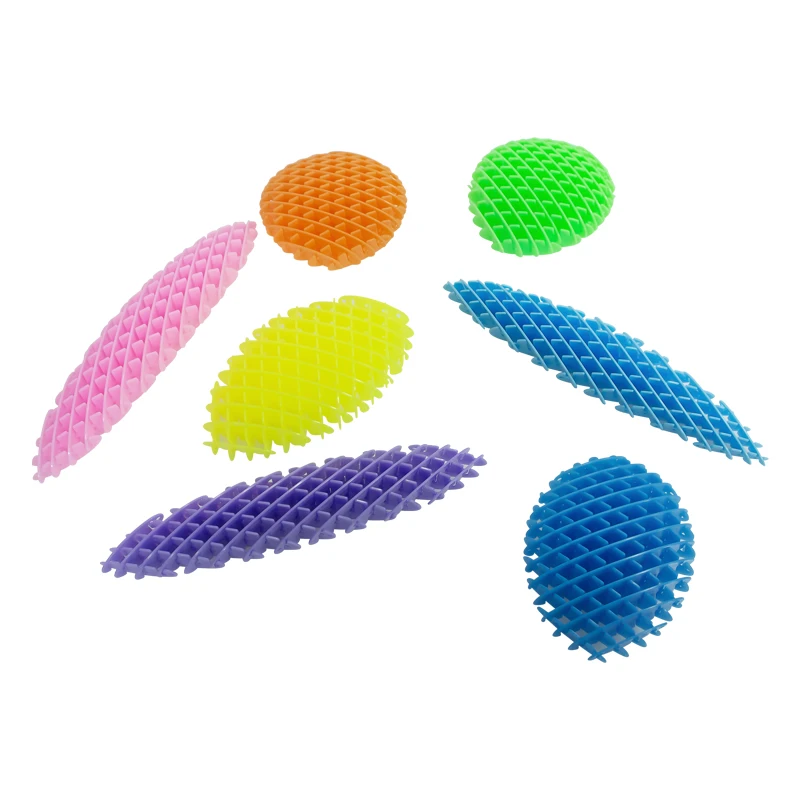
Long, textured geometry makes stress distribution and surface finish especially important during OEM review.
Have artwork but no technical drawing?
Share the logo file, product size, target squeeze feel, market, and packaging. Hineslead can use those inputs to organize a manufacturability and quotation review.
Send your TPR concept for review →8. Packaging is part of material compatibility
Packaging is often approved by the graphics team while the product team focuses on molding. For soft TPR, those decisions belong together. Film, printed ink, insert card, tray, adhesive, tie, and neighboring products can touch the toy for weeks. Pressure and heat during transport can amplify surface transfer, deformation, blocking, or odor.
Run a packed-product trial
Pack production-like samples exactly as they will ship. Include the final bag, card, tray, label, sealing method, carton count, dividers, and compression. Store part of the trial under normal conditions and part under an agreed accelerated condition. Inspect color transfer, surface marks, shape recovery, print adhesion, bag blocking, odor on opening, and seal condition. A packaging trial is much cheaper than learning from a warm container.
Control compression and carton loading
Increasing pieces per carton can reduce freight per unit, but too much compression may deform a soft product or stress a filled shell. Verify actual master-carton dimensions and gross weight after the retail pack is approved. Use a pack-out sample or photograph that shows orientation and layers. If stacking direction matters, place it in the packing instruction.
9. Compliance planning begins before sampling
The target country, age grading, product claims, construction, components, and packaging determine what rules and standards may apply. Do not ask only whether a factory has “a certificate.” A report for a different material, color, construction, or age category may not cover the product being ordered.
For the United States, buyers can start with the U.S. Consumer Product Safety Commission's Toy Safety Business Guidance and its phthalates information.For the European Union, consult the European Commission's toy safety overview. These authoritative starting points help frame the discussion, but the importer should confirm the applicable current requirements and test plan with qualified compliance professionals and an accredited laboratory.
Build a bill of materials for testing
List every accessible material: TPR shell, filler, pigment, ink, coating, plug, adhesive, glitter, beads, insert, label, cord, and package component where relevant. Link each to an approved supplier or internal material code. When a color or filler changes, the team can then assess whether previous evidence remains applicable. Without a bill of materials, “same product” becomes a subjective claim.
Mechanical and physical hazards are design questions
Chemical reports alone do not address small components, seams, projections, accessible sharp features, foreseeable abuse, or filling release. Age grading should be defensible and consistent with design, marketing, instructions, and distribution. Ask the laboratory to review the complete product and packaging, not only a material pellet.
Claims require their own evidence
Words such as non-toxic, hypoallergenic, therapeutic, food-grade, medical, or eco-friendly can carry legal and commercial consequences. Do not add them because a competitor does. Define the claim, market, test or documentation basis, and approval owner. If the product is simply intended as a general novelty or sensory item, keep marketing language accurate and proportionate.
10. MOQ, tooling, sample charges, and honest cost comparison
A unit price is comparable only when scope is comparable. One quotation may exclude tooling, print setup, retail packing, testing, inspection, export carton, or freight. Another may use a different compound or a lighter construction. Ask suppliers to break out assumptions.
| Cost element | What changes it | Question to put in the RFQ |
|---|---|---|
| Tooling | Size, cavities, undercuts, finish, closure details, expected life | What is included, who owns it, and which revisions trigger extra cost? |
| Material and molding | Grade, hardness, mass, color effect, cycle time, scrap | Which approved material code and net unit weight support the quote? |
| Filling and sealing | Filler type, mass, inclusions, closure, leak checks | Is the fill mass tolerance and verification method included? |
| Decoration | Method, colors, area, registration, pretreatment, curing | Does the price include print plates, jigs, and approved durability checks? |
| Packaging | Film, card, tray, labels, carton loading, barcode | Is the quote based on the final pack specification and packing quantity? |
| Quality and compliance | Test market, sample size, inspection level, reports | Which testing and third-party inspection costs are included or excluded? |
Why MOQ differs by component
The finished-product MOQ may be driven by molding efficiency, but custom pigment, printed packaging, filler, or decoration can have different minimums. Ask for the constraint behind the number. If your launch quantity is below the economical custom level, a stock mold with custom color and packaging may be wiser than a fully custom shape.A staged program—development samples, pilot, then repeat order—can reduce uncertainty, though it may carry higher initial unit cost.
Lead time should be a milestone schedule
“Thirty days” is incomplete unless the start point is named. Request dates for design confirmation, tool drawing, first mold trial, revision, decorated sample, packaging sample, compliance samples, production, inspection, and shipment readiness. State buyer response times. A project can lose a week while a sample waits on a desk, and that delay should not be confused with molding time.
11. Build a QC plan around failure modes
Generic AQL inspection can be useful for workmanship, but a squeeze toy also needs product-specific checks. Classify defects by risk and commercial impact. A leaking filled toy, wrong compound, or detached part is not equivalent to a minor color speck. Decide which characteristics receive 100% screening, which are sampled, and which require laboratory or fixture-based verification.
| Characteristic | Possible method | Timing | Example acceptance logic |
|---|---|---|---|
| Material identity / color batch | Document and lot verification; approved limit sample | Incoming and start-up | Approved code and color range only |
| Dimensions and mass | Caliper, scale, defined points | First article and in-process | Within drawing tolerance |
| Feel / squeeze response | Reference comparison plus agreed fixture where practical | Start-up and lot checks | Matches signed range or numeric target |
| Seal integrity | Visual plus defined pressure/cycle/hold protocol | In-process and release | No release or seepage under agreed method |
| Decoration | Position gauge, rub/flex method, visual limit | After cure and final | Within placement tolerance; no unacceptable peel |
| Surface / odor after packing | Conditioned packed sample assessment | Preproduction and retain review | No defined transfer, blocking, or unacceptable odor |
| Carton pack-out | Count, weight, barcode, drop/transport plan as applicable | Final release | Matches approved packing instruction |
Retain samples and lot traceability
Keep dated retains from approved development, production start, and final lot. The supplier should link the order to material and processing records at a level appropriate to the product and risk.If a complaint appears, the team can compare it with a matching retain rather than arguing from photos alone. Define retention duration in the quality agreement.
Pre-shipment inspection is not process validation
A final inspector can find visible defects, quantity issues, wrong labels, and some functional problems. They cannot reconstruct an uncontrolled material change or prove long-term compatibility from a few hours on site. Use pre-shipment inspection as one layer. Put the most important controls upstream, where a correction is still possible.
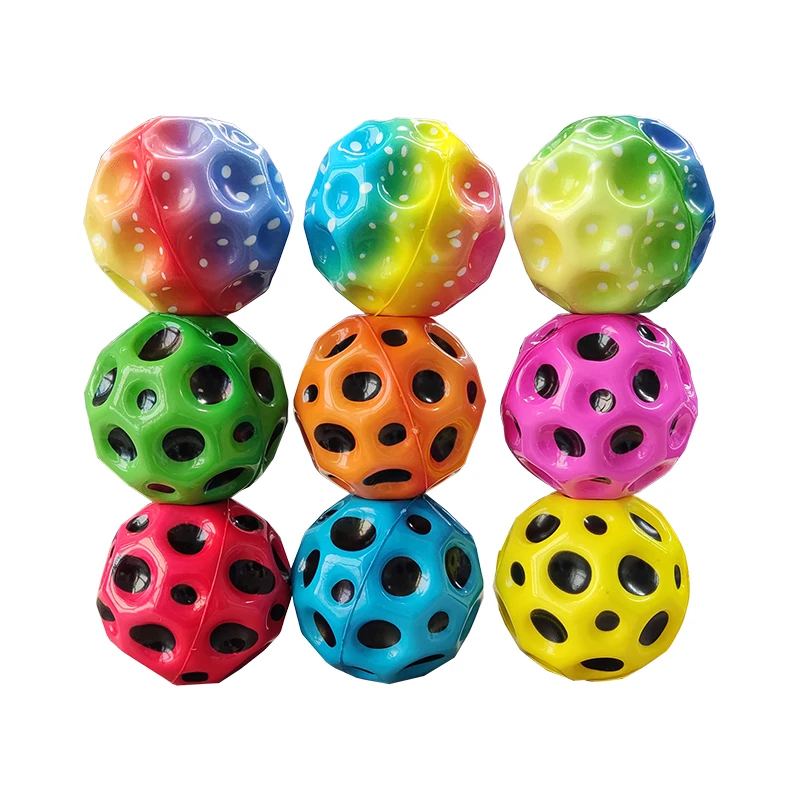
Simple-looking products still need a controlled size, texture, color, rebound, and pack-out standard.
12. How to evaluate a TPR squeeze toy supplier
A supplier should be judged on the quality of its questions as well as its answers. Fast pricing is convenient; thoughtful risk identification is more valuable. Compare suppliers using the same brief and ask them to explain differences.
- Can the team distinguish solid, hollow, and filled construction risks?
- Will it identify the proposed compound by a controlled code and disclose when it changes?
- Does the quotation state dimensions, weight, print, packaging, testing, and exclusions?
- Can it show how mold revisions, artwork versions, and approved samples are controlled?
- Does it have a defined method for fill mass and seal verification where applicable?
- Will it run packed-product compatibility and conditioned-sample reviews?
- Can it support an independent laboratory and third-party inspection selected by the buyer?
- Does it discuss IP custody, tooling ownership, and confidentiality before files are released?
Be wary of absolute answers to product-specific questions. “Never leaks,” “passes every market,” or “any logo is possible” may sound reassuring but ignore design and scope. A credible partner explains what it needs to verify, which trade-offs exist, and how approval will be documented.
13. Write an RFQ that produces useful quotations
The goal of an RFQ is not to produce the lowest number. It is to make assumptions visible so that engineering, quality, and commercial teams can compare the same object.
Commercial information
- Buyer company, sales channel, destination country, and intended age grade
- Estimated launch quantity, annual forecast, color split, and reorder scenario
- Required incoterm and preferred port or delivery point
- Target launch date with time reserved for testing and revision
Product information
- Reference images plus original 2D/3D files where available
- Overall dimensions, target mass, squeeze zone, hardness or feel reference
- Construction: solid, hollow, filled, foam-filled, or hybrid
- Material, color, translucency, texture, odor, and surface expectations
- Filler composition description, fill mass, visual effect, and closure expectation
- Logo artwork, print area, colors, position, and durability requirement
- Retail packaging, barcode, warning, carton, and pack-out concept
Quality and evidence
- Applicable market and proposed test plan to be confirmed with a qualified lab
- Critical checks, leak or durability protocol, inspection standard, and retain plan
- Requested sample stages and number of pieces at each stage
- Bill of materials, revision history, material declarations, and lot traceability expectation
14.Choosing among related OEM toy materials
TPR is useful when a project needs elasticity, squeezability, and certain molded effects, but it is not the default answer for every sensory or promotional program. Buyers comparing sensory toys wholesale programs should begin with the desired user experience, construction, lifespan, market, and branding method. A capable sensory toy manufacturer should explain the material trade-off rather than forcing every idea into one process.
For office campaigns, custom stress balls with logo and promotional stress balls wholesale may use different foam or elastomer constructions depending on feel and decoration. If delayed recovery is the main experience, compare a PU foam toys manufacturer and review custom PU foam toys. For lightweight molded foam parts, packaging inserts, or sports-style items, examine EVA foam toys wholesale and custom EVA foam toys.
Within soft elastomers, a TPR squeeze toy manufacturer may be the right starting point for stretch and filled concepts, while mochi squishy toys wholesale programs often emphasize very soft, small character forms. For slow recovery, visit slow rising squishy toys wholesale options and ask a squishy toy manufacturer to define rebound measurement. Projects that require a silicone construction should be reviewed by a silicone squishy toy manufacturer, especially for custom silicone sensory toys.
Softness can also come from textile and stuffing systems. A custom plush toy manufacturer or plush toys OEM program may fit character-led brands better. Sports promotions may call for custom foam sports toys or foam balls wholesale. When a range spans several processes, working with an OEM toy manufacturer China sourcing team can simplify coordination, but the buyer should still approve the material and process for each SKU. The same discipline applies to any custom toy manufacturing program: define function first, then select the process.
15.Common mistakes—and the correction for each
Mistake: approving the softest sample
The softest piece in a sample box usually gets passed around first. That does not make it the best specification. Push softness too far and the buyer may inherit tack, dust, deformation or a package that leaves marks. Choose the sample people enjoy and the process can repeat. Reopen it after conditioned storage before signing.
Mistake: changing color after testing
“Only the blue changed” sounds harmless. It may not be. The pigment, coating or supplier behind that blue can alter the bill of materials and the evidence needed for the market. Give every colorway its own controlled identity, then let a qualified laboratory advise whether the variants can be grouped. Do not make that judgment from appearance.
Mistake: treating leakage as a final-inspection problem
A final inspector who finds a wet bag has found the symptom, not the first mistake. The cause may sit in a thin wall, an overfilled shell, the port shape, a material interaction or a sealing parameter that drifted on Tuesday afternoon. Work backward from those causes during development. A release inspection still matters, but it should not be asked to rescue the construction.
Mistake: ordering custom packaging too early
Printed bags and cards feel like safe items to order early. They are not safe if the molded size is still moving, the packed odor has not been reviewed or the carton requires more compression than expected. Run a small, real pack-out first.A week spent there can prevent a storeroom full of attractive packaging that no longer fits.
Mistake: requesting a quotation without a market
Without destination and age grade, suppliers cannot responsibly scope compliance, labeling, warnings, or documentation. State the launch markets even if expansion may come later.
16. Frequently asked questions from B2B buyers
What is a typical MOQ for a custom TPR squeeze toy?
No single MOQ applies to “a TPR toy.” One number may come from the molding run, another from custom pigment, and a third from the printed bag converter. A stock shape with one-color printing is therefore a different commercial project from a new mold with special filler and a window box. Ask which component creates each minimum. Once that is visible, the team can simplify the feature that actually blocks a sensible launch quantity.
How long does a new mold take?
A responsible answer begins with another question: “From which approval?” Tool cutting cannot sensibly start while the character model is still changing. Ask for dated steps—drawing sign-off, first trial, correction, decorated set, packed sample and production approval. Put courier days and buyer review days on the same page. Then add the laboratory and correction time that a one-line “mold lead time” leaves out.
Can every TPR toy be liquid filled?
No. A front-view picture cannot answer whether the wall, port, closure and chosen filler will live together through use and transport. Age grading and market requirements matter as well.The right supplier will sketch a construction, name the uncertainties and propose a trial; it will not promise liquid filling simply because another catalogue shape contains liquid.
How can a buyer reduce leakage risk?
Start by weighing the fill and defining the closure. Review the port and thin-wall zones before the mold is final. Trial real shell, filler, plug, ink and package materials together, then run the agreed compression, hold, twist, drop and conditioning checks. During production, watch the sealing process and retain dated pieces. If the concept still depends on a fragile detail, an unfilled version may be the more saleable product.
Why does a TPR sample smell stronger after opening the bag?
The bag is a small closed room. Odor from the toy, print, coating, adhesive, film or card accumulates there until someone opens it. That is why an unpacked sample can seem mild while a retail unit does not. Store the complete pack, agree how and when it will be assessed, and investigate the source before swapping materials or making reassuring claims.
Can the factory match a Pantone color exactly?
A color code is a target, not a guarantee that every material and finish will appear identical. Translucency, texture, gloss, thickness, pigment behavior, and lighting affect appearance. Approve a physical molded standard and tolerance range, then control production against it.
Which logo method is best?
It depends on artwork size, colors, surface curvature, strain, compound, order quantity, and required durability. Provide vector art and ask for printable-area and flex-test samples.A simple one-color mark may suit pad printing; broad coverage may need another route. Judge the production-intent decorated sample after conditioning and repeated handling.
What should be included in a quotation?
At minimum: product dimensions and weight, construction, material assumption, colors, decoration, packaging, order quantity, tooling, setup charges, sample stages, test and inspection exclusions, carton information, lead-time milestones, incoterm, payment terms, quotation validity, and deviations. If a field is unknown, label it “to be confirmed” rather than leaving it invisible.
How should IP be protected?
Use appropriate confidentiality and manufacturing agreements, share files through controlled channels, define ownership of artwork and tooling, restrict subcontracting as needed, and record disposal or return obligations. Legal counsel should tailor protections to the countries and commercial relationship. Operational discipline—version control, access limits, and documented custody—supports the contract.
Should the buyer use third-party inspection?
Yes, when it matches the risk and the inspector receives a real brief. Send the current specification, defect classes, sampling rule, photographs, functional steps, packing diagram and reference pieces. Do it before the visit is booked. An inspector arriving to “check quality” without those materials can count cartons and notice obvious flaws, but cannot reconstruct months of buyer decisions.
17.Final buyer checklist before production approval
- The construction and every accessible material are listed in a controlled specification.
- Dimensions, mass, color, feel, surface, filler, and decoration have measurable or physical standards.
- The tool drawing, parting line, gate, closure, artwork, and packaging are approved by revision.
- Production-intent samples represent all mold cavities and are not hand-selected showpieces.
- The packed-product trial covers heat, pressure, contact, odor, appearance, and recovery risks.
- The applicable compliance plan is confirmed with qualified experts for each destination and age grade.
- Critical defects, sample checks, 100% checks, test methods, and retains are agreed.
- The quotation, PO, quality agreement, and milestone plan describe the same product.
- Tooling ownership, confidentiality, change control, and material substitutions are documented.
- The pre-shipment inspection has objective instructions and the final release owner is named.
Most reliable projects are not rescued by one dramatic inspection. They are built from a series of small, recorded choices: this cross-section, this feel sample, this filler mass, this seal method, this face position, this bag and this test plan. Once those choices are visible, quotations become easier to compare and production has something firm to repeat. That is the unglamorous advantage of a good OEM brief. It replaces guesswork on both sides.
Ready to brief a TPR squeeze toy project?
Tell Hineslead the destination market, age grade, shape, size, construction, desired feel, logo, packaging, estimated quantity, and launch date. Attach a reference photo or drawing and identify anything that is still flexible. That is enough to begin a focused OEM review.
Contact Hineslead for a TPR OEM quotation →